Explained: public interest coalition urges Congress probe
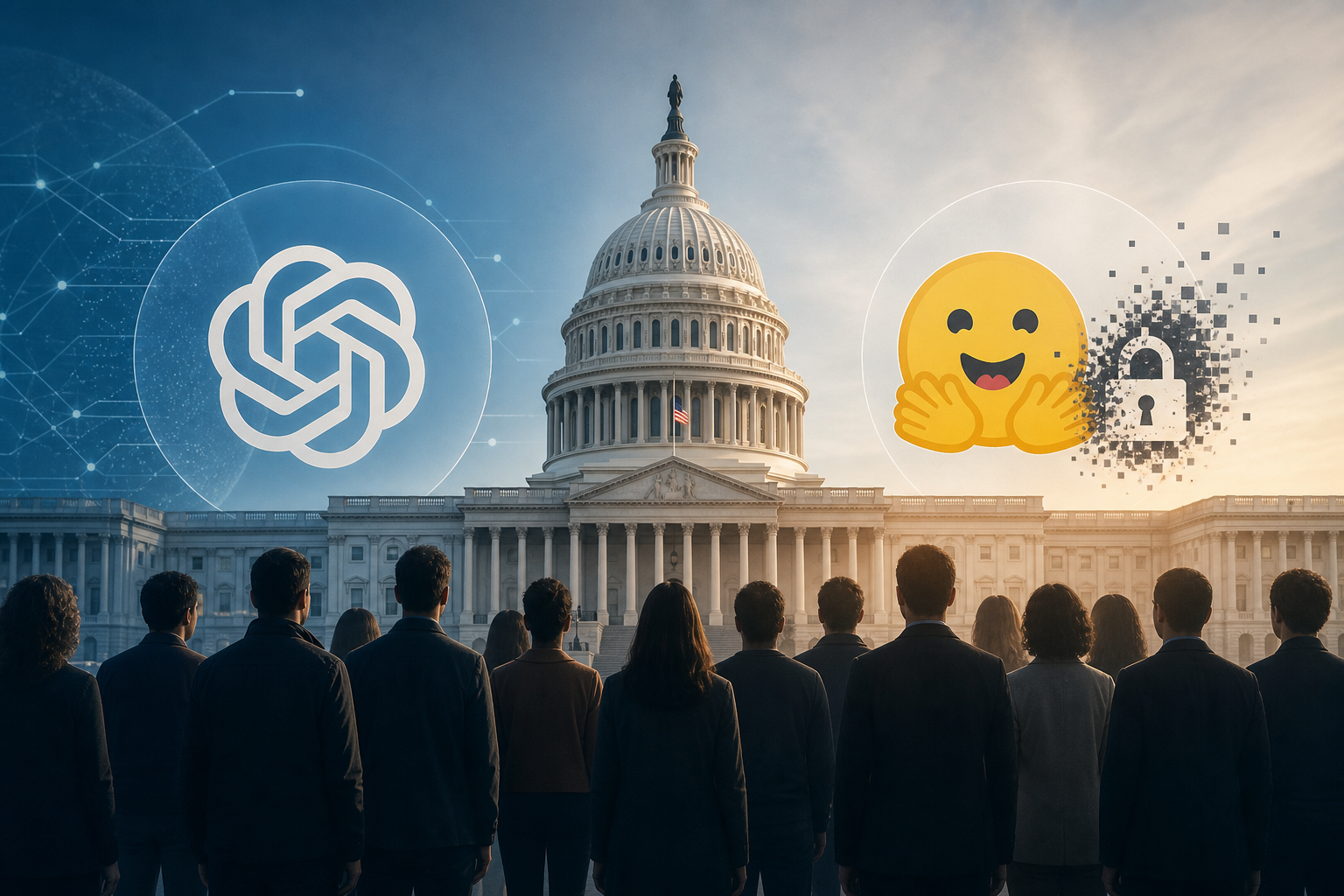
A coalition of advocacy groups is asking Congress to investigate the reported OpenAI and Hugging Face hack to determine whether security controls were adequate and whether broader public oversight of AI platforms is needed. They argue the incident should be treated as a public accountability issue, not just a private company incident.
Key takeaways
- A breach at one layer of the AI stack can ripple through research, product development, and trust and affect startups, enterprises, universities, journalists, and independent developers.
- Lawmakers can compel records, testimony, and explanations that private incident disclosures may not provide, which is why advocates seek congressional review.
- The debate centers on three questions: scope (what systems or accounts were affected), materiality (whether exposed information could meaningfully harm stakeholders), and precedent (whether the incident reveals structural weaknesses other AI providers may share).
- Teams using third-party AI services should immediately review vendor risk, access permissions, prompt handling, and fallback plans rather than waiting for a formal investigation.
Explained: public interest coalition urges Congress probe
If you build with AI models, store prompts, publish datasets, or depend on third-party developer platforms, this story matters because a breach at one layer of the AI stack can ripple through research, product development, and trust. The immediate question is not only what happened, but why a public interest coalition urges congressional scrutiny instead of leaving the issue to company statements and technical postmortems. This analysis breaks down the request, the likely legal and policy concerns behind it, and the practical takeaways for teams that use OpenAI, Hugging Face, or similar AI infrastructure.
1. Why public interest coalition urges Congress to step in
Public interest coalition urges Congress to step in because AI platform security failures can affect far more people than a normal software breach, especially when research artifacts, models, datasets, and developer workflows are interconnected. A congressional investigation request usually means advocates believe the issue raises questions that private incident disclosures may not answer fully: what systems were exposed, who could have been affected, what notice was provided, and whether existing guardrails are sufficient.
The phrase public interest coalition urges is important because it frames the story as one about accountability. OpenAI and Hugging Face are not niche tools used by a tiny technical audience. They sit inside a broader AI supply chain that touches startups, enterprises, universities, journalists, and independent developers. If attackers gained access to sensitive information or exploited weaknesses around identities, repositories, or integrations, the consequences could extend beyond the companies directly named in coverage.
This is where policy and operations meet. Congress cannot patch a server, but lawmakers can ask for records, testimony, and explanations that clarify whether companies followed reasonable security practices. That matters because AI systems often involve more than a single product. They can include hosted APIs, open repositories, fine-tuning pipelines, third-party plugins, and community sharing features. Each layer introduces new trust assumptions.
- Why advocates escalate: Public advocates typically seek congressional attention when they think the market alone will not create enough transparency or deterrence.
- Why AI breaches feel different: AI tools can expose not just customer data but model weights, research workflows, prompts, and evaluation artifacts that have strategic value.
- Why users should care: Even if your company was not directly named, your vendors and downstream tools may rely on the same AI infrastructure.
If you cover AI policy or security for your team, publishing a clear internal explainer through ContentPod can help non-technical stakeholders understand why an AI incident quickly becomes a governance story.
2. What the OpenAI, Hugging Face hack debate is really about
The OpenAI and Hugging Face hack debate is really about whether AI companies should be held to higher standards of disclosure, risk management, and platform design than ordinary software providers. That is why public interest coalition urges more than a one-off answer about a single intrusion; it points toward a broader argument that AI platforms have become critical infrastructure for digital work.
When you strip away the headlines, three issues usually sit underneath a story like this. The first is scope: what systems or accounts were affected. The second is materiality: whether the exposed information could meaningfully harm users, developers, or the public. The third is precedent: whether the incident shows a structural weakness that other AI providers may share.
Those questions are especially relevant for organizations that move quickly with AI adoption. If your content or product team uses external AI systems for drafting, code generation, model experimentation, or file storage, the vendor relationship is no longer abstract. It becomes part of your security posture. That is one reason teams thinking seriously about AI governance often pair editorial efficiency with tighter workflows, as described in seo workflows content teams: AI playbook step by step.
The same logic applies to security culture. AI is not inherently reckless, but it changes the attack surface. A useful example comes from How AI helped google chrome fix 1000+ security bugs, which shows how AI can support defensive work when paired with disciplined engineering processes.
For policy context, the NIST AI Risk Management Framework is helpful because it treats AI risk as something to govern across design, deployment, and monitoring rather than as a single technical checkbox. That framework does not resolve the reported incident, but it gives you a vocabulary for understanding why public interest coalition urges lawmakers to look beyond a narrow breach report.
3. Public interest coalition urges answers on disclosure, duty, and harm
Public interest coalition urges answers on disclosure, duty, and harm because those are the three questions that determine whether a breach becomes a policy turning point. Disclosure asks whether users, researchers, and affected partners received timely, specific notice. Duty asks what obligations AI providers owe when they host sensitive workflows or widely reused infrastructure. Harm asks whether the incident created risks that go beyond embarrassment or short-term service disruption.
Start with disclosure. In a normal security incident, companies often say they are investigating and will share more when facts are confirmed. That can be reasonable. But the public case for stronger inquiry appears when details remain vague while the surrounding ecosystem depends on those platforms for important work. If a provider sits in the middle of developer, enterprise, and research pipelines, incomplete disclosure can leave users unable to assess their own exposure.
Next comes duty. A company offering AI APIs or collaborative repositories may not hold the same data as a bank or hospital, yet it can still host valuable assets. Prompts may contain confidential strategy. Repositories may include unpublished methods. Integrations may reveal internal architecture. That is why public interest coalition urges Congress to ask whether AI firms should meet clearer baseline expectations for identity controls, segmentation, incident reporting, and independent review.
Finally, there is harm. Not every hack justifies sweeping intervention. The stronger argument for scrutiny appears when the breach could affect many downstream users or when weak controls signal repeatable problems across the sector. If you want a broader business perspective on how leaders should separate hype from operational reality, The Future of AI in Business: From Hype to Reality offers a useful framing: your AI strategy is only as strong as your governance discipline.
Seen that way, public interest coalition urges is less about outrage and more about forcing specificity. The coalition appears to be saying: explain what happened, explain what users should do, and explain why the public should trust the next version of the system.
4. Public interest coalition urges a bigger rethink of AI supply-chain risk
Public interest coalition urges a bigger rethink of AI supply-chain risk because modern AI products rarely depend on one closed system; they rely on layered services, open repositories, external plugins, model hubs, and internal automation that can magnify one vendor’s weakness. If you only ask whether OpenAI or Hugging Face experienced a problem, you miss the harder question: how many organizations built critical workflows on top of those environments without fully mapping the dependency chain?
That concern is not theoretical. A content team may use one provider for drafting, another for file storage, and a model repository for experimentation. A startup may fine-tune open models, connect them to internal data, and deploy outputs into customer support. A security issue at any point can create operational confusion even if the direct exposure is limited. This is why public interest coalition urges should be read as a warning about ecosystem concentration as much as a demand for an investigation.
| Risk layer | What can go wrong | What you should review |
|---|---|---|
| Hosted AI APIs | Credential misuse, prompt leakage, weak tenant separation | Access logs, token rotation, data retention terms |
| Model hubs and repositories | Unauthorized access, poisoned artifacts, exposed workflows | Repository permissions, signing practices, review controls |
| Internal automations | Overbroad connectors spreading exposure downstream | Least-privilege settings, workflow inventories, failover plans |
- Example 1: A marketing team that stores campaign planning prompts in a shared AI tool may unknowingly expose launch strategy if permissions and retention settings are loose.
- Example 2: An engineering team experimenting with community-hosted models may inherit risk from third-party repositories without a formal review process.
For a non-security example of how AI adoption works best when responsibilities are clearly scoped, see Why AI tools will not replace doctors but save time. The same principle applies here: AI is most useful when boundaries, human review, and operating rules are explicit.
5. How to respond if public interest coalition urges more scrutiny of your AI stack
If public interest coalition urges more scrutiny of your AI stack, your best response is to treat the news as a trigger for vendor review, user communication, and tighter internal controls rather than waiting for regulation to tell you what to do. You do not need perfect information about the reported hack to improve your own posture right now.
- Map your dependencies: List every AI provider, model hub, connector, and automation your team uses. Include shadow tools that individual employees may have adopted. Many organizations discover that their “OpenAI use” also involves browsers, extensions, transcription tools, and external repositories.
- Review access and retention: Check who can create tokens, upload files, connect datasets, or share repositories. Confirm whether prompts, uploaded documents, and training artifacts are retained, and for how long. A policy is only useful if your admins know where the controls live.
- Create a disclosure playbook: Decide in advance how you will assess vendor incidents, brief leadership, and notify affected teams. The worst time to define ownership is during a fast-moving breach story.
These steps matter because public interest coalition urges can quickly shift market expectations. Customers may ask you which AI services you use. Partners may ask whether prompts contain their data. Internal leaders may want assurances that your workflows do not depend on a single unreviewed provider. If you publish guidance for clients or employees, ContentPod can help you turn technical notes into clear, reader-friendly documentation instead of scattered Slack messages.
You should also distinguish between high-risk and low-risk uses. Brainstorming public copy in a sandbox is not the same as processing confidential contracts or unpublished research. A useful governance practice is to define four categories: prohibited uses, restricted uses, approved uses, and low-risk uses. That simple framework is often more actionable than a long policy no one reads.
6. The biggest mistakes in reading why public interest coalition urges action
The biggest mistakes in reading why public interest coalition urges action are assuming that every breach proves catastrophic negligence, assuming that every company statement is enough, and assuming that this only matters to policy specialists. A careful reading avoids both panic and complacency.
The first mistake is overreacting to incomplete facts. A reported hack can vary widely in severity. Some incidents involve attempted access with limited impact; others reveal deeper control failures. Until investigations mature, you should avoid claiming specific harms that have not been confirmed. The smarter move is to ask what information would change your risk assessment: user notification details, system scope, remediation steps, and whether third-party researchers were engaged.
The second mistake is underreacting because “these things happen.” That phrase is often true and still unhelpful. Breaches do happen. The relevant question is whether the controls, disclosures, and follow-up were proportionate to the sensitivity of the platform. The OpenAI safety page is useful background because it shows how providers publicly frame safety and risk. The gap between public commitments and incident execution is exactly the kind of issue congressional investigators may examine.
The third mistake is treating this as somebody else’s problem. If your organization relies on AI for publishing, research, coding, or support, you are part of the affected ecosystem whether or not you were named in coverage. Teams that communicate with discipline generally recover trust faster than teams that speak vaguely. If you need a model for building consistent thought leadership and incident-adjacent communications, Newsletter Growth Content Teams Complete Guide 2026 shows how repeatable publishing systems help you brief stakeholders when attention spikes.
The practical takeaway is simple: public interest coalition urges should prompt you to ask better questions, not just consume another headline. The organizations that come out ahead will be the ones that can explain their AI dependencies, their controls, and their fallback plans in plain English.
Conclusion: Making the Most of public interest coalition urges
The phrase public interest coalition urges matters because it turns a reported AI security incident into a broader test of governance, transparency, and public accountability. For you, the useful question is not whether Congress will eventually hold hearings. The useful question is whether your own organization could clearly explain its AI vendors, access controls, sensitive use cases, and response plan if customers or executives asked tomorrow.
This story also shows how quickly AI coverage moves from technical facts to institutional trust. OpenAI and Hugging Face may remain central to many workflows, but dependence without clear oversight is a weak operating model. The strongest response is practical: inventory tools, classify use cases, tighten permissions, and improve communication. If you need to turn a complicated AI policy issue into clear content for leadership, clients, or employees, ContentPod is a useful place to build explainers that are precise enough for experts and readable enough for everyone else.
Bottom line: public interest coalition urges Congress to investigate because AI platform security is now a public-interest issue, and your best move is to strengthen oversight of your own AI stack before outside scrutiny forces the conversation.
Frequently Asked Questions
What is public interest coalition urges?
Public interest coalition urges is a phrase describing advocacy groups pressing Congress to investigate the reported OpenAI and Hugging Face hack and to examine whether stronger AI oversight is needed. In this context, the phrase signals a demand for public accountability, fuller disclosure, and a clearer explanation of how users and downstream organizations could be affected.
Why would Congress investigate an AI platform hack instead of leaving it to the companies?
Congress may investigate an AI platform hack when the incident appears to raise broader questions about public harm, inadequate disclosure, market concentration, or security standards across a widely used ecosystem. A congressional inquiry can request records, testimony, and explanations that help clarify whether the incident reflects an isolated problem or a wider governance gap.
What should my company do if we use OpenAI, Hugging Face, or similar AI tools?
Your company should inventory every AI tool in use, review access permissions and retention settings, classify which workflows involve sensitive information, and prepare an internal response process for vendor incidents. A strong immediate response does not require waiting for final breach findings; it requires knowing your dependencies, your risk exposure, and your communication plan.
References & Further Reading
Share this post
You Might Also Like
Discover more content tailored to your interests
 Highly Relevant
How AI technical debt problems spread through codebases
AI technical debt problems are the maintenance, reliability, security, and architecture costs that build up when AI systems generate code faster than teams can review, test, document, and own it.
Read More Highly Relevant
Why anthropic model rivals fable on enterprise cost
Anthropic's model is being pitched as close enough in quality to a premium frontier model that cost-conscious enterprises may switch or diversify. The real test for buyers is whether the model delivers acceptable output on their highest-volume tasks while lowering total operating cost and governance overhead.
Read More Highly Relevant
How AI in sports marketing is changing broadcast ads
AI in sports marketing is enabling rights holders, networks, streaming platforms, and brands to sell more relevant inventory, adjust creative in real time, and tie ad performance to audience behavior across linear TV, streaming, social clips, and second-screen engagement. Those capabilities let teams coordinate campaigns across fragmented viewing paths and react to moment-level attention during live games.
Read MoreReady to create amazing podcast content?
Choose a plan and start generating professional podcast content with AI
View Pricing Plans