How India influencer economy crosses ₹5,000 crore
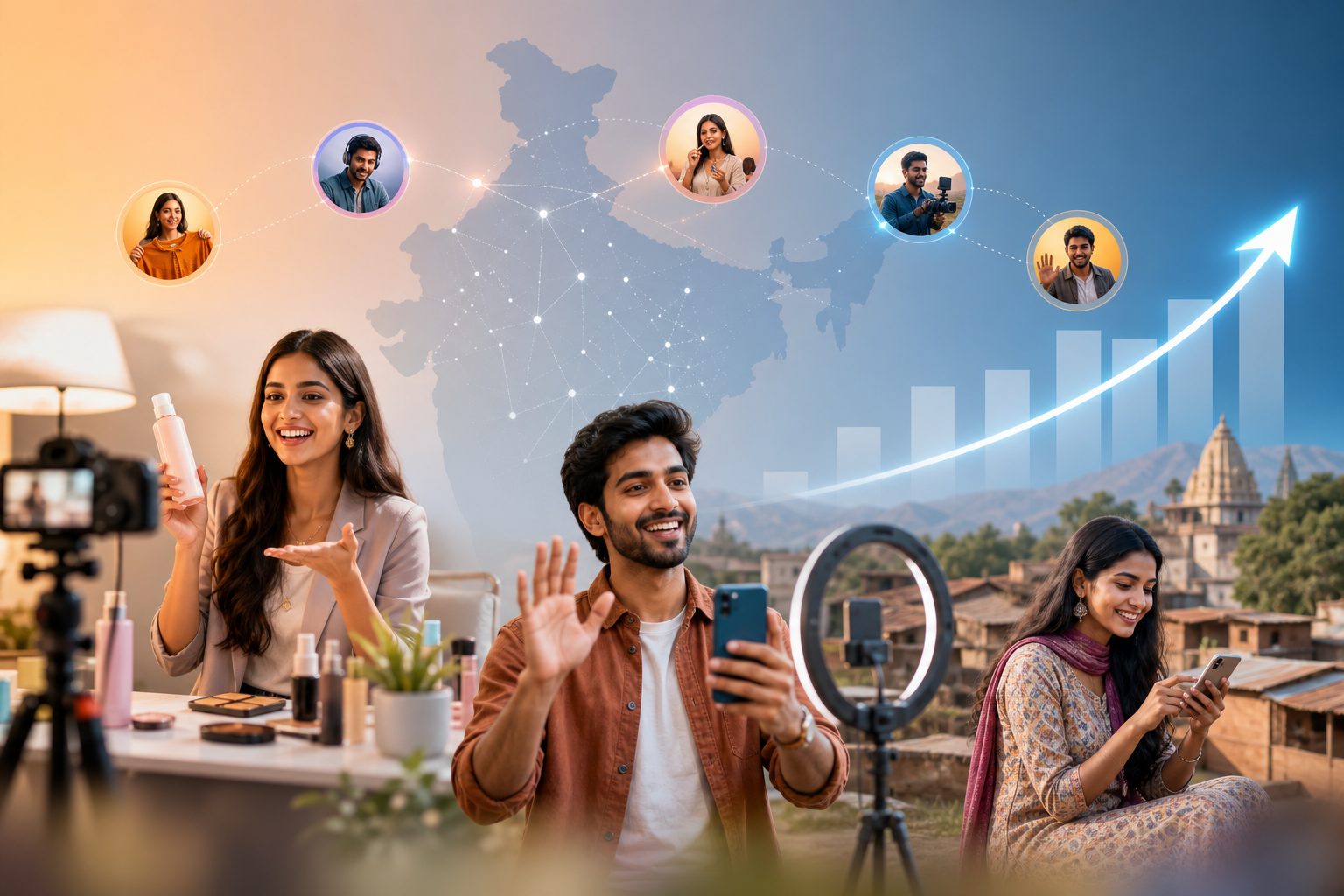
Creator-led marketing in India has become a mainstream growth and performance channel, and the scale of regional, niche, and commerce-oriented creators pushed commercial creator spend past ₹5,000 crore. As a result, brands now treat creator activity as a budgeted, measurable part of media planning rather than an experimental line item.
Key takeaways
- The ₹5,000 crore milestone indicates the market now behaves like a structured channel that requires formal budgeting, measurement, and governance.
- Tier 2 and Tier 3 cities expanded the creator supply because affordable smartphones, simple editing tools, vernacular audiences, and platform recommendation systems made creators more discoverable and commercially useful.
- Brands are shifting spend from broad awareness to creator-led explainers, demos, reviews, and offer-led collaborations that can be tied to outcomes through affiliate links, product tags, and promo codes.
- Micro and mid-tier creators and clusters of niche regional creators are gaining budget share because they offer lower production cost, stronger community trust, and better relevance for local buying behavior; execution quality and creator fit matter more than follower count.
How india influencer economy crosses ₹5,000 crore
The important shift is not just the headline number. The deeper story is that the market is broadening beyond metros, English-first content, and vanity metrics. If you are a marketer, founder, agency lead, or creator, you need to understand why regional language reach, trust-based recommendations, and short-form discovery now matter as much as polished national campaigns. This article explains what the ₹5,000 crore milestone really means, why smaller cities are driving the next phase, where brand money is likely to go, and what practical moves you should make if you want results rather than noise.
1. Why india influencer economy crosses ₹5,000 crore now
India influencer economy crosses ₹5,000 crore now because the market has reached a point where creator attention, platform commerce, and brand budgets reinforce one another at scale. This is not a single-platform story, and it is not driven only by a handful of famous faces. Brands across beauty, fashion, fintech, food, education, electronics, and local services increasingly treat creators as a distribution layer that can explain, demonstrate, and validate products faster than traditional ads. That is especially valuable when buyers are skeptical, price-sensitive, or overwhelmed by choices.
A simple definition helps. The influencer economy refers to the commercial system built around creators, audiences, platforms, agencies, affiliate tools, and brand partnerships that monetize influence. In India, that system has widened because mobile internet usage is deep, video consumption is routine, and creators can now build communities in Hindi, Tamil, Bengali, Marathi, Telugu, Malayalam, Punjabi, and many other languages without waiting for national media gatekeepers.
If you manage marketing spend, the significance of this moment is practical. Once india influencer economy crosses a milestone like ₹5,000 crore, you are no longer asking whether creator marketing is “real.” You are deciding how to budget it, measure it, govern it, and scale it. That means creator strategy needs process, not just enthusiasm. Tools for briefing, asset capture, repurposing, and SEO also become more important, which is where platforms such as ContentPod can fit naturally into a broader content workflow.
- Budget migration: Money is shifting from broad awareness campaigns toward creator-led explainers, demos, reviews, and offer-led collaborations that feel more native to social feeds.
- Audience fragmentation: Consumers no longer gather in one media channel, so brands use creators to reach multiple communities with more relevance.
- Commerce integration: Affiliate links, product tagging, live shopping behavior, and trackable promo codes make influencer activity easier to connect to outcomes.
The result is that india influencer economy crosses a symbolic number for a very structural reason: influence has become operationalized. It now sits inside media planning, creator partnerships, customer education, and even local market entry.
2. India influencer economy crosses because smaller cities changed the supply side
India influencer economy crosses ₹5,000 crore partly because Tier 2 and Tier 3 cities dramatically expanded the creator supply side. The market did not grow only because brands wanted more creators; it grew because more creators became discoverable, credible, and commercially useful. Affordable smartphones, simpler editing tools, vernacular-first audiences, and platform recommendation systems lowered the cost of becoming visible.
For brands, that changes campaign design. Instead of overpaying for generic reach, you can now build clusters of creators around a category, geography, and language. A skincare brand can activate creators in Indore, Coimbatore, Lucknow, Surat, or Guwahati with messaging tailored to climate, affordability, and local beauty habits. A D2C food brand can test city-specific offers through local creators before committing to bigger distribution or ad spend.
This is also why the logic in Why influencer advantage says creator now wins ROI matters in practice: creator value often comes from fit and credibility, not fame. Likewise, if you want the output of creator collaborations to perform beyond social feeds, the workflow ideas in SEO Workflows Content Consultants Step-by-Step Playbook are useful because campaign assets can be repurposed into search-friendly pages, FAQs, landing pages, and testimonial-style educational content.
According to the broader industry discussion tracked through Google News coverage of the original report, regional growth is a central theme behind the market’s expansion. That fits what many marketers already observe: discovery happens nationally, but trust often forms locally.
So when india influencer economy crosses this level, do not reduce the story to “more creators exist.” The better reading is that smaller cities made the ecosystem deeper, cheaper to test, and more relevant to actual purchase journeys.
3. India influencer economy crosses a new threshold in trust, not just spend
India influencer economy crosses an important threshold because creator marketing now competes on trust formation, not just audience size. A local finance creator explaining UPI safety in plain Hindi, a homemaker reviewing kitchen products in Marathi, or a fitness coach comparing budget protein options in Tamil can influence a buyer more effectively than a broad brand ad because the message feels contextual and human.
This matters most in categories where buyers need interpretation before purchase. Insurance, health supplements, education products, home appliances, parenting products, and financial tools often require explanation, demonstration, or reassurance. Smaller-city creators are strong here because they sound like peers rather than polished endorsers. That peer effect is one reason india influencer economy crosses a scale that older media models would have struggled to unlock.
If you create campaigns in these categories, your real challenge is less about “finding reach” and more about finding the right explanation layer. The strongest creators often do four things well: they simplify the product, localize the language, anticipate objections, and model usage in daily life. Those are content skills, not celebrity traits.
This is also where interview-driven content can strengthen creator programs. The conversation patterns explored in Unlocking Local Visibility: AI's Role in Business Content are relevant because local visibility increasingly depends on turning expertise into accessible content that feels native to specific communities.
If you are evaluating creators, look beyond follower totals and ask sharper questions:
- Does the creator translate complexity? A smaller creator who can explain a product clearly may outperform a larger creator with weak category understanding.
- Does the audience match the buying context? A wedding creator, for example, may be more useful for jewelry or beauty purchases than a generic lifestyle account.
- Does the creator drive comment quality? Questions, saves, and practical discussion often indicate stronger purchase intent than passive likes.
That is why india influencer economy crosses a business milestone and a credibility milestone at the same time: creators are no longer only borrowing attention from entertainment culture; they are increasingly shaping decision-making inside everyday commerce.
4. Where india influencer economy crosses into real business value
India influencer economy crosses into real business value when brands stop treating creators as a one-post media buy and start using them across the funnel. The most effective programs connect creators to awareness, education, social proof, retargeting assets, and sometimes even product feedback. That integrated approach matters more in Tier 2 and Tier 3 markets, where brand familiarity may be lower and community endorsement may matter more.
You can see the difference in how mature teams operate. They do not just ship a brief and wait for views. They collect audience objections, test hooks in local languages, compare creator types, and repurpose strong creator clips into ads, landing pages, and search content. The systems mindset described in Playbook for interview-based content marketing teams is useful here because creator campaigns generate raw market insight that can fuel multiple channels.
A practical comparison looks like this:
| Approach | What brands do | Likely result |
|---|---|---|
| One-off vanity collaboration | Choose the biggest creator, ask for one branded post, track likes | Visible reach, weak learning, inconsistent conversion |
| Regional creator cluster | Activate 10-20 niche creators by city or language with a common offer | Better message-market fit and clearer performance signals |
| Full-funnel creator system | Use creators for awareness, objections, tutorials, retargeting, and repurposed content | Higher long-term efficiency and more usable campaign data |
- Example 1: A consumer electronics brand can use local tech reviewers to explain after-sales concerns, installation issues, and price-performance tradeoffs in regional languages.
- Example 2: A beauty brand can test different shade communication or routine-based education through city-specific creators before scaling media nationally.
When india influencer economy crosses ₹5,000 crore, the best takeaway is not that influencer marketing became bigger. The best takeaway is that creator-led campaigns now support real operating decisions in positioning, messaging, and conversion strategy.
5. If india influencer economy crosses this level, your strategy needs tighter rules
India influencer economy crosses a level where informal execution starts to break down, so your strategy now needs stronger rules around selection, measurement, rights, and reuse. As more money enters the channel, weak processes become expensive. Marketers who still choose creators only by surface popularity risk overpaying, misreading performance, or ending up with content they cannot repurpose effectively.
This is the moment to create a repeatable operating model. Your team should know what type of creator belongs to which objective, what a good brief includes, what counts as success, and how campaign content feeds other channels. If your company publishes expert or interview-based content elsewhere, a structured content system through ContentPod can help you keep creator insights connected to your broader editorial engine rather than trapped inside campaign folders.
- Best Practice 1: Map creators to funnel stage. Use larger creators for discovery, mid-tier creators for education, and niche local creators for trust, offer framing, or community conversion.
- Best Practice 2: Standardize tracking before launch. Build campaign URLs, coupon codes, retention metrics, comment themes, and content-rights terms into the workflow before the first post goes live.
- Best Practice 3: Repurpose what performs. A creator video that explains a product well can become a paid ad variation, FAQ answer, sales enablement asset, or search landing-page support element.
One more point matters: once india influencer economy crosses this milestone, compliance and disclosure become more important. Clear partnership labels, sensible claims, and category-specific caution in sectors such as health or finance are not optional details. They are part of trust protection.
If you are planning budgets for the next quarter, assume that creator spend will reward discipline. The winners will not be the loudest teams. The winners will be the teams that can test, attribute, and reuse content intelligently.
6. The biggest mistakes brands make after india influencer economy crosses ₹5,000 crore
India influencer economy crosses a major threshold, but many brands will still waste money if they confuse scale with certainty. The biggest mistake is assuming that a larger market automatically makes campaign outcomes predictable. In reality, the market is larger, but also more fragmented. That means creator selection errors, weak measurement, and poor audience fit can become even more costly.
The first common error is metro bias. Some teams still default to English-speaking urban creators even when their actual customers are in regional markets. The second error is chasing reach without comment quality or save behavior. The third is treating all creators as interchangeable inventory rather than individual communicators with distinct trust patterns. The fourth is ignoring content rights, which limits reuse and lowers return on every strong asset produced.
If you want a broader strategic lens on how marketers should assess channel hype versus substance, the discussion on MarketingProfs is a useful ongoing resource. The editorial analysis on Content Marketing Institute is also worth watching because the line between creator marketing and content marketing keeps shrinking.
Here is a simple corrective framework you can apply:
- Start with buying behavior: Choose creators based on the decisions they help audiences make, not only on demographic labels.
- Audit local language relevance: Ask whether your messaging sounds natural to the audience you want, especially in Tier 2 and Tier 3 cities.
- Measure learning, not only sales: Strong campaigns teach you what objections, phrases, visuals, and offers move buyers.
The market headline matters, but the execution gap matters more. India influencer economy crosses ₹5,000 crore; brands that keep working with old assumptions will still get mediocre results. Brands that adapt to regional trust, creator diversity, and full-funnel reuse will capture the upside.
Conclusion: Making the Most of india influencer economy crosses
India influencer economy crosses ₹5,000 crore because creators have become a practical distribution, education, and trust layer for modern commerce in India, and Tier 2 and Tier 3 cities are a major reason that layer now scales. For you, the useful takeaway is not simply to spend more on influencers. The smarter move is to build a creator strategy that reflects language diversity, local context, measurable outcomes, and content reuse across your broader marketing system.
If you are a brand, start with a regional pilot built around clear conversion or education goals. If you are an agency, develop creator clusters and reporting that clients can actually act on. If you are a creator, strengthen your niche, your audience trust, and your category understanding. And if your team needs a better way to turn expert conversations, campaign learnings, and creator insights into reusable content assets, ContentPod is worth exploring as part of that workflow.
Bottom line: india influencer economy crosses ₹5,000 crore because regional creators turned influence into a scalable business channel, and the brands that win next will be the ones that treat local trust as a measurable growth asset.
Frequently Asked Questions
What is india influencer economy crosses?
India influencer economy crosses is the core phrase used to describe the moment India’s influencer market moved beyond ₹5,000 crore in value. The phrase points to a larger shift in which creators, especially regional and niche creators, now play a serious role in brand discovery, product education, and purchase influence across India.
Why are Tier 2 and Tier 3 cities so important to India’s influencer economy?
Tier 2 and Tier 3 cities matter because they contribute both audience growth and creator growth, often in regional languages and culturally specific formats that feel more trustworthy. Brands benefit from these markets because local creators can explain products more naturally, reach underserved segments, and often produce more efficient campaigns than broad metro-first influencer plans.
How should a brand respond now that India’s influencer economy has crossed ₹5,000 crore?
A brand should respond by moving from ad hoc influencer experiments to a structured creator program with clear goals, creator-selection rules, performance tracking, and content-rights planning. A smart first step is to test a regional creator cluster in one category or geography, measure both conversions and audience learning, and then scale only the formats and creator profiles that prove fit.
References & Further Reading
- Google News source on India’s influencer economy crossing ₹5,000 crore
- Content Marketing Institute
- MarketingProfs
- IBEF: Media and Entertainment Industry in India
Share this post
You Might Also Like
Discover more content tailored to your interests
 Highly Relevant
Content calendar planning for B2B: mistakes to avoid
Align your calendar to recurring buyer questions and buying-stage needs so each asset helps prospects compare options, reduce implementation risk, or move closer to purchase. Pick a sustainable cadence of fewer, stronger pieces and make the calendar a repeatable operating system rather than a collection of urgent one-offs.
Read More Highly Relevant
newsletter growth saas companies complete guide 2026
Newsletter growth for SaaS means growing qualified email subscribers who support activation, retention, pipeline, and revenue rather than chasing list size alone. The most effective approach pairs a clear subscriber promise with targeted signup paths, useful content and segmentation, and measurement that links to business outcomes.
Read MoreReady to create amazing podcast content?
Choose a plan and start generating professional podcast content with AI
View Pricing Plans