Explained: AI-Proof Lawyers at Law Schools
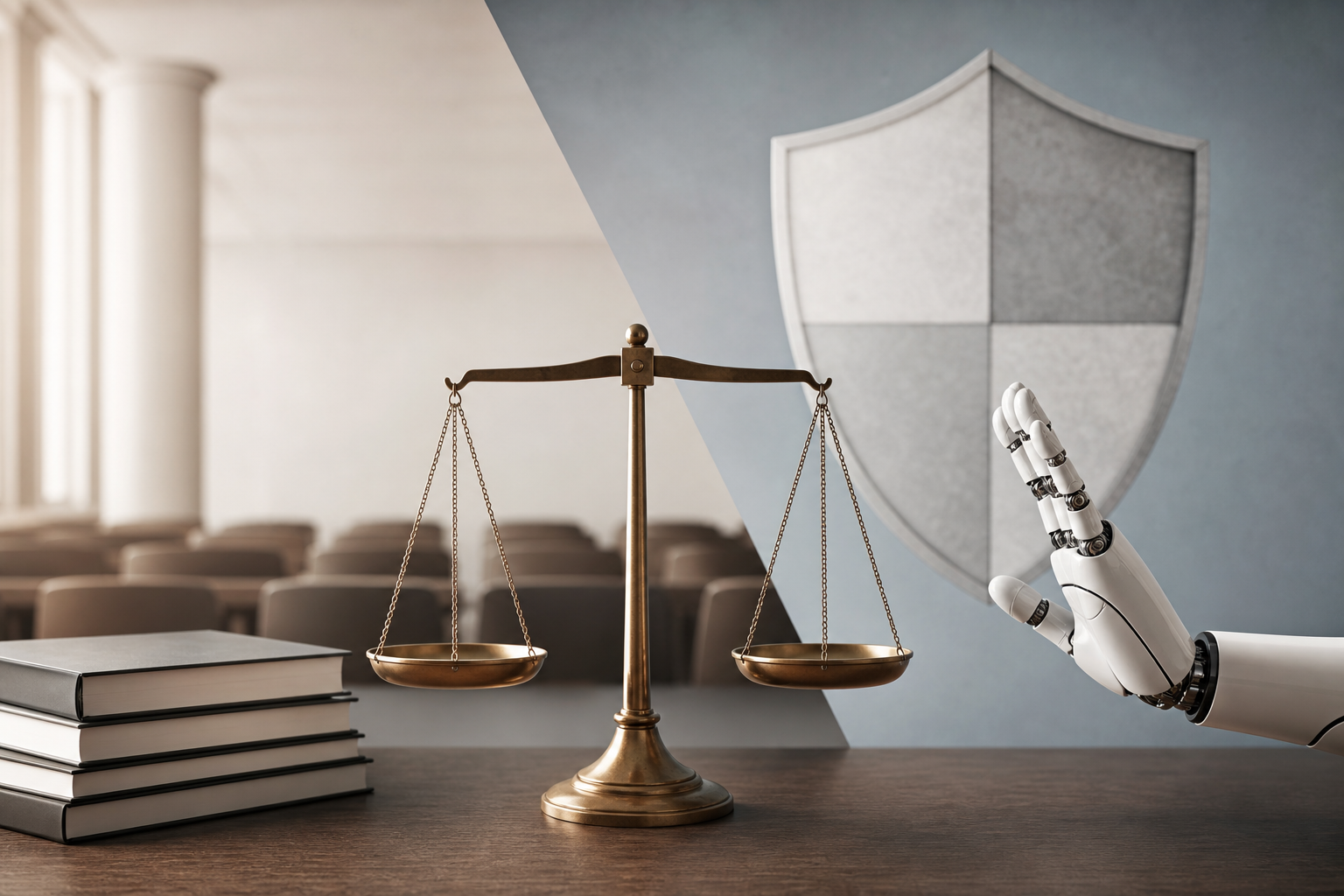
Some law schools restrict or tightly control AI and other digital tools in specific courses and assessments so students build close reading, original analysis, writing, and professional judgment before using automation. The policy aim is to preserve assessment integrity and ensure graduates understand legal risks and methods before they apply AI in practice.
Key takeaways
- Restrictions are usually targeted rather than total bans: common limits include no generative AI on take-home exams, no laptops in certain seminars, no automated case briefing in first-year classes, and no AI help for draft sections meant to show original reasoning.
- First-year doctrinal courses drive many restrictions because those classes train issue-spotting, distinguishing holdings from dicta, and seeing how small factual differences change outcomes; AI summaries can flatten those distinctions.
- Assessment integrity is a central concern: exams, memos, and oral arguments lose meaning if faculty cannot tell whether a student or a system performed the core legal reasoning.
- Professional-ethics and confidentiality risks also motivate limits: schools worry about client confidentiality, duties of competence and candor, and AI producing or citing non-existent authority.
- Some programs separate phases of training so students first practice legal reasoning without automation and later learn where and how AI tools can appropriately assist.
The tension is easy to see: law firms are adopting AI for research, drafting, and review, yet some professors are limiting laptops, generative AI, or automated research shortcuts in class and on assessments. That can sound backward until you look at what legal work actually demands. A lawyer is paid for judgment, not just output volume, and judgment is hardest to build when software fills every silence. This explained guide on ai governance and risk management unpacks why ai-proof lawyers some law has become a serious educational idea in 2026, what schools are trying to protect, where restrictions help, where they may go too far, and what practical takeaways matter for students, faculty, and employers.
1. Why ai-proof lawyers some law is gaining support
ai-proof lawyers some law is gaining support because some educators believe legal training breaks down when students outsource foundational thinking too early. Law school is not only about finding a plausible answer; law school is about learning how to identify ambiguity, weigh competing authorities, spot unstated assumptions, and defend a position under pressure. Generative systems can imitate that process, but imitation is not mastery. If a first-year student leans on AI before building core habits, the student may submit cleaner prose while understanding less of the doctrine underneath it.
This is especially important in the first-year curriculum. Courses such as contracts, torts, civil procedure, and criminal law train you to parse cases line by line, distinguish holdings from dicta, and notice how a small factual difference changes an outcome. An AI summary can flatten those distinctions. A professor who restricts tools in that context is often trying to preserve the mental friction that creates expertise. That is the logic behind ai-proof lawyers some law: remove shortcuts at the stage where shortcuts can hollow out the skill itself.
The approach also reflects the profession’s ethical structure. Lawyers handle confidential information, owe duties of competence and candor, and may face consequences if they cite non-existent authority or overstate a conclusion. Legal education therefore cannot treat AI as a neutral writing aid. A school that limits use may be saying that students must first understand the risk profile of the profession before they automate any part of the work. If you follow how other industries are wrestling with AI tradeoffs, Explained: openai meta spacexai compete on AI cost offers a useful parallel on how speed, access, and capability do not erase governance questions.
- Foundational reasoning: Restrictions can force students to generate issue-spotting and analysis on their own before seeing machine-produced options.
- Assessment integrity: Professors can better evaluate whether a student actually understands doctrine, structure, and legal method.
- Professional formation: Students learn that good lawyering means owning the reasoning process, not just delivering polished text.
2. What schools are actually restricting, and why
Some law schools are not banning technology outright; they are narrowing tool use in specific contexts so learning goals stay visible and measurable. That distinction matters because the public conversation often makes ai-proof lawyers some law sound broader than it is. In practice, restrictions are usually targeted: no generative AI on take-home exams, no laptop use during certain seminars, no automated case briefing in first-year doctrinal classes, or no AI assistance for draft sections that are supposed to show original reasoning.
The reasons vary by task. A closed-book exam measures recall, prioritization, and speed under pressure. A legal writing memo measures structure, authority use, and analogical reasoning. A clinic may involve client confidentiality concerns that make open consumer tools inappropriate. According to the National Institute of Standards and Technology’s AI Risk Management Framework, organizations adopting AI should pay close attention to validity, transparency, privacy, and accountability. Those are not abstract concerns in legal education; they map directly onto plagiarism rules, honor codes, and duties of competence.
Restrictions also respond to a simple pedagogical question: what exactly are you teaching? If the assignment is “produce a polished memo,” AI can help with speed and surface quality. If the assignment is “show how you reason from precedent to conclusion,” AI can obscure the student’s actual contribution. That is why some professors divide work into stages: brainstorm manually, outline manually, draft manually, then use approved tools for revision or citation checking. If you are thinking about how editorial workflows change when AI enters a process, ai-assisted content repurposing saas templates is a useful non-legal example of breaking work into stages instead of treating AI as all-or-nothing.
ai-proof lawyers some law therefore does not mean every device is forbidden. It usually means that schools are deciding, assignment by assignment, which capabilities belong to the student and which can be delegated to software without damaging the learning objective.
3. The strongest argument for ai-proof lawyers some law is judgment
The strongest argument for ai-proof lawyers some law is that legal judgment is built through struggle, not through perfect first drafts. A new lawyer must learn to sit with uncertainty, choose among incomplete authorities, and explain why one interpretation is stronger even when there is no tidy answer. AI can generate a persuasive-looking response quickly, but the speed can hide the absence of genuine legal judgment. If you have never had to build the argument yourself, you may not know when the system’s answer is subtly wrong, overbroad, or based on a premise that a court would reject.
This matters in practice because clients do not hire lawyers only to summarize cases. Clients hire lawyers to assess risk, frame options, and take responsibility for advice. That responsibility cannot be outsourced. A student trained under ai-proof lawyers some law conditions may initially work more slowly, but that student is often better equipped to supervise an AI system later. Supervision is the key professional skill. You need enough independent competence to ask, “What did the model miss? Which facts change the rule? Is this jurisdiction-specific? Is this authority real?”
The same pattern shows up outside law. In The Future of AI in Business: From Hype to Reality, the most useful theme is not blind adoption but disciplined implementation: people still need to understand the work they are accelerating. That principle fits legal education almost perfectly. A law graduate who can produce a memo without assistance is more valuable than one who can only prompt a tool. A graduate who can do both is stronger still. That is the actual promise behind ai-proof lawyers some law: build human capability first, then layer in automation with clear accountability.
There is also a courtroom dimension. Judges expect advocates to answer follow-up questions, defend interpretations, and adjust under challenge. No prompt history will save you if you cannot explain your own brief. Restrictive teaching environments can therefore be understood as preparation for live legal performance, not just nostalgia for pre-AI classrooms.
4. Where the ai-proof lawyers some law approach can go wrong
The ai-proof lawyers some law approach can go wrong when restriction becomes symbolism instead of strategy. A blanket ban may protect some classroom objectives, but it can also leave students underprepared for the actual tools law firms, in-house teams, and courts are beginning to evaluate. If a school teaches as though AI will remain external to legal work, students may graduate with strong doctrinal habits but weak operational judgment about verification, tool selection, confidentiality, and workflow design.
The better critique is not “allow everything.” The better critique is “match the policy to the skill.” First-year case analysis may justify severe limits. Upper-level drafting, e-discovery exercises, transaction simulations, and professional responsibility seminars may justify supervised use. The schools that get this balance right will likely produce graduates who are both independent and adaptable. For a broader look at how institutions navigate AI policy after public controversy, Explained: meta axes controversial muse privacy fallout shows how governance failures often start when capability races ahead of policy.
A practical way to evaluate whether restrictions are sensible is to compare the learning objective with the technology risk.
- Example 1: A professor bans generative AI for a first draft of an appellate brief because the assignment is intended to reveal the student’s own issue framing and authority selection. That is a focused, defensible restriction.
- Example 2: A school prohibits all AI use, including citation checks and proofreading in advanced practice courses. That may protect authorship, but it may also ignore legitimate low-risk uses students will encounter in practice.
In other words, ai-proof lawyers some law works best when it is a staged training model, not a permanent refusal to modernize. Students need enough exposure to recognize what AI can accelerate and enough independence to recognize what AI cannot be trusted to decide.
5. How students and faculty should respond in practice
Students and faculty should respond by building a two-track model: first prove human competence, then add tool fluency with explicit rules. That model turns ai-proof lawyers some law from a culture-war phrase into a practical curriculum design choice. If you are a student, the safest assumption is that any unapproved assistance can distort assessment and create honor-code risk. If you are faculty, the safest assumption is that vague policies will be interpreted inconsistently and enforced unevenly.
Clear process design helps. A school can require manual briefing in the first half of a course and supervised AI comparison in the second half. A professor can permit AI for grammar review but prohibit it for rule synthesis. A legal writing program can require students to append an AI use statement explaining what tools were used, for what purpose, and how the output was verified. If you create policy documents or educational materials around these rules, a workflow platform such as ContentPod can help teams keep guidance consistent across blogs, internal pages, and training content without turning every discussion into product marketing.
- Best Practice 1: Define the skill before the tool. State whether the assignment is testing recall, analysis, drafting, revision, client counseling, or oral defense, then allow only the tools that do not undermine that target.
- Best Practice 2: Require verification logs. Ask students to document where AI was used, what claims were checked, and how authority was confirmed, especially for citations and quotations.
- Best Practice 3: Teach escalation rules. Students should know when an AI suggestion can be accepted, when it must be independently checked, and when the task is too sensitive for external systems because of confidentiality or accuracy risks.
Faculty can also reduce confusion by providing examples of permitted and prohibited use. A one-page matrix often works better than a broad warning. The goal is not fear. The goal is competence you can observe, measure, and trust.
6. The bigger takeaway from ai-proof lawyers some law for the legal profession
The bigger takeaway from ai-proof lawyers some law is that the legal profession is moving toward a split model in which baseline human expertise and supervised AI use become equally important. Employers are unlikely to reward graduates who reject technology completely, and they are also unlikely to trust graduates who cannot produce reliable work without it. The advantage will go to people who can operate under both conditions.
That has hiring implications. Firms may start asking not only whether you can use AI research or drafting tools, but whether you know when not to use them. Courts and regulators are also paying attention to AI-related reliability and disclosure issues. The legal sector does not have the margin for confident but unsupported output, especially in briefs, affidavits, contracts, or client advice. If you want a useful way to think about this, ai-proof lawyers some law is less about being future-proof against machines and more about being failure-proof when machines are involved.
For students, the challenge is psychological as much as technical. You may feel slower without AI. You may produce uglier drafts at first. That is not evidence of backwardness; it is usually evidence that you are still building the muscles AI tries to replace. Once those muscles exist, tools become amplifiers rather than crutches. If you publish guidance or thought leadership on these shifts for your institution or firm, ContentPod can help organize editorial workflows so policy changes are explained clearly and consistently.
The profession’s near-term winners will likely be the people who can do four things at once: think independently, use AI selectively, verify relentlessly, and explain their reasoning in plain language. That is the real lesson behind ai-proof lawyers some law.
Conclusion: Making the Most of ai-proof lawyers some law
ai-proof lawyers some law is best understood as a disciplined attempt to protect the parts of legal training that AI cannot safely replace: close reading, original analysis, ethical judgment, and accountable advocacy. Some restrictions are sensible because they preserve assessment integrity and force students to build independent reasoning. Other restrictions can become counterproductive if they keep students from learning how to supervise the tools they will almost certainly encounter in practice. Your practical takeaway is simple: support policies that distinguish between learning the skill and accelerating the skill. That is where law schools, employers, and students can align. If your team needs to explain these AI policy choices through clear, consistent content, ContentPod is one useful place to manage that editorial work. Bottom line: ai-proof lawyers some law works when schools train students to think without AI first and then teach them to use AI without surrendering judgment.
Frequently Asked Questions
What is ai-proof lawyers some law?
ai-proof lawyers some law refers to the idea that some law schools restrict certain AI or digital tools so students develop core legal skills without overdependence on automation. The phrase points to a training philosophy in which independent reading, writing, analysis, and ethical responsibility come before broad AI-assisted efficiency.
Why would a law school restrict AI if lawyers will use AI on the job?
A law school may restrict AI because students need to master legal reasoning before they can supervise automated output responsibly. A graduate who can work without AI is usually better prepared to catch hallucinated authority, weak reasoning, confidentiality risks, and overconfident conclusions when AI is later introduced into professional practice.
How should students prepare for a career if their school limits AI tools?
Students should treat restrictions as a chance to strengthen baseline legal skills while separately learning AI governance, verification, and workflow design through approved settings. The most valuable preparation combines manual competence, careful source checking, and a clear understanding of when AI can assist research, drafting, editing, or organization without taking over judgment.
References & Further Reading
Put this into practice
Share this post
You Might Also Like
Discover more content tailored to your interests
 Highly Relevant
How AI Technical Debt Problems Spread Through Codebases
AI technical debt problems are the maintenance, reliability, security, and architecture costs that build up when AI systems generate code faster than teams can review, test, document, and own it.
Read More Highly Relevant
Why Anthropic Model Rivals Fable on Enterprise Cost
Anthropic's model is being pitched as close enough in quality to a premium frontier model that cost-conscious enterprises may switch or diversify. The real test for buyers is whether the model delivers acceptable output on their highest-volume tasks while lowering total operating cost and governance overhead.
Read More Highly Relevant
AI Risks to Global Security at the U.N. Briefing 2026
AI risks to global security are the ways advanced AI systems can increase cyberattacks, accelerate disinformation, lower barriers to biological or weapons misuse, and outpace the laws meant to control them. In the AI briefing to the U.N.
Read MoreReady to create amazing podcast content?
Choose a plan and start generating professional podcast content with AI
View Pricing Plans