AI risks to global security at the U.N. briefing 2026
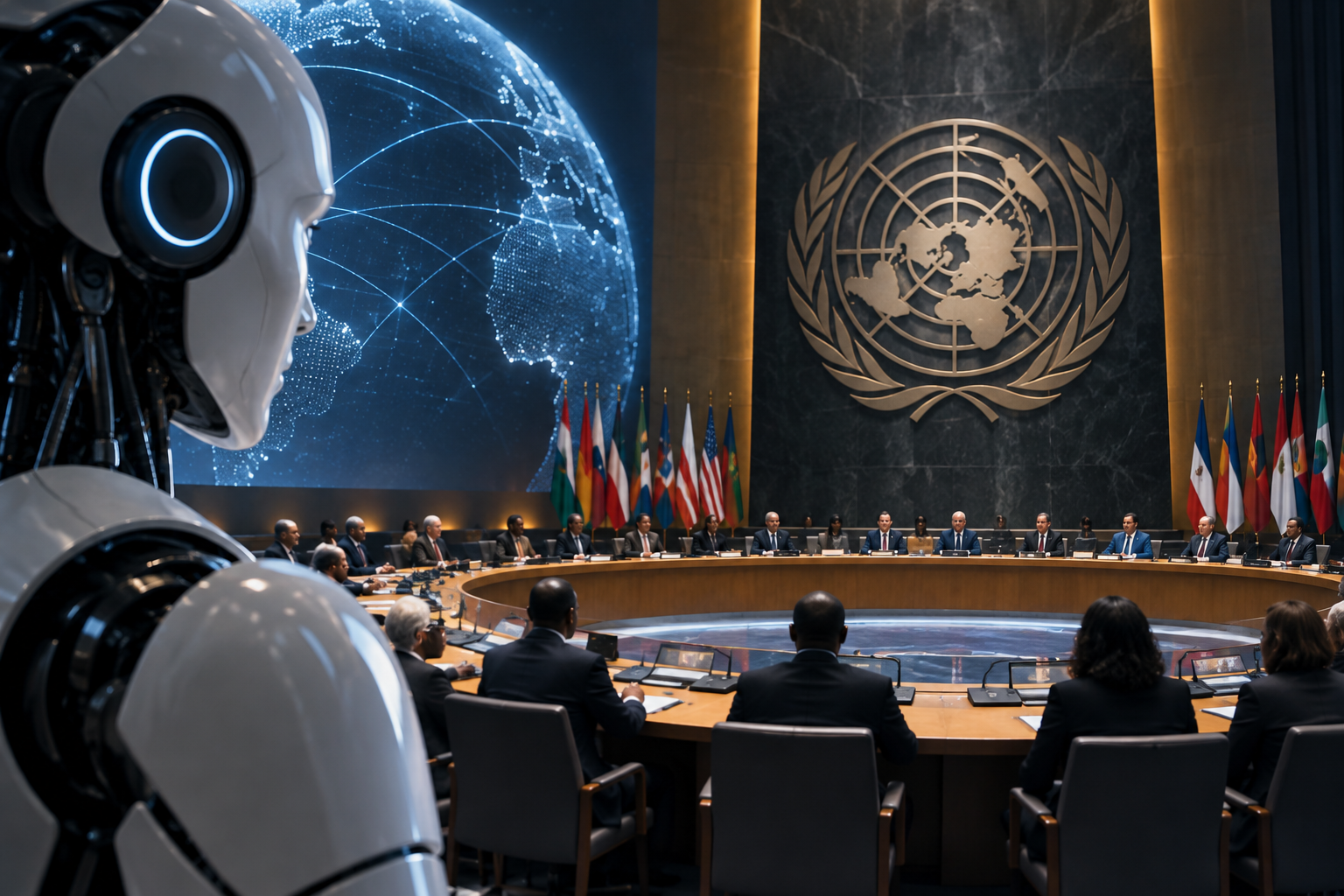
AI risks to global security are the ways advanced AI systems can increase cyberattacks, accelerate disinformation, lower barriers to biological or weapons misuse, and outpace the laws meant to control them. In the AI briefing to the U.N. , the core message was that governments cannot treat these threats as a narrow tech issue because AI risks to global security affect conflict prevention, public trust, strategic stability, and crisis response at the same time.
Key takeaways
- The U.N. discussion treated AI as a security issue: The Council conversation focused on misuse, instability, and weak oversight rather than consumer convenience.
- Cyber, disinformation, and bio-related misuse were central concerns: Those categories keep appearing because they combine technical feasibility with cross-border impact.
- Testing and access controls matter as much as model capability: A powerful model with poor safeguards can create the same policy problem as a more advanced model with better controls.
- AI risks to global security require international coordination: National AI policy helps, but cross-border threats move faster than single-country rules.
AI risks to global security at the U.N. briefing 2026
The tension is simple: AI systems are spreading faster than international rules, testing standards, and crisis coordination. That gap is why the U.N. Security Council AI discussion matters in 2026. When you assess AI risks to global security, you have to look beyond chatbot errors and ask harder questions about cyber offense, election interference, autonomous decision support, and access to powerful models by state and non-state actors. A useful baseline is the NIST AI Risk Management Framework, which treats AI risk as a governance problem, not only an engineering problem. This article breaks down what AI leaders were signaling to diplomats, what those warnings mean in practice, and how you can think about AI governance and safety without turning every AI debate into science fiction.
1. Why the Council framed AI risks to global security as a security problem
The Security Council framed AI risks to global security as a security problem because the main concerns are cross-border, fast-moving, and hard to contain once misuse starts. That framing changes how you read the briefing. The point was not that every AI system is dangerous. The point was that certain capabilities, especially in cyber operations, information operations, and scientific assistance, can be repurposed in ways that matter for conflict, coercion, and public safety. When diplomats hear from AI company leaders and safety advocates, they are trying to map technical risk onto familiar security questions: deterrence, attribution, escalation, and verification.
That is why AI risks to global security keep appearing in discussions about model release decisions, compute controls, red-team testing, and incident reporting. A model does not need agency or consciousness to create a security issue. It only needs to help the wrong actor write malware faster, generate convincing propaganda at scale, or provide dangerous guidance that was once harder to access. If you cover technology policy or build content on these issues, ContentPod is useful for organizing source material into plain-language explainers without flattening the technical details that policymakers care about.
- Security framing changes the policy toolkit: Once AI is treated as a security issue, governments start asking about export controls, incident disclosure, procurement rules, and international monitoring.
- Misuse matters more than novelty: A familiar capability becomes a global concern when AI lowers cost, increases speed, or removes skill barriers for harmful actions.
- The audience is broader than tech regulators: Foreign ministries, defense agencies, election authorities, and emergency planners all have a role when the subject is AI risks to global security.
If you want the shortest reading of the briefing, it is this: the Security Council was not debating whether AI is useful. It was asking whether current political institutions can keep up with the misuse scenarios that advanced systems make easier.
2. What AI leaders appear to have emphasized in the AI briefing to the U.N.
The AI briefing to the U.N. appears to have centered on concrete misuse pathways rather than abstract fear, which is why the discussion landed on cyberattacks, disinformation, and access to high-capability systems. That matters because the public conversation often jumps between two weak extremes. One extreme treats AI as ordinary software. The other treats AI as an unstoppable autonomous actor. The more practical middle ground is to ask what existing harms become cheaper, faster, and harder to track when AI systems improve.
One likely reason the Council gave attention to AI risks to global security is that these risks overlap. A single actor may use AI to scrape sensitive data, generate spear-phishing campaigns, impersonate public officials, and flood media channels with conflicting narratives after a crisis. According to public standards work from NIST, AI risk management depends on governance, measurement, and ongoing monitoring rather than one-time compliance checklists. That logic fits the Council setting because international security threats do not stay still.
If you want more context on how political and institutional pressure shapes AI policy, two useful reads are Why Nvidia AI lobbying in Congress is being tested and What Trump AI czar plan could mean for U.S. policy. Both help explain why global AI regulation is not only a technical matter. It is also a question of who sets the rules, who audits compliance, and what governments do when commercial incentives move faster than public safeguards.
You can read the briefing as a request for governments to stop treating AI governance as a future issue. In 2026, the debate is less about whether international coordination is needed and more about which mechanisms can work before the next serious misuse incident forces a rushed response.
3. Which AI risks to global security drew the strongest concern
The strongest concerns around AI risks to global security are the ones that combine plausible misuse, weak oversight, and cross-border impact. That is why the same categories keep surfacing in policy forums. They are not random talking points. They are the areas where AI capability can amplify harm without requiring breakthroughs that belong only in labs or movies.
The first category is cyber offense. AI can help attackers with reconnaissance, code generation, phishing variation, and social engineering. The second is synthetic media and disinformation. AI-generated text, audio, and video can pollute information environments during conflict or elections, especially when institutions are already under strain. The third is scientific misuse, including assistance that could support dangerous experimentation. The fourth is autonomy in military and intelligence workflows, where poor human oversight can create escalation risks even if a model is technically functioning as designed.
These concerns also connect to public communication. If your team explains AI policy for executives, journalists, or citizens, you need language that is precise enough to avoid panic but direct enough to avoid minimizing the issue. A useful conversation on translating AI complexity into practical business terms is The Future of AI in Business: From Hype to Reality. The same discipline applies here. You should describe AI risks to global security as a set of operational risks with different probabilities and consequences, not as one monolithic threat.
The Council’s concern makes sense for another reason. Security systems depend on trust in communications, institutions, and chain-of-command decisions. AI can weaken all three if safeguards are weak or if states wait for perfect evidence before acting on obvious risk patterns.
4. Where artificial intelligence security risks show up first in practice
Artificial intelligence security risks usually show up first in systems and institutions that already have pressure points, which is why you should expect AI risks to global security to appear through familiar channels rather than dramatic new ones. In practice, that means governments, media systems, healthcare research environments, and critical infrastructure operators are exposed before any grand international treaty catches up.
You can think about the problem through a simple comparison of where harm appears fastest:
| Risk area | Why it matters | What early warning looks like |
|---|---|---|
| Cyber operations | AI can increase attack volume and improve targeting | More convincing phishing, faster malware iteration, automated recon |
| Information operations | AI can flood channels with persuasive falsehoods | Coordinated synthetic content during elections or crises |
| Scientific misuse | AI assistance may lower knowledge barriers | Requests for dangerous guidance, weak lab or platform controls |
| Public administration | Officials may overtrust AI outputs in high-stakes settings | Poor documentation, absent review, vague accountability |
For a sharper look at security controls in a consumer-facing environment, see Google Gemini AI hack and the new AI security rules. That article is not about the U.N., but it illustrates a larger point. Security debates become concrete when misuse is tied to prompts, access pathways, logging, and response obligations rather than broad statements about innovation.
- Example 1: A hostile actor can use AI-generated translation, targeting, and narrative testing to tailor disinformation to different audiences across borders within hours.
- Example 2: A public agency can create its own security problem if staff rely on AI outputs for rapid assessment without source validation, documentation, and escalation rules.
If you are reading the U.N. discussion for practical meaning, this is where to look. AI risks to global security become visible first in institutions that already struggle with speed, verification, and trust.
5. What reduces AI risks to global security without freezing useful development
The best way to reduce AI risks to global security is to combine testing, access controls, monitoring, and international coordination instead of betting on one silver bullet. That answer is less dramatic than blanket bans, but it is more workable. Most policy proposals break down when they ignore tradeoffs. Governments want innovation and fast deployment, while security agencies want evidence that dangerous capabilities are not being distributed without guardrails. A serious AI governance and safety plan has to hold both concerns at once.
- Require capability-relevant testing: Test for dangerous capabilities that relate to cyber misuse, biological assistance, deception, and tool-use autonomy before wide release. Public summaries help outside stakeholders understand what was tested and what was not.
- Control access instead of treating every model release the same: High-capability models may need stronger API restrictions, identity checks, rate limits, and logging than low-risk consumer tools. The idea is to match controls to credible misuse pathways.
- Build incident reporting into governance: Organizations should know how to record, escalate, and share serious misuse signals. If your team publishes policy analysis, ContentPod can help you keep track of source documents, hearing notes, and risk categories so updates do not become inconsistent across articles.
This is also where private standards work matters. Safety statements from leading labs, national standards from NIST, and international forum discussions all become more useful when they point to repeatable controls. The policy goal is not to remove all uncertainty. The policy goal is to lower the chance that AI risks to global security become harder to manage because everyone waited for someone else to act first.
6. Where governments and companies still get the U.N. Security Council AI debate wrong
Governments and companies still get the U.N. Security Council AI debate wrong when they confuse public visibility with real control, and that mistake makes AI risks to global security harder to manage. A press release is not an audit, and a voluntary pledge or model card is not proof that dangerous capabilities were tested under realistic conditions. Those distinctions matter because security failures usually come from process gaps, not from lack of high-level principles.
One common mistake is treating all AI models as if they create the same level of risk. That approach leads to noisy regulation that misses the systems and deployment contexts that matter most. Another mistake is focusing on domestic compliance while ignoring cross-border effects. A disinformation campaign, malware toolkit, or unsafe release does not stop at national boundaries. A third mistake is overtrusting human review when reviewers do not have time, documentation, or authority to block deployment.
You can avoid those errors by asking sharper questions:
- What exact capability creates the concern? Broad fear produces weak policy. Specific capability mapping produces workable controls.
- Who has access, and under what conditions? Access design often matters more than benchmark headlines.
- What happens after an incident? If there is no disclosure path, no logging standard, and no escalation chain, governance is thin.
The broader lesson from the Council discussion is clear. AI risks to global security are not solved by better messaging alone. They are reduced when institutions can test claims, limit misuse, share warnings, and revise policy after real incidents.
Conclusion: making the most of AI risks to global security
The U.N. discussion showed that AI risks to global security are now part of mainstream security policy, not a side conversation for technologists. If you need to explain this issue to clients, readers, or internal stakeholders, focus on the practical chain of harm: capability, access, misuse, and weak oversight. That frame helps you separate speculative claims from real governance questions. It also helps you read AI company statements with a better filter. Are they describing safeguards that can be checked, or broad intentions that cannot?
If you publish on AI policy often, ContentPod can help you turn dense briefings, standards documents, and policy updates into clear articles that keep the technical and political context intact. The next useful step is to build your own monitoring list: lab safety statements, national standards updates, international forum actions, and incident disclosures. That gives you a better lens for tracking how AI risks to global security move from diplomatic language into real policy and operating rules.
Bottom line: AI risks to global security become manageable only when governments and AI developers pair capability growth with testing, access controls, and international coordination that can be checked in practice.
Frequently Asked Questions
What is AI risks to global security?
AI risks to global security refers to the ways advanced AI systems can increase threats that cross borders, including cyberattacks, disinformation, unsafe autonomy, and dangerous scientific misuse. The phrase is useful because it connects AI development to public safety, conflict prevention, and international governance rather than limiting the issue to consumer technology mistakes.
What did the AI briefing to the U.N. Security Council focus on?
The AI briefing to the U.N. focused on how advanced AI can affect international stability through misuse, weak oversight, and uneven regulation. The main policy question was how governments can build testing, reporting, and access controls before harmful incidents force rushed regulation.
How should policymakers reduce artificial intelligence security risks in 2026?
Policymakers should reduce artificial intelligence security risks in 2026 by tying rules to specific capabilities and deployment contexts instead of writing one broad law for every AI system. A workable approach includes pre-deployment testing for high-risk capabilities, stronger access controls for powerful models, incident reporting requirements, and international coordination on standards and enforcement.
References & Further Reading
- Google News source on the U.N. Security Council AI briefing
- NIST AI Risk Management Framework
- OpenAI Frontier Risk and Preparedness
- Anthropic Responsible Scaling Policy
Share this post
You Might Also Like
Discover more content tailored to your interests
 Highly Relevant
How AI technical debt problems spread through codebases
AI technical debt problems are the maintenance, reliability, security, and architecture costs that build up when AI systems generate code faster than teams can review, test, document, and own it.
Read More Highly Relevant
Why anthropic model rivals fable on enterprise cost
Anthropic's model is being pitched as close enough in quality to a premium frontier model that cost-conscious enterprises may switch or diversify. The real test for buyers is whether the model delivers acceptable output on their highest-volume tasks while lowering total operating cost and governance overhead.
Read More Highly Relevant
How AI in sports marketing is changing broadcast ads
AI in sports marketing is enabling rights holders, networks, streaming platforms, and brands to sell more relevant inventory, adjust creative in real time, and tie ad performance to audience behavior across linear TV, streaming, social clips, and second-screen engagement. Those capabilities let teams coordinate campaigns across fragmented viewing paths and react to moment-level attention during live games.
Read MoreReady to create amazing podcast content?
Choose a plan and start generating professional podcast content with AI
View Pricing Plans