How AI wildlife behavior detection reveals right whales
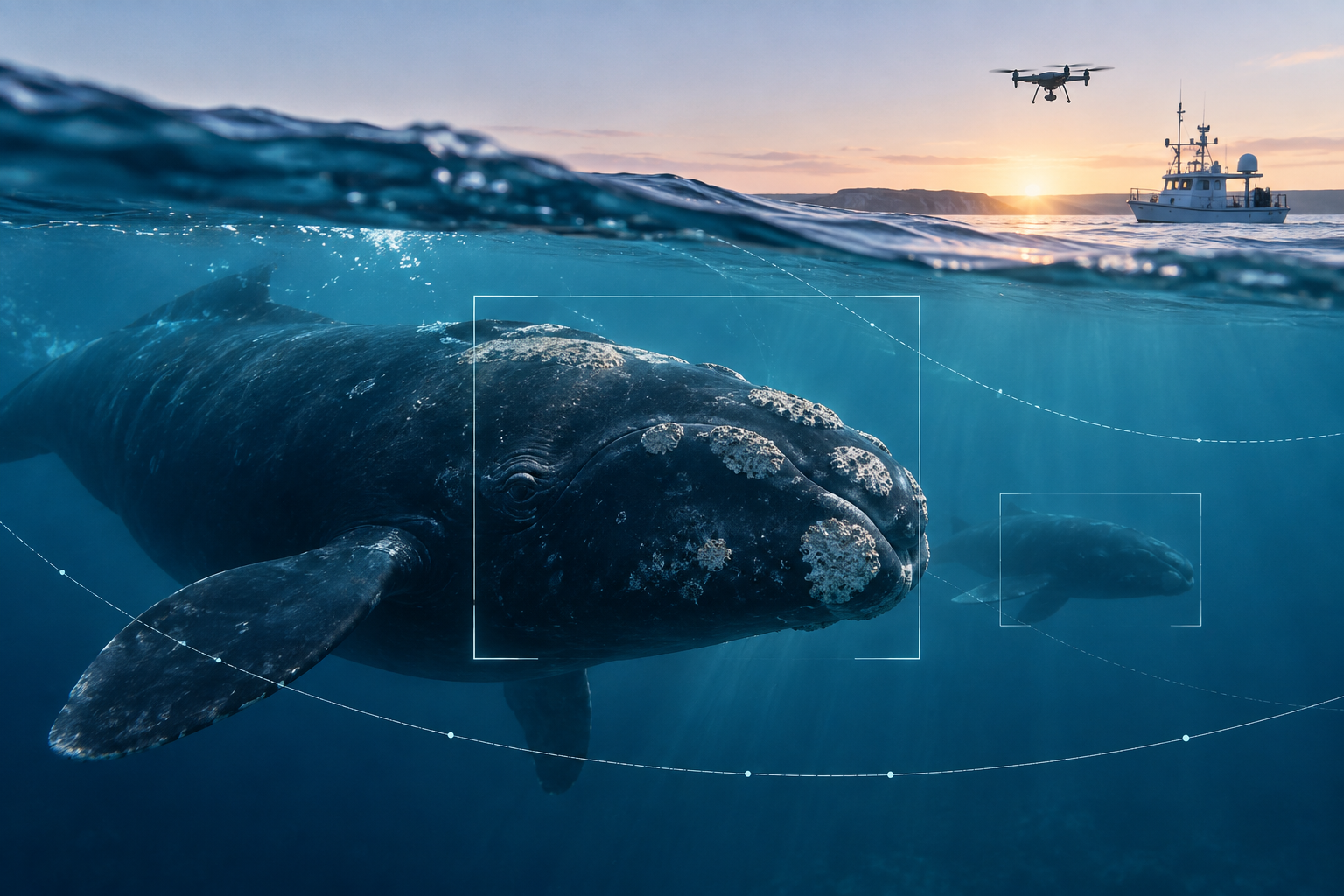
AI wildlife behavior detection is the use of machine learning models to spot, classify, and interpret animal actions from images, video, sound, and movement data. In endangered right whales, AI wildlife behavior detection helps researchers find feeding, nursing, socializing, diving, and stress-related patterns that human observers often miss because the ocean is noisy, wide, and hard to monitor continuously.
Key takeaways
- Right whale behavior is often hidden by the medium itself: Surface sightings tell only part of the story because many important behaviors happen underwater, at night, or far from survey vessels.
- AI models work best when they combine data types: Video, passive acoustics, body condition imagery, and movement tracks together give a more reliable picture than any single sensor.
- Behavior detection is useful only if it changes action: The value of a model is highest when it informs ship speed rules, fishing area alerts, aerial survey priorities, or rapid review by marine mammal experts.
- Human review still matters: Good conservation systems use AI wildlife behavior detection to narrow the search space, flag unusual patterns, and speed up science, not to remove expert judgment.
How AI wildlife behavior detection reveals right whales
Right whales can disappear below the surface for long stretches, shift their range, and pass through shipping lanes with little warning. That makes conservation hard when the job depends on knowing where whales are, what they are doing, and how those behaviors change around vessels, fishing gear, and prey. A growing body of work in North Atlantic right whale monitoring from NOAA points to the same problem: you need more observation hours than people alone can provide. This is where AI wildlife behavior detection has become useful in 2026. You can use it to process drone footage, hydrophone recordings, satellite inputs, and photo catalogs at a scale that manual review cannot match, while still keeping scientists in the loop for validation and conservation decisions.
1. Why AI wildlife behavior detection matters for right whales
AI wildlife behavior detection matters for right whales because the species is hard to observe directly, and many conservation choices depend on behavior rather than simple presence. A whale that is feeding near the surface poses a different management problem than a whale that is traveling quickly through a shipping corridor, and a mother-calf pair may need different protective measures than a lone adult. If your monitoring system records only a sighting, you miss the context that informs action.
Right whale research has long relied on visual surveys, photo-identification, tagging, and acoustic listening. Those methods remain valuable, but they produce more data than small teams can review quickly. AI wildlife behavior detection shortens that gap. A model can screen hours of drone footage for repeated rolling motions linked to social activity, mark changes in surfacing intervals that suggest altered feeding effort, or scan acoustic streams for call patterns that indicate group presence in poor weather or darkness.
The hidden part is not just underwater movement. Hidden behavior also includes subtle changes in spacing, respiration timing, body posture, and call structure that a tired human reviewer may overlook after many hours of analysis. If you work in machine learning marine mammal research, this is where AI earns its place. It does not replace field biology. It extends the amount of behavior a field program can inspect.
- Practical point 1: Use behavior labels that matter for management, such as feeding, resting, nursing, social interaction, entanglement indicators, or vessel avoidance, rather than broad labels like “active” or “inactive.”
- Practical point 2: Pair model outputs with confidence scores so analysts can review uncertain clips first and avoid over-trusting automated labels.
- Practical point 3: Keep a documented review workflow in a shared research system or editorial workspace such as ContentPod when multiple scientists, writers, and policy teams need the same evidence summarized clearly.
When people ask what is new in right whale conservation technology, the answer is often scale. You are moving from sample-based observation to near-continuous pattern detection. That shift is what makes hidden behavior visible enough to study.
2. How AI wildlife behavior detection turns raw ocean data into behavior labels
AI wildlife behavior detection turns raw ocean data into useful labels by breaking the problem into sensing, annotation, model training, validation, and decision support. If you skip any stage, you get outputs that look impressive in a dashboard but fail in the field.
The first step is choosing the right sensor for the behavior you want to capture. Drone video can detect body posture, skim-feeding, mother-calf spacing, and visible injuries. Hydrophones can detect upcalls and some social sounds when visibility is poor. Tags add dive depth, acceleration, and orientation. Satellite or aerial imagery may help with broad distribution, though fine behavior labels usually need closer data. According to NOAA Ocean Service, right whales are often identified by features such as callosities and body shape, which is why imaging quality and angle matter so much for automated review.
The next step is annotation. You need domain experts to label short clips or acoustic segments with definitions that are consistent enough for training. This is where many projects slow down. If one reviewer calls a sequence “surface feeding” and another calls it “travel with open mouth posture,” your model learns noise. Teams working through similar data bottlenecks may appreciate the operational lessons in How AI technical debt problems spread through codebases, because annotation drift is a form of technical debt in science as much as in software.
After annotation, you train models that match the data type. Convolutional networks still work well for images. Sequence models and spectrogram classifiers help on sound. Multimodal systems can combine both. For rare events, synthetic augmentation may help, but only if you preserve biological realism. The tradeoffs resemble those discussed in Why synthetic data generation for enterprise works: synthetic examples can fill gaps, but only when they reflect the structure of the real signal.
The result is a pipeline that can convert unstructured footage and sound into candidate behavior events for expert review. That is the working core of AI wildlife behavior detection in marine science.
3. What hidden right whale behaviors AI animal behavior analysis can find
AI animal behavior analysis can find hidden right whale behaviors by measuring repeated visual and acoustic patterns at a scale that allows comparison across time, habitat, and disturbance conditions. The goal is not to invent new behavior categories out of thin air. The goal is to detect overlooked regularities in known behaviors and to flag unusual sequences worth human inspection.
For example, drone video reviewed manually may note a whale at the surface. A behavior model can go further by tracking roll angle, mouth opening, fluke exposure, calf distance, turning frequency, and surfacing rhythm across the whole clip. That can separate probable feeding from casual travel. It can also help identify whether a calf stays unusually close to a mother near vessel traffic, which may suggest disturbance or caution behavior. In acoustic data, models may distinguish repeated call types, clustering activity, or changes in call rates across locations that deserve closer ecological interpretation.
This is where AI wildlife behavior detection becomes more than automation. It supports hypotheses you can test. If a model repeatedly flags changes in surfacing intervals near dense vessel routes, researchers can compare those detections with AIS ship traffic data. If the system finds different movement signatures in areas with varying prey conditions, scientists can investigate whether the whales are adjusting foraging effort.
You can also use these systems to prioritize what biologists review. A project may collect thousands of hours of data but only have staff to examine a fraction. Ranking clips by novelty, uncertainty, or suspected risk creates a more useful review queue. The broader management lesson is similar to the one discussed in the The Future of AI in Business: From Hype to Reality interview. The useful AI system is usually the one that helps experts focus attention, not the one that claims to remove them.
For right whales, the hidden behaviors most worth finding are often the ones tied to harm reduction: feeding at the surface in risky corridors, repeated avoidance turns around vessels, body states linked to entanglement, and calf care patterns that indicate sensitive habitat use. AI wildlife behavior detection makes those patterns easier to search for and compare.
4. Where AI wildlife behavior detection is strongest and where it still fails
AI wildlife behavior detection is strongest when the target behavior has clear, repeated signals and high-quality labeled data, and it still fails when data are sparse, biased, or too ambiguous for a clean label. If you need a realistic plan for right whale conservation technology, you should know both sides before you build a workflow around model output.
Surface-feeding behavior in clear aerial footage is a good candidate because posture and motion can be visible across frames. Acoustic presence detection is also well suited to automation when call libraries are well described. Problems appear when sea state changes, camera angle is poor, calves are partly obscured, or human labelers disagree on what a clip shows. Another issue is class imbalance. You may have many examples of routine surfacing and few examples of entanglement-related motion or unusual avoidance turns. That imbalance can make a model look accurate overall while missing the rare behaviors that matter most.
Projects using deep learning ocean wildlife monitoring also have to deal with domain shift. Footage collected in one region, light condition, or drone altitude may not transfer cleanly to another. The same warning appears in broader AI operations. If you want a plain-language view of why teams place limits on model use until quality is proven, see Why companies restricting AI models keep tightening.
- Example 1: A behavior classifier trained mostly on calm-water drone footage may label rough-water rolling as social behavior because wave action changes the visible body line.
- Example 2: An acoustic detector may confuse non-target sounds with calls in busy coastal soundscapes unless the training set includes enough vessel and ambient noise examples.
The right response is not to abandon AI wildlife behavior detection. It is to define clear use cases, report uncertainty, and revalidate models whenever sensor conditions or habitats change. The strongest systems are modest about what they know.
5. Building a reliable right whale workflow in 2026
A reliable right whale workflow in 2026 uses AI wildlife behavior detection as a triage and analysis layer inside a broader scientific process that includes field protocol, annotation rules, quality checks, and conservation action. If you treat the model as the whole system, you will miss errors that matter in management.
Start with the conservation decision you want to support. Do you need faster alerts for probable whale presence near vessel traffic, a better map of feeding hot spots, or a repeatable way to estimate mother-calf behavior from drone surveys? The answer determines the data, labels, and review speed you need. A newsroom, research lab, or policy team documenting this work can keep methods and outputs organized in ContentPod so the science notes, media summaries, and stakeholder updates stay aligned.
- Best Practice 1: Define behaviors operationally before training begins. “Feeding” should describe observable markers such as mouth posture, skim position, repeated lunge sequence, or associated movement pattern. A label set without behavioral definitions creates noisy training data and weak conclusions.
- Best Practice 2: Build a human review ladder. High-confidence routine detections can be spot-checked, medium-confidence detections should be reviewed in batches, and low-confidence or novel detections should go straight to expert analysts. This keeps AI wildlife behavior detection fast without turning it into a black box.
- Best Practice 3: Measure ecological usefulness, not just model accuracy. A detector that improves survey targeting, speeds injury review, or sharpens vessel-risk mapping is more valuable than a model with a neat benchmark that does not change any management decision.
You should also plan for model maintenance. New sensors, new regions, and new annotation teams all affect output quality. The practical question is simple: when the ocean changes, does your detector still read behavior the same way? If not, retraining and relabeling are part of the work, not an afterthought.
6. The biggest mistakes in AI wildlife behavior detection for marine science
The biggest mistakes in AI wildlife behavior detection for marine science are overclaiming what the model can infer, training on narrow datasets, and failing to connect detections to an action that helps whales. These mistakes are common because the technical result can look stronger than the biological meaning.
The first mistake is confusing correlation with interpretation. A model may cluster clips into repeated movement types, but that does not mean each cluster has a proven ecological explanation. You still need field context, expert review, and often additional data such as prey distribution, vessel traffic, weather, or tag records. The second mistake is underestimating sampling bias. Surveys happen where funding, aircraft access, and weather allow. That means the training data may overrepresent certain seasons or habitats and underrepresent the places where hidden behavior matters most.
The third mistake is reporting detection without uncertainty. If a system flags a probable feeding event, you should know whether that label is near-certain or barely above threshold. The fourth mistake is ignoring governance. Sensitive species data can affect enforcement, industry response, and public communication. A good process documents who reviews detections, how decisions are made, and how false positives are handled.
For added context on why cautious deployment matters in any AI system with real-world consequences, the essay Dario Amodei AI slowdown and the case for caution is worth reading. It is not about whales, but the operational lesson carries over. AI wildlife behavior detection should help you ask better biological questions and act faster on credible signals. It should not tempt you into certainty that the data do not support.
Conclusion: Making the Most of AI wildlife behavior detection
AI wildlife behavior detection gives right whale researchers a way to turn scattered visual, acoustic, and movement records into a more continuous view of behavior. That matters because conservation action often depends on what whales are doing, not just where they are. If you are building or evaluating a whale monitoring program in 2026, the most useful approach is to start with a specific decision, choose the sensor that can capture the relevant behavior, define labels carefully, and keep expert review at the center. If your team also needs a place to organize drafts, findings, and published explainers around this work, ContentPod can support that coordination without forcing the science into a marketing template.
Bottom line: AI wildlife behavior detection is most valuable for endangered right whales when it finds behavior patterns that human teams can verify and use to reduce risk in the water.
Frequently Asked Questions
What is AI wildlife behavior detection?
AI wildlife behavior detection is a method that uses machine learning to identify and classify animal behaviors from data such as video, photos, sound recordings, and tracking signals. In right whale research, AI wildlife behavior detection can help identify feeding, social activity, calf care, dive patterns, and possible disturbance responses at a scale that manual review alone cannot manage.
How does AI help protect endangered right whales?
AI helps protect endangered right whales by processing large monitoring datasets quickly enough to support faster scientific review and better management decisions. A well-designed system can flag likely whale presence, detect behavior linked to feeding or risk exposure, and help agencies or researchers focus vessel guidance, survey effort, or habitat analysis where it matters most.
What data do researchers need for machine learning marine mammal research?
Researchers need labeled data that match the behavior question being studied, such as drone video for body posture, hydrophone recordings for calls, or tag data for diving and acceleration patterns. Good machine learning marine mammal research also needs clear annotation rules, independent validation sets, and a review process that checks whether model outputs are biologically meaningful rather than just statistically neat.
References & Further Reading
- Google News source on AI and right whale behavior research
- NOAA Fisheries: North Atlantic right whale
- Marine Mammal Commission: North Atlantic right whales
- World Wildlife Fund: Right whale
Share this post
You Might Also Like
Discover more content tailored to your interests
 Highly Relevant
Newsletter Growth Marketing Teams: Practical Playbook
A newsletter growth marketing team is a repeatable operating model that combines audience targeting, signup conversion, editorial planning, and performance review into one shared workflow to attract qualified subscribers, retain attention, and produce measurable business results. For the model to work, teams must define a clear audience and a primary growth outcome before deploying tactics.
Read More Highly Relevant
Content calendar planning for B2B: mistakes to avoid
Align your calendar to recurring buyer questions and buying-stage needs so each asset helps prospects compare options, reduce implementation risk, or move closer to purchase. Pick a sustainable cadence of fewer, stronger pieces and make the calendar a repeatable operating system rather than a collection of urgent one-offs.
Read More Highly Relevant
newsletter growth saas companies complete guide 2026
Newsletter growth for SaaS means growing qualified email subscribers who support activation, retention, pipeline, and revenue rather than chasing list size alone. The most effective approach pairs a clear subscriber promise with targeted signup paths, useful content and segmentation, and measurement that links to business outcomes.
Read MoreReady to create amazing podcast content?
Choose a plan and start generating professional podcast content with AI
View Pricing Plans