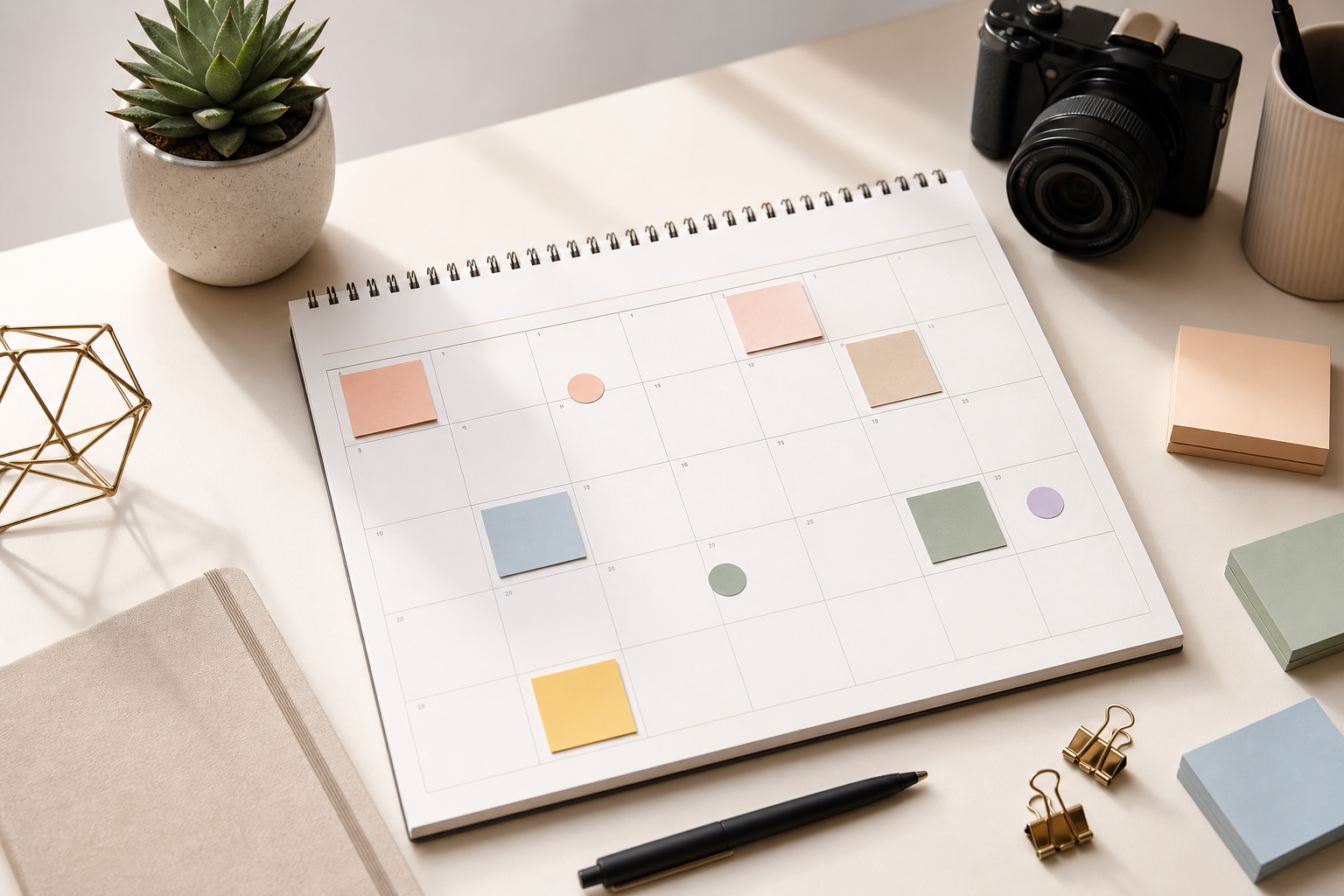
A 30-day content calendar is a monthly schedule that defines what you will publish, where, and when. It turns sporadic posting into a repeatable workflow so you can stay consistent, reduce stress, and connect daily content to a single, measurable goal.
Key takeaways
- Start the month with one primary goal and use it to filter every topic; examples include growing email signups, promoting a service, increasing watch time, or testing content types.
- Choose three to five repeating content pillars to keep the calendar focused and easier to maintain; the article gives examples for fitness and freelance design.
- Separate idea generation from production: brainstorm, draft, record, edit, and publish on different days whenever possible to make batching realistic.
- Match your publishing cadence to real capacity by planning around the time you have for writing, filming, editing, approvals, and recovery.
- Build a simple monthly framework that follows a weekly rhythm, track only fields that affect publishing (topic, format, platform, status, due date, publish date, call to action), and use a tool you will open every day.
If you post only when you feel inspired, your content usually ends up uneven. One week is packed with ideas. The next week is silent because filming, writing, editing, thumbnails, client work, or plain fatigue got in the way. That is why content calendar planning creators use is less about being rigid and more about protecting your time. A 30 day plan gives you a visible schedule, a batchable workload, and a way to connect daily output to a bigger content strategy. In this guide, you will build a beginner friendly system, choose realistic publishing goals, map 30 days of topics, and learn how to adjust your calendar without abandoning it when life changes.
1. content calendar planning creators need before they pick dates
Content calendar planning creators do well starts with decisions, not a spreadsheet. Before you place any topic on a calendar, define what the next 30 days need to accomplish. A creator who wants newsletter subscribers will plan different content than a creator who wants course sales or better reach on short video. This first step keeps your calendar from becoming a list of disconnected ideas.
Begin with one primary goal for the month. Keep it simple. Examples include growing email signups, promoting one service, increasing watch time on a video series, or testing whether educational content outperforms personal updates. Then choose three to five content pillars. These are the repeating categories your audience expects from you. A fitness creator may use beginner workouts, nutrition basics, client questions, and behind the scenes routines. A freelance designer may use portfolio breakdowns, pricing advice, process clips, and client education.
Next, choose your publishing cadence based on your real capacity. If you can comfortably make two videos, three short clips, one email, and one blog post each week, write that down. If you promise daily posting and cannot sustain it, your calendar will fail in week two. According to Google’s guidance on helpful content, content should be made for people first. That advice applies to planning too. A realistic calendar produces better work than an overstuffed one.
- Set one monthly goal: Pick the result that matters most for the next 30 days and use it to filter ideas.
- Choose a small set of pillars: Three to five themes are enough for most beginner creators and make planning easier.
- Match output to energy: Plan around the time you have for writing, filming, editing, approvals, and recovery.
If you want a team based version of the same method, the Content Calendar Planning Teams: Your 30-Day Plan article shows how the same structure changes when more than one person is involved.
2. build a simple monthly framework for content calendar planning creators
Content calendar planning creators can keep up with usually follows a weekly rhythm that repeats, because repetition reduces decision fatigue. A monthly framework is your skeleton. It tells you what type of content belongs on which day before you choose exact topics. This is easier than staring at 30 empty boxes and trying to invent something different for each one.
A beginner friendly framework might look like this: Monday for educational posts, Wednesday for proof or examples, Friday for personal connection, and one weekend slot for repurposed or lighter content. On a blog and newsletter schedule, you might publish one in depth article each week, one email that expands on it, and several social posts that pull clips, quotes, or checklists from the same topic.
This is where a calendar tool helps. Your tool can be a spreadsheet, Notion, Trello, or a planning workspace such as ContentPod. The right tool is the one you will open every day. Many creators fail because their system is too detailed to maintain. For beginners, your calendar should track only what affects publishing: topic, format, platform, status, due date, publish date, and call to action.
When you plan, also decide which topics deserve search traffic and which are better for engagement. Search focused posts answer direct questions and often become blogs, YouTube videos, or detailed LinkedIn posts. Engagement content may include stories, opinions, quick reactions, or community prompts. If you mix both, your calendar has short term interaction and longer term discovery.
You can see related workflow thinking in SEO Workflows Content Consultants: Templates Guide, which breaks down repeatable production steps, and in Content Marketing Institute, which regularly publishes editorial planning guidance for content teams and solo publishers.
Here is a simple monthly framework many beginners can sustain:
- Week 1: Publish cornerstone content that teaches a core topic in your niche.
- Week 2: Follow with examples, case breakdowns, or common mistakes.
- Week 3: Answer audience questions collected from comments, DMs, or search queries.
- Week 4: Repurpose the strongest ideas and review what performed well.
3. map your first 30 days without overfilling the calendar
Your first month should be specific enough to guide production and flexible enough to survive delays. The easiest way to map 30 days is to plan by week, then fill individual dates only after the weekly themes are set. That approach keeps the month coherent and stops you from scheduling content that competes with itself.
Start by listing 12 to 16 topic ideas, not 30. Most creators do not need a unique flagship piece every day. Instead, one strong weekly topic can become several assets. For example, if you are a career creator, a weekly topic like “how to write a better project update” can become a blog post, a short LinkedIn post, a carousel, a Q and A story, and a short video. This is the practical side of content strategy. One idea expands into a set of useful posts rather than forcing you to invent everything from scratch.
A good 30 day calendar also assigns production days. If Monday is research, Tuesday is writing, Wednesday is recording, Thursday is editing, and Friday is publishing, your schedule becomes easier to follow. That separation matters because creative work slows down when every day contains ideation, production, and admin all at once.
Burnout is often a planning problem as much as a workload problem. The interview The Burnout Epidemic: Why High Achievers Struggle is useful here because it explains why high output without recovery tends to break down. Your calendar should include one catch up block each week and at least two lower intensity slots each month.
A workable draft for 30 days often includes:
- 4 anchor pieces: One per week, such as a blog post, podcast episode, or long form video.
- 8 to 12 support posts: Short clips, quotes, image posts, or email snippets derived from anchor pieces.
- 4 audience response posts: Replies to common questions, comment prompts, polls, or FAQ style posts.
- 2 open spaces: Reserved for trends, timely ideas, or a missed deadline that needs to move.
This is where content calendar planning creators becomes practical. You are not filling a month with random content. You are giving each week one main idea and a realistic production path.
4. content calendar planning creators can use across platforms
Content calendar planning creators works better when one topic is adapted to different platforms instead of rewritten from zero every time. Cross platform planning saves time, but only if you respect how each channel is used. A blog post can hold detail and search intent. A short video can summarize one point. An email can add context and a call to action. A carousel can turn steps into a visual checklist.
Suppose your monthly goal is to attract consulting leads. Your week one anchor piece could be “5 mistakes in a first website audit.” From that single topic, you could create a blog post, a 60 second video covering one mistake, a LinkedIn post about the most common issue you see, and an email offering a simple checklist. The topic stays the same. The packaging changes.
This repurposing approach is easier when your calendar tracks asset relationships. Add a column called “source content” so every short post points back to the longer piece that generated it. If you use a tool like ContentPod, a linked workflow keeps that relationship visible while you move a post from idea to draft to published.
For more examples of how content workflows intersect with AI and marketer collaboration, the post Explained: kinetik launches teams team for marketers is a useful read. It is not a calendar guide, but it helps you think about how planning changes once multiple contributors or tools are involved.
- Example 1: A food creator plans one weekly recipe video, then pulls ingredient swaps into Instagram stories, a printable shopping list into email, and a step summary into a blog post.
- Example 2: A B2B creator records one client education video, then turns one question from that video into a LinkedIn post, one quote into a graphic, and one objection into an FAQ email.
When content calendar planning creators use follows this model, the calendar becomes lighter. You are planning systems, not 30 unrelated performances.
5. content calendar planning creators best practices for staying consistent
Content calendar planning creators can sustain depends less on motivation and more on habits that reduce friction. Consistency usually comes from smaller, repeatable actions: keeping an idea capture system, using templates, assigning deadlines before publish dates, and reviewing each week before the next one starts.
Your calendar should include status labels. A simple set works: idea, approved, drafting, recording, editing, scheduled, published, repurpose. Without statuses, a content plan often looks full when nothing is near ready. You also need a single place to store hooks, titles, source links, and audience questions. That is why some creators keep the calendar and the draft system together inside ContentPod or a similar workspace.
Consistency also improves when you batch similar work. Write all captions in one block. Film all short videos in one session. Design all graphics after the copy is final. According to Copyblogger, strong content starts with clarity of message. Batching helps because your brain stays in one mode longer, which often improves clarity and speed.
- Use a weekly review: Check each Friday or Sunday what published, what slipped, and what must move into the next week. A calendar is only useful if it is updated.
- Write deadlines before publish dates: If a post goes live on Thursday, the draft may be due Monday and the edit due Wednesday. Backward planning prevents last minute panic.
- Keep one buffer post ready: Store at least one evergreen post that can go live when a planned piece falls through or a news based topic no longer fits.
One more point matters for beginners. Your first month is a test, not a permanent operating manual. Good content calendar planning creators use gets sharper after you see what you can make consistently and what your audience responds to.
6. common problems in content calendar planning creators face
Content calendar planning creators face usually comes down to overplanning, underestimating production time, and confusing activity with progress. A full calendar can still fail if the posts are too hard to produce, too broad for your audience, or disconnected from your goals.
The most common mistake is planning around ideal conditions. You assume perfect energy, no interruptions, and instant approvals from collaborators. Real schedules do not work like that. Add time for editing, formatting, thumbnails, publishing, and revisions. A second common mistake is filling every date. Empty space is useful. It gives you room for audience requests, better ideas, and schedule recovery.
Another problem is choosing topics that are interesting to you but vague to the reader. “Thoughts on branding” is harder to publish and harder to click than “3 homepage fixes before you pay for a redesign.” Specific topics make production easier and improve search intent. If you need help tightening angles, resources from MarketingProfs can help you think more clearly about audience needs and editorial usefulness.
You should also watch for these warning signs:
- Your calendar is full but drafts are missing: You planned publishing dates without assigning production work.
- Every post uses a new format: Constant novelty increases editing time and weakens repeatable process.
- You cannot explain the monthly goal: Without a goal, measuring success is guesswork.
- You keep moving unfinished posts forward: That usually means the topics are too large, the cadence is too high, or the workflow has too many steps.
The fix is simple. Reduce the number of anchor pieces, narrow the topics, and schedule one review point every week. Effective content calendar planning creators use is less about squeezing more in and more about making each planned piece easier to finish.
Conclusion: Making the Most of content calendar planning creators
Content calendar planning creators use well is a monthly habit of choosing a goal, setting a realistic cadence, assigning production steps, and leaving room for change. If you follow the 30 day approach in this guide, you will end the month with a system you can repeat, not just a list of posts you hoped to publish. Start with one goal, three to five pillars, four weekly anchor pieces, and a small set of repurposed assets. Then review the month and adjust your cadence based on what you finished and what your audience responded to.
If you want one place to organize ideas, drafts, statuses, and publishing dates, ContentPod can help keep your process visible without making it harder than it needs to be. The next useful step is to open your calendar and draft week one today. Put in one anchor topic, two support posts, one audience question, and one open slot. That is enough to begin.
Bottom line: content calendar planning creators use consistently works best when the schedule fits the creator, the topics fit the audience, and the workflow fits the time available.
Frequently Asked Questions
What is content calendar planning creators?
Content calendar planning creators is a monthly or weekly system for deciding what content a creator will publish, on which platform, and on what date. A useful content calendar planning creators process also includes production steps such as drafting, recording, editing, approvals, and repurposing so that publishing happens on time.
How many posts should a beginner creator plan for 30 days?
A beginner creator should plan as many posts as the creator can finish without rushing quality or burning out. For many beginners, a good 30 day plan includes four anchor pieces, eight to twelve support posts, a few audience response posts, and one or two open slots for flexibility.
What should be included in a content calendar for creators?
A creator content calendar should include the topic, content format, platform, goal, due date, publish date, status, call to action, and any source content used for repurposing. A better calendar also includes notes about audience questions, links to drafts or assets, and a weekly review checkpoint so the plan stays current.
References & Further Reading
- How to Create a Content Calendar
- How to Create a Social Media Content Calendar
- Creating helpful, reliable, people-first content
- Build a content calendar in Notion
Put this into practice
Share this post
You Might Also Like
Discover more content tailored to your interests
 Highly Relevant
AI-Assisted Content Repurposing Marketing in 30 Days
Use AI to turn one strong source into multiple channel-ready assets while your team edits and approves them. A practical 30-day plan starts with a content audit, moves into template-based drafting and clear ownership, and finishes with measurement so you know which formats to scale next month.
Read More Highly Relevant
How B2B Content Marketing AI Fits Buyer Intent in 2026
B2B content marketing AI is the practice of planning, writing, structuring, and measuring business content so it helps human buyers make decisions and also gives AI systems clear, extractable answers they can cite or summarize.
Read More Highly Relevant
Content Calendar Planning for B2B: Mistakes to Avoid
Align your calendar to recurring buyer questions and buying-stage needs so each asset helps prospects compare options, reduce implementation risk, or move closer to purchase. Pick a sustainable cadence of fewer, stronger pieces and make the calendar a repeatable operating system rather than a collection of urgent one-offs.
Read MoreReady to create amazing podcast content?
Choose a plan and start generating professional podcast content with AI
View Pricing Plans