Email Sequence vs Drip Campaign: Definitions and Use Cases
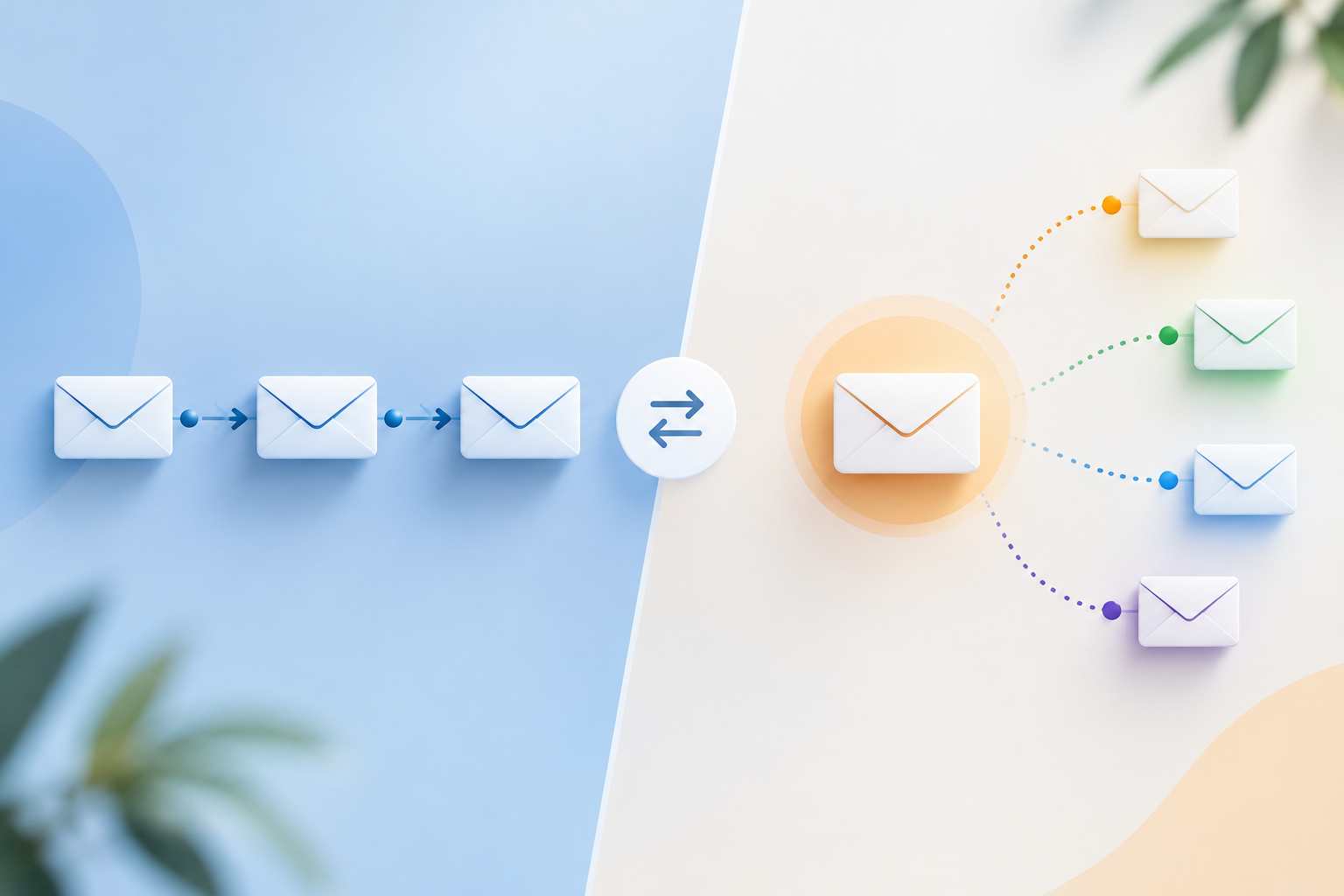
Email sequence vs drip campaign comes down to structure and trigger: an email sequence is a planned series of emails sent in a set order for a specific experience, while a drip campaign is an automated set of emails released based on time, behavior, or a predefined trigger. In practice, many marketers use the terms interchangeably, but a sequence usually describes the narrative flow and a drip campaign usually describes the automation logic.
Key takeaways
- An email sequence is usually content-first: An email sequence is a planned order of messages that moves a subscriber through one experience, such as onboarding or re-engagement.
- A drip campaign is usually automation-first: A drip campaign sends messages because a trigger or timeline tells the system when to send them.
- The same workflow can be both: A welcome series can be an email sequence in content design and a drip campaign in delivery mechanics.
- Your choice depends on the job: Use a sequence when you need a clear story and use a drip campaign when timing, behavior, or segmentation should control delivery.
If you have ever opened your email tool and wondered whether to build a welcome sequence, a nurturing flow, or a drip campaign, the confusion is normal. Different platforms label similar automations in different ways, and beginner guides often blur the line. According to Mailchimp’s explanation of drip campaigns, a drip campaign is automation based on specific actions or timing. That definition helps, but it does not answer how you should organize your own program. This guide explains email sequence vs drip campaign in plain language, shows where each one fits, and connects the choice to your broader email and newsletters strategy so you can build the right workflow without overcomplicating it.
What email sequence vs drip campaign means in plain language
Email sequence vs drip campaign is mainly a difference between how you think about content and how you think about automation. An email sequence is a set of emails arranged in a specific order to guide a person through one experience. A drip campaign is an automated workflow that sends emails when a rule is met, such as signing up, abandoning a cart, downloading a guide, or going inactive for 30 days.
If you write five emails for new subscribers and send them over ten days, you have created an email sequence. If your platform sends those emails automatically after a signup trigger, you also have a drip campaign. The content series is the sequence. The automated delivery is the drip campaign.
This distinction matters because it changes how you plan. If your problem is weak messaging, think in sequences. If your problem is timing, segmentation, or scale, think in drips. If your problem is both, you need both. Many teams discover this once they move beyond one-off newsletters and start building recurring newsletter content that supports leads and subscribers across different stages.
You can also see the difference in day-to-day work:
- Sequence planning: What does email one say? What should email three assume the reader already knows? What action should come last?
- Drip planning: What starts the automation? How long should the delay be? What happens if the person clicks, buys, or unsubscribes?
- Campaign planning: Which audience gets this workflow? What business goal is attached to it? How will you measure success?
The secondary phrase email sequence vs email campaign causes similar confusion. An email campaign often means any coordinated email effort, including one-off promotional sends, newsletters, launches, and automated workflows. A sequence is narrower. A drip campaign is narrower in a different way. Knowing those boundaries helps you name things clearly inside your team.
Email sequence vs drip campaign in one side-by-side table
Email sequence vs drip campaign becomes easier to understand when you compare purpose, timing, and setup side by side. The table below gives you the short version you can use when you are mapping workflows or naming automations in your platform.
| Category | Email sequence | Drip campaign |
|---|---|---|
| Primary focus | Message order and customer path | Automation rules and send timing |
| Definition | A planned series of emails sent in a deliberate order | An automated email workflow triggered by time or behavior |
| Typical trigger | May be manual or automated | Usually automated by signup, click, purchase, inactivity, or date |
| Best for | Onboarding, education, trust building, lead nurturing | Behavior-based follow-up, lifecycle automation, reminders |
| Content style | Usually progressive, each email builds on the last | May be linear, branching, or event-specific |
| Success question | Did the series move the reader to the next step? | Did the trigger send the right message at the right time? |
| Common example | A 5-email welcome series for new subscribers | An abandoned cart reminder sent 1 hour and 24 hours after cart exit |
That side-by-side view also explains why marketers talk past each other. One person is describing the story. Another person is describing the engine that sends the story. In many tools, both sit inside the same automation builder, which makes the terms feel interchangeable even when they are not.
When to use an email sequence vs drip campaign
Email sequence vs drip campaign is a practical choice about what needs to happen first: a guided message arc or an event-driven response. If you need to introduce your brand, educate a lead, or move someone through a fixed set of ideas, start with an email sequence. If you need to react to behavior or timing automatically, start with a drip campaign.
Use an email sequence when:
- You need a clear narrative: A new subscriber should get the same core introduction in the same order.
- You are teaching something: Product education, course delivery, and onboarding all depend on message progression.
- You want to shape expectations: A sequence helps set cadence, explain benefits, and point readers to the next action.
Use a drip campaign when:
- Timing matters: Reminders, renewal notices, and trial expiration prompts lose value if they are late.
- Behavior matters: Cart abandonment, demo follow-up, and content download workflows should react to what the person did.
- Segments need different paths: Customers, leads, and inactive users often need different email timing and different messages.
You will often combine them. A SaaS company may have a five-email onboarding sequence that starts when a user creates an account. The content order is fixed. The send mechanism is automated. If a user activates a key feature after email two, the automation may skip email three and move them to advanced tips. That means the company is running a sequence inside a drip framework.
If you want examples before writing your own, the ContentPod guide to email sequence examples is useful because it maps sequences to customer stages rather than treating every workflow as the same. That mindset prevents a common beginner mistake, which is writing one generic nurture flow and trying to make it do every job.
Examples that make the difference obvious
The easiest way to understand email sequence vs drip campaign is to look at common workflows and ask whether the content logic, the automation logic, or both are doing the heavy lifting. Once you do that, the naming becomes much clearer.
Example 1: welcome emails
A classic welcome flow is usually an email sequence first. You may send:
- Welcome and expectation setting.
- Top resources or getting-started steps.
- Proof, testimonials, or use cases.
- Main call to action, such as booking a demo or trying a feature.
If these emails send automatically after signup, they are also a drip campaign. If you want ideas for structure and tone, this guide to welcome email examples can help you build the sequence without making every email sound like a sales pitch.
Example 2: abandoned cart reminders
An abandoned cart workflow is usually a drip campaign first. The trigger is behavior. Someone adds a product to the cart and leaves. The platform sends a reminder after a delay. The series may have one, two, or three emails. There is a sequence inside it, but the defining characteristic is the trigger.
Example 3: weekly educational lead nurture
A lead magnet follow-up series is often an email sequence. You decide what a lead should learn over the next four weeks and write each message to build on the last. According to ConvertKit’s explanation of email sequences, sequences are useful when you want subscribers to receive a planned set of emails in order. If the series only begins after someone downloads a resource, the delivery is drip-based.
Example 4: inactive subscriber re-engagement
A re-engagement workflow is usually a drip campaign driven by inactivity. The trigger might be “has not opened or clicked in 60 days.” The content may be a short sequence: reminder, value recap, then preference update or unsubscribe request. The timing rule defines the campaign more than the story does.
Example 5: newsletter growth program
If you are trying to grow a newsletter, you will usually need both recurring editorial sends and automation. A regular newsletter is not automatically a sequence or a drip campaign. It is an ongoing campaign with repeated sends. The acquisition and onboarding around it, though, often use sequences and drips. For deeper planning, the ContentPod playbook on newsletter growth marketing teams shows how editorial and automation work together instead of competing for attention.
How to choose the right setup for your business
The right setup depends on your goal, your audience state, and how much branching logic you need. If you choose before answering those three points, you may build a neat automation that sends the wrong message, or a good message series that goes out at the wrong time.
Use this decision process:
- Define the job: Are you welcoming, educating, converting, reminding, or re-engaging?
- Identify the trigger: Does the flow start because of a signup, purchase, click, inactivity window, or fixed date?
- Map the reader’s knowledge: What does the reader know at email one, and what should they know by the final email?
- Decide whether every subscriber should get the same path: If yes, a sequence may be enough. If no, use drip logic with conditions.
- Set one main goal: A good automation usually has one next action, not five competing ones.
- Name the workflow clearly: “New subscriber welcome sequence” is more useful than “nurture flow 2.”
A simple rule helps beginners: if you can outline the emails before you open your automation tool, you are probably designing a sequence. If you need to define rules and branches before you can write the copy, you are probably building a drip campaign.
This is where planning and production often slow teams down. If you already have a recorded founder conversation, interview, or customer insight session, ContentPod can help turn that source material into written assets. Its Interview tool can turn one interview into formats such as a blog post, email newsletter, LinkedIn post, and FAQ, which is useful when your sequence needs consistent messaging across channels. That does not replace your strategy, but it does reduce the blank-page problem.
For teams thinking more broadly about how AI fits into content operations, the interview AI and the Future of Content Marketing: A Dynamic Discussion adds context on using AI to speed production without giving up editorial judgment.
How to write each one without sounding automated
A sequence or drip campaign works best when each email feels like it belongs to one reader at one moment, even when thousands of people receive it. The problem is not automation itself. The problem is generic writing that ignores context.
For an email sequence, write with progression in mind:
- Email one: State why the subscriber is hearing from you and what they can expect next.
- Email two: Solve one immediate problem or answer one early question.
- Email three: Add proof, examples, or a stronger call to action.
- Final email: Ask for one next step, such as replying, booking, buying, or reading more.
For a drip campaign, write with trigger context in mind:
- Cart abandonment: Reference the incomplete purchase and remove friction.
- Trial onboarding: Reference the account state and point to the next action inside the product.
- Inactivity: Acknowledge the gap and offer a useful reason to return.
A simple copy template helps:
Sequence email template
Subject: One clear next step for [goal]
Opening: You signed up for [reason], so this email focuses on [specific outcome].
Body: One lesson, one example, one action.
CTA: Try [action] today.
Drip email template
Subject: You left [item/task] unfinished
Opening: You started [action] but did not complete it.
Body: Here is what to do next, what may be blocking you, and where to click.
CTA: Return to [action].
For onboarding and retention emails, design quality matters as much as copy. Litmus has written about email design systems, and the practical takeaway is simple: consistent modules, spacing, and calls to action make automation easier to maintain over time.
Common mistakes beginners make with email sequence vs drip campaign
Most mistakes come from mixing goals, ignoring triggers, or assuming every automated workflow should sell immediately. When you understand email sequence vs drip campaign, you can catch these problems before they reduce opens, clicks, or conversions.
- Treating every workflow like a sales series: A welcome sequence should orient the reader first. If email one jumps straight to a hard sell, many subscribers will disengage.
- Skipping trigger logic: A useful sequence can fail if it reaches people after they already bought, churned, or completed the action.
- Writing every email from scratch with no arc: Sequences work because each email advances the conversation. Random standalone emails feel disjointed.
- Using one workflow for every segment: New leads, active customers, and cold subscribers should not all receive the same messages.
- Ignoring suppression rules: If someone converts after email one, they may need a different branch instead of the remaining persuasion emails.
- Confusing newsletters with automations: A newsletter is usually a recurring broadcast. It may support automation, but it is not the same thing.
The fix is usually operational, not just editorial. Create a simple workflow document with five fields: goal, audience, trigger, email order, and exit condition. That one-page summary prevents a lot of accidental overlap between campaigns. If you need help generating first drafts, editing copy, or expanding one idea into multiple channels, the tools on ContentPod can speed production, especially when your team is turning one source interview into blog, email, and social assets.
Conclusion: Making the Most of email sequence vs drip campaign
The useful way to think about email sequence vs drip campaign is this: a sequence defines the message flow, and a drip campaign defines the automated delivery logic. Some workflows are mostly one or the other. Many are both. If you start by naming the goal, the trigger, and the reader’s stage, you will know whether you need a fixed series, a behavior-based automation, or a sequence delivered through drip rules.
If your team is building newsletter funnels, onboarding emails, or lead nurture programs, write the sequence first, then add automation logic where timing or behavior matters. That approach keeps the copy clear and the system manageable. If you want help turning interviews, notes, or source material into usable content across email and other formats, ContentPod is a practical place to start.
Bottom line: Email sequence vs drip campaign is the difference between planning the order of messages and automating when those messages are sent, and most effective email programs use both together.
Frequently Asked Questions
What is email sequence vs drip campaign?
Email sequence vs drip campaign refers to the difference between a planned series of emails and an automated delivery system. An email sequence is the ordered set of messages a subscriber receives for a specific experience, while a drip campaign is the automation that sends emails based on timing, signup, behavior, or another trigger.
Is a welcome series an email sequence or a drip campaign?
A welcome series is usually both an email sequence and a drip campaign. A welcome series is an email sequence because the messages follow a deliberate order, and a welcome series is a drip campaign when the platform sends those emails automatically after a signup trigger.
What is the difference between email sequence vs email campaign?
Email sequence vs email campaign is a broader comparison than email sequence vs drip campaign. An email campaign can include newsletters, one-time promotions, product launches, and automations, while an email sequence is a narrower set of ordered emails built for one experience, such as onboarding or nurturing.
References & Further Reading
- HubSpot Email Marketing Guide
- Mailchimp: What Is a Drip Campaign?
- Litmus: How to Build an Email Design System
Put this into practice
Share this post
You Might Also Like
Discover more content tailored to your interests
 Highly Relevant
Newsletter Growth Marketing Teams: Practical Playbook
A newsletter growth marketing team is a repeatable operating model that combines audience targeting, signup conversion, editorial planning, and performance review into one shared workflow to attract qualified subscribers, retain attention, and produce measurable business results. For the model to work, teams must define a clear audience and a primary growth outcome before deploying tactics.
Read More Highly Relevant
Explained: Google CEO Sundar Pichai on AI Shake-Up
Sundar Pichai announced that Jeff Dean is leaving after 27 years and that Demis Hassabis will take on new responsibilities, and he framed the change as a managed transition meant to reassure employees and identify who will lead Google’s AI efforts. The message functions as a signal about how Google plans to organize AI leadership rather than a routine personnel note.
Read More
Welcome Email Examples and How to Write Your Own
Welcome email examples are sample first messages you send after someone subscribes, signs up, buys, or starts a trial, and they show the structure, tone, and call to action that help new contacts take the next step.
Read MoreReady to create amazing podcast content?
Choose a plan and start generating professional podcast content with AI
View Pricing Plans