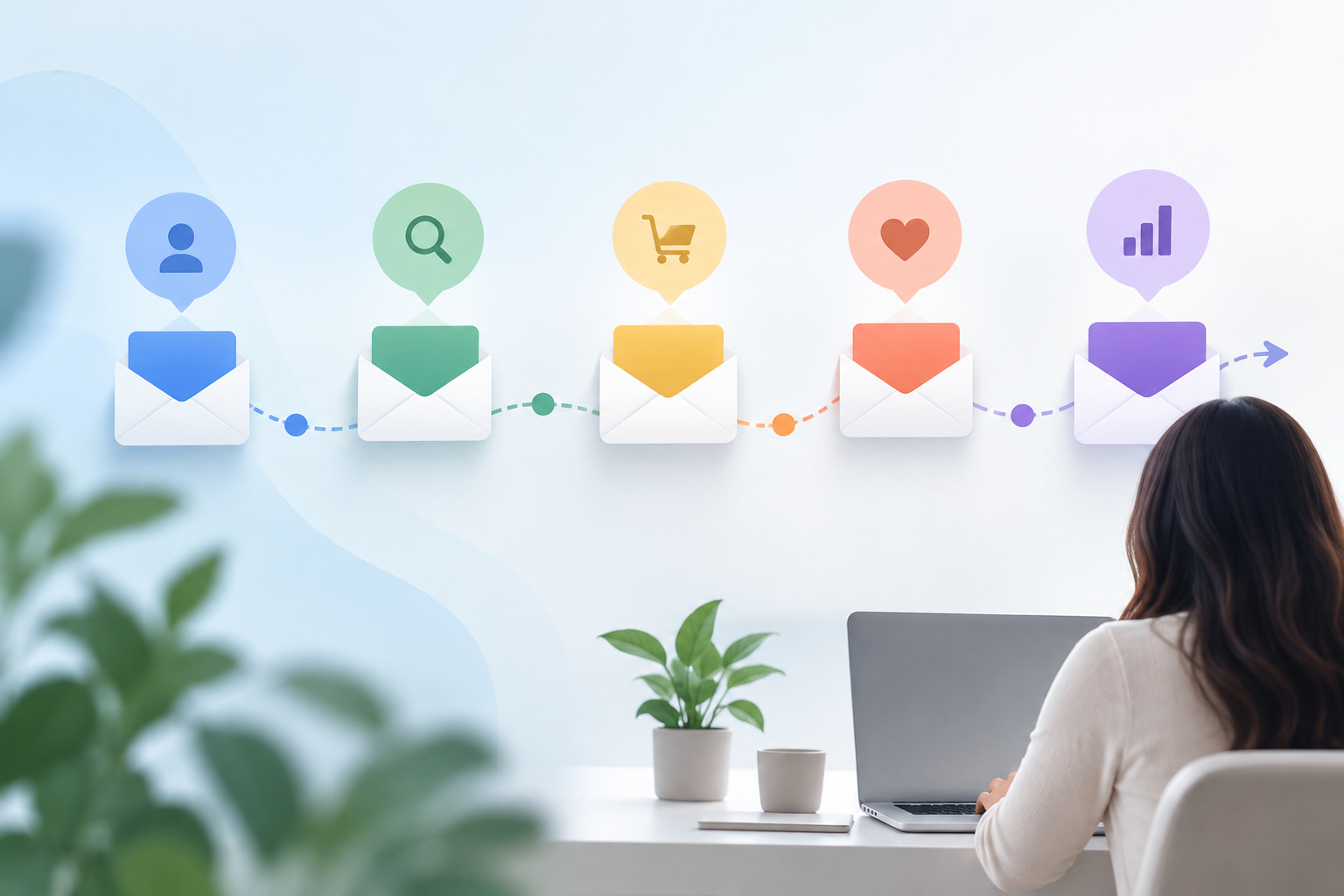
Email sequence examples are sample sets of timed, automated emails that guide a person from first signup through purchase, ongoing retention, or re-engagement. The best email sequence examples match the customer stage, give one clear next step per message, and change based on what the reader has already done.
Key takeaways
- Email sequences work best when each message has one job: Welcome, educate, convert, retain, or win back are different goals and should not be mixed into the same email.
- The right timing depends on intent: A cart reminder may go out within hours, while a re-engagement series often needs wider spacing and a stronger reason to return.
- Short sequences are easier to manage and improve: Three to five emails is enough for most beginner sequences, especially when each email builds on the last action.
- Examples are starting points, not scripts: The strongest results come from adapting the offer and tone, along with the call to action, to your product, audience, and buying cycle.
If you have ever sent one newsletter, crossed your fingers, and waited for results, you have already seen the problem. A single email rarely moves someone from curiosity to action. An email sequence does that job better because it spreads the message across several touches, each with a clear purpose. If you are still working out what is an email sequence and which types of email sequences you should build first, this guide will give you templates you can use right away. For a broader view of email marketing fundamentals, it helps to pair these examples with a practical email and newsletters resource hub so your sequences fit into the rest of your program.
A simple way to plan your flows is to map the sequence to the stage. The table below gives you a quick decision guide before you start writing.
| Customer stage | Best sequence type | Main goal | Suggested length |
|---|---|---|---|
| Awareness | Welcome sequence | Set expectations and earn the next click | 3 emails |
| Consideration | Lead magnet nurture | Turn interest into product understanding | 3 to 4 emails |
| Intent | Abandoned cart or demo follow-up | Recover a high-intent action | 2 to 3 emails |
| Activation | Trial onboarding | Help users reach first value | 4 emails |
| Retention | Post-purchase onboarding | Reduce regret and increase usage | 3 emails |
| Loyalty | Renewal or upgrade sequence | Extend customer value | 3 emails |
| Reactivation | Re-engagement sequence | Bring inactive people back or clean the list | 3 emails |
1. Email sequence examples for a welcome flow
A welcome sequence is the simplest place to start because new subscribers expect to hear from you right after they join.
This sequence works for newsletters, online brands, SaaS products, agencies, and ecommerce stores that collect email before a purchase. If you publish regular emails, your first automated flow should explain what the subscriber signed up for, what they should read next, and what action matters most. If you need a system for producing ongoing newsletter content, build that alongside the welcome flow so your automation and newsletter cadence feel connected.
- Example email 1, sent immediately: Subject: Welcome. Here is what you will get. Body: “Thanks for signing up. You will receive one email each week with practical advice on [topic]. Start with these two resources: [link 1] and [link 2]. If you want the quickest win, reply and tell us your biggest challenge.”
- Example email 2, sent 2 days later: Subject: Start here if you are new to [topic]. Body: “Most new readers ask the same question first: where should I begin? This short guide will help you avoid common mistakes and get a result faster. Read it here: [resource link].”
- Example email 3, sent 5 days later: Subject: A simple next step. Body: “You have seen what we cover. If you want more focused help, here is the next action: [book a demo, browse products, join the newsletter archive, or view a case study].”
Why it works: The sequence meets the reader at a low-commitment moment. The opening email confirms the signup, the follow-up reduces uncertainty, and the final message asks for a meaningful next action after a bit of trust has formed.
- How to adapt it for a newsletter: Point readers to your strongest archived issues. This pairs well with the practical ideas in newsletter growth templates.
- How to adapt it for services: Swap resource links for one short client problem and one short explanation of how you solve it.
- How to adapt it for ecommerce: Add product category links and a first-purchase incentive only if discounting fits your margin.
2. A lead magnet nurture sequence for early interest
A lead magnet nurture sequence turns a download or signup into product understanding by connecting the free resource to the paid solution.
This sequence is useful when someone has shown interest but is not yet ready to buy. The mistake is to send the asset and stop there. A better sequence helps the subscriber use the resource, see the gap between where they are and where they want to be, then understand how your offer closes that gap.
- Example email 1, sent immediately: Subject: Your checklist is inside. Body: “Here is your [lead magnet]. Save this email so you can come back to it. The fastest way to use it is to start with section 2, because that section identifies what to fix first.”
- Example email 2, sent 2 days later: Subject: One mistake that makes this harder than it needs to be. Body: “Many teams download a checklist and use it as a reading exercise. Instead, pick one item and finish it this week. This short example shows what that looks like in practice.”
- Example email 3, sent 4 days later: Subject: What to do when the checklist is not enough. Body: “Templates help you start, but they do not rewrite, segment, or structure your campaign. If you want help building the full sequence, here is how our process works.”
Why it works: The first email delivers the promise. The second helps the reader use the asset instead of forgetting it. The third creates a natural bridge to the product or service.
- How to adapt it for SaaS: Replace the sales pitch with an invitation to a demo or free trial.
- How to adapt it for education products: Add a short lesson email between email 2 and 3.
- How to adapt it for teams: If several people contribute to email writing, document the sequence structure so new contributors do not change the voice mid-flow. The article on newsletter growth content teams covers avoidable workflow issues that often spill into automation.
3. An abandoned cart sequence for high-intent buyers
An abandoned cart sequence should remind, reduce friction, and answer hesitation while the buying intent is still fresh.
This sequence is one of the clearest examples of behavior-based automation because the trigger is specific. Someone added an item to the cart and left. Your job is not to write a long brand story. Your job is to help them finish a task they almost completed.
- Example email 1, sent 1 to 3 hours later: Subject: You left something behind. Body: “Your cart is still saved. Complete your order here: [cart link]. If something stopped you, reply to this email and tell us what happened.”
- Example email 2, sent 24 hours later: Subject: A quick answer before you check out. Body: “People often pause at this step because they are unsure about sizing, delivery, or returns. Here are the details that matter most before you buy: [brief FAQ bullets].”
- Example email 3, sent 48 to 72 hours later: Subject: Still thinking it over? Body: “Your cart expires soon. If you want to finish your order, use this link. If you are comparing options, this short guide may help you decide.”
Why it works: The first email catches simple distraction. The second addresses objections. The third creates a decision point without sounding desperate.
- How to adapt it for high-price products: Replace urgency with reassurance, support options, or a product comparison.
- How to adapt it for B2B: Use “request a quote” or “book a walkthrough” instead of checkout language.
- How to adapt it for mobile-heavy audiences: Keep the copy short and put the cart button high in the email.
Email clients also shape performance. According to Litmus guidance on preheader text, the line after the subject can do more work than many teams give it credit for. For cart reminders, use that space to answer the obvious question, such as shipping details or return policy.
4. Email sequence examples for free trial onboarding
Free trial onboarding emails should help a user reach first value fast because activation matters more than feature awareness at this stage.
This is where many beginner automations go off track. The sequence becomes a product tour by email. A better version focuses on one outcome per message. The user does not need all features explained on day one. The user needs one useful result as soon as possible.
- Example email 1, sent immediately: Subject: Start with this one task. Body: “Welcome to your trial. If you do only one thing today, do this: [single setup action]. It takes about five minutes and gives you the quickest result.”
- Example email 2, sent 1 day later: Subject: Your next step after setup. Body: “Now that your account is ready, use this workflow to complete your first [campaign, report, draft, upload, or project]. Here is a short walkthrough.”
- Example email 3, sent 3 days later: Subject: Two common blockers and how to fix them. Body: “If you have not completed your first task, one of these issues is usually the reason. Here is how to get past each one.”
- Example email 4, sent 6 days later: Subject: Ready to make this part of your process? Body: “If the trial has helped, here is what changes when you move to a paid plan. If you have not seen value yet, reply and tell us what you are trying to do.”
Why it works: Each message removes one source of drop-off. Setup, first task, blockers, and conversion are separate moments and should be treated that way.
- How to adapt it for an AI writing product: Focus the first email on one deliverable, such as drafting a welcome email or a three-part nurture sequence.
- How to adapt it for teams: Add a collaboration email only after the primary user has completed the first solo task.
- How to adapt it with content operations support: If you are building onboarding assets and email copy together, ContentPod can help create drafts for related assets like articles, FAQs, and newsletters from the same source material, which keeps onboarding language more consistent.
If you are planning onboarding for a SaaS newsletter audience as well, the guide to newsletter growth saas companies is a good companion because trial users often enter through newsletter content first.
5. A post-purchase sequence that reduces buyer hesitation
A post-purchase sequence should confirm the decision, help the customer get value, and prepare the next logical purchase or action.
Many brands stop once the order confirmation is sent. That leaves a gap where uncertainty grows. A thoughtful post-purchase sequence reduces support tickets, sets expectations, and gives the buyer a reason to stay engaged after the transaction.
- Example email 1, sent immediately: Subject: Your order is confirmed. Body: “Thanks for your order. Here is what happens next: [delivery timeline, access details, or next steps]. If you need help before it arrives, reply here.”
- Example email 2, sent after delivery or access: Subject: How to get the most from your purchase. Body: “Start with these three steps so you can use [product] without guesswork. Step 1: [action]. Step 2: [action]. Step 3: [action].”
- Example email 3, sent 5 to 7 days later: Subject: A useful next step. Body: “Now that you have started using [product], this add-on or related resource may help with [specific outcome].”
Why it works: The sequence keeps the customer moving forward. It also changes the tone from “buy now” to “use this well,” which is more believable after a purchase.
- How to adapt it for digital products: Put login, access, and getting-started links near the top.
- How to adapt it for services: Replace product tips with onboarding steps and scheduling instructions.
- How to adapt it for newsletter-first brands: Send selected educational issues after the purchase to keep value visible between transactions. The playbook on newsletter growth marketing teams has ideas for keeping those messages useful instead of repetitive.
6. A renewal or upgrade sequence for active customers
A renewal or upgrade sequence works best when it frames the decision around continued results, not around pressure.
Customers who already use your product are different from prospects. They know the basics. Your emails should remind them what they have done, what they still need, and what changes if they renew or move up to a higher plan.
- Example email 1, sent 14 to 30 days before renewal: Subject: Your plan renews soon. Body: “Your current plan renews on [date]. Here is what stays active if you renew, and here is what you would lose if access ends.”
- Example email 2, sent 7 days later: Subject: Is your current plan still the right fit? Body: “Based on how you use [product], these are the main reasons customers stay on the current plan and the main reasons they upgrade.”
- Example email 3, sent 3 days before renewal: Subject: Last reminder before renewal. Body: “This is a reminder that your plan renews on [date]. If you want to change plans or ask a question first, use this link.”
Why it works: The sequence gives enough notice, keeps the tone practical, and gives people time to choose rather than react at the last minute.
- How to adapt it for annual subscriptions: Add a usage recap if you can provide one honestly and clearly.
- How to adapt it for agencies or retainers: Focus the message on upcoming work, deliverables, and capacity planning.
- How to adapt it for education products: Tie renewal to continued access, community, or updated lessons rather than general motivation.
If you are unsure how long a sequence should run, resources on planning email sequences can help you think through pacing and conditional logic before you build anything inside your email platform.
7. Email sequence examples for re-engagement
Re-engagement emails should give inactive subscribers a clear reason to return and a clean way to opt out if they no longer want your messages.
This sequence matters because list decay is normal. People change jobs, priorities change, inboxes fill up, and attention drops. Sending more often to people who have stopped interacting usually makes the problem worse. A short re-engagement series is cleaner and more respectful.
- Example email 1, sent after a defined inactivity window: Subject: Still want these emails? Body: “You have not opened our recent emails, so we wanted to check in. If you still want updates on [topic], click here to stay on the list.”
- Example email 2, sent 4 days later: Subject: Before we stop sending. Body: “If the issue is relevance, you can choose a different topic or lower frequency here. If you still want the best recent resources, start with this one.”
- Example email 3, sent 7 days later: Subject: We are about to remove you. Body: “We only want to email people who want these messages. Click here to remain subscribed. If you do nothing, we will stop sending.”
Why it works: The sequence respects consent, improves list quality, and may recover readers who still care but missed earlier emails. According to Mailchimp’s overview of email automation, behavior-based automations are built around actions and timing, which makes re-engagement a natural fit for a trigger-based flow.
- How to adapt it for media newsletters: Offer topic preferences or reduced frequency before removal.
- How to adapt it for ecommerce: Feature new arrivals or category preferences rather than broad brand updates.
- How to adapt it for content teams: Review your acquisition source before blaming the sequence. Low-quality signup sources often create low-engagement lists. The practical issues discussed in AI and the Future of Content Marketing: A Dynamic Discussion also apply here, especially when teams scale production faster than audience intent.
Conclusion: Making the Most of email sequence examples
The most useful email sequence examples do one thing well at one customer stage. A welcome flow sets expectations. A nurture flow turns interest into understanding. An abandoned cart sequence recovers intent. Trial, post-purchase, renewal, and re-engagement flows each solve a different problem. If you are starting from scratch, pick one sequence that matches your biggest gap and build only three emails first. Then review replies, clicks, and conversions before expanding it.
If you need help turning rough ideas into usable drafts, ContentPod can help you create supporting content like newsletters, articles, FAQs, and email copy from the same source material, which makes your messaging easier to keep consistent. The point is not to copy these email sequence examples word for word. The point is to use them as working models, then rewrite them around your audience, product, and buying cycle.
Bottom line: The best email sequence examples match one clear customer stage, ask for one clear next action, and make the next email feel like a logical continuation rather than a disconnected blast.
Frequently Asked Questions
What is email sequence examples?
The phrase email sequence examples usually means sample sets of automated emails that are sent in a planned order to move a subscriber or customer toward a goal. A sequence may welcome a new subscriber, recover an abandoned cart, onboard a trial user, or re-engage an inactive contact, with each email tied to a customer stage.
What is an email sequence and how many emails should it include?
An email sequence is a planned series of emails sent based on time, behavior, or both. Most beginner sequences work well with three to five emails because that is enough room to introduce the topic, address hesitation, and ask for a next step without creating unnecessary complexity.
What types of email sequences should a beginner build first?
The best types of email sequences for beginners are a welcome sequence, a lead magnet nurture sequence, and either a trial onboarding or abandoned cart sequence depending on the business model. These flows are easier to map because the trigger is clear, the audience intent is easier to read, and the success metrics are more direct than in broad promotional campaigns.
References & Further Reading
- HubSpot: Email Marketing
- ConvertKit: Email Sequences
- Litmus: Email Preheader Text Guide
- Mailchimp: About Email Automation
Put this into practice
Share this post
You Might Also Like
Discover more content tailored to your interests
 Highly Relevant
Newsletter Growth Marketing Teams: Practical Playbook
A newsletter growth marketing team is a repeatable operating model that combines audience targeting, signup conversion, editorial planning, and performance review into one shared workflow to attract qualified subscribers, retain attention, and produce measurable business results. For the model to work, teams must define a clear audience and a primary growth outcome before deploying tactics.
Read More Highly Relevant
Newsletter Growth Content Teams: Mistakes to Avoid
Treat the newsletter as a product: give it a single, specific promise that states audience, format, and cadence, put signup offers where readers have intent, and remove workflow and technical friction so the email delivers exactly what subscribers expected. Do this before chasing design changes or more traffic.
Read More Highly Relevant
Explained: Google CEO Sundar Pichai on AI Shake-Up
Sundar Pichai announced that Jeff Dean is leaving after 27 years and that Demis Hassabis will take on new responsibilities, and he framed the change as a managed transition meant to reassure employees and identify who will lead Google’s AI efforts. The message functions as a signal about how Google plans to organize AI leadership rather than a routine personnel note.
Read MoreReady to create amazing podcast content?
Choose a plan and start generating professional podcast content with AI
View Pricing Plans