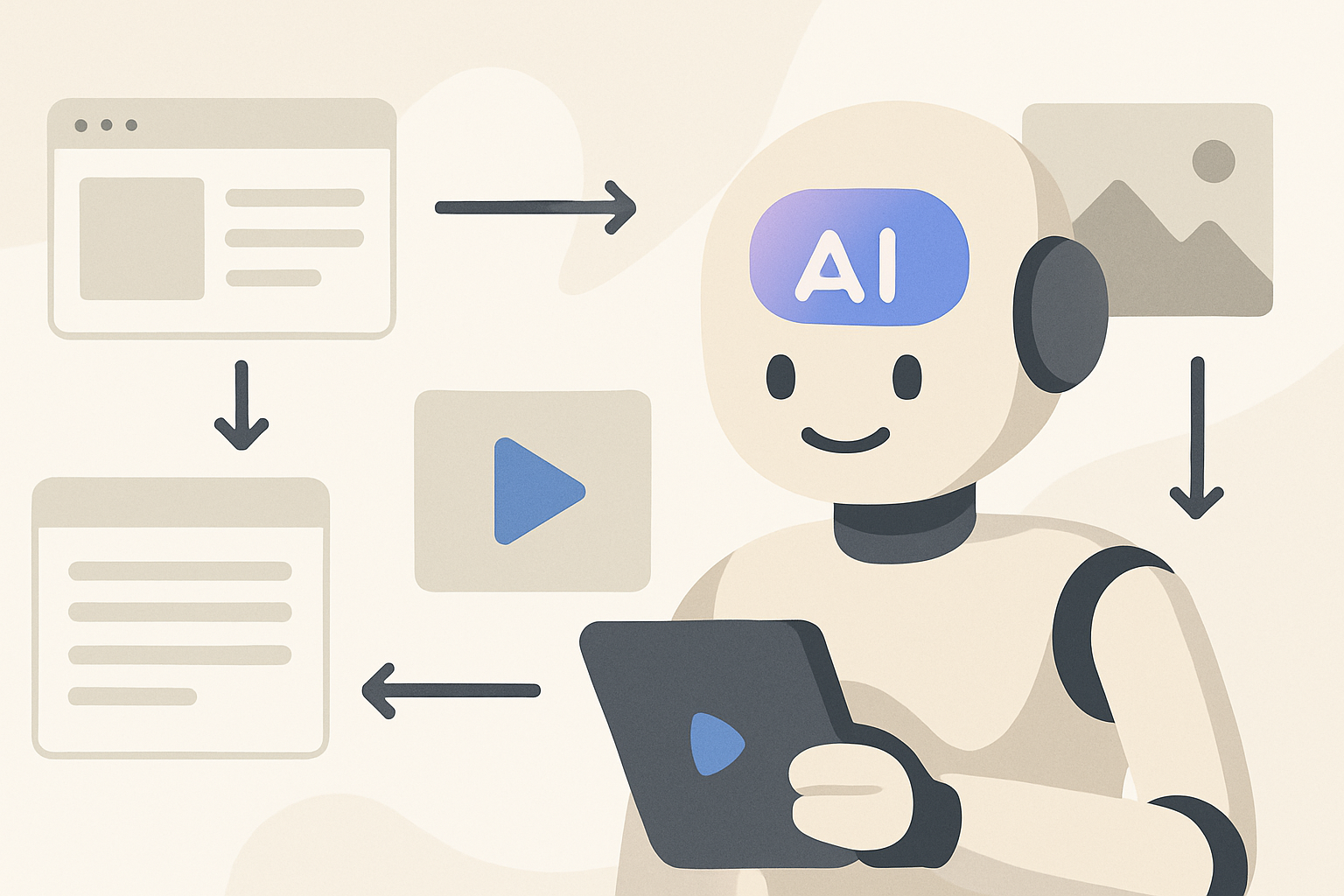
AI-assisted content repurposing lets creators convert existing material into new formats to extend its useful life, reach more people, and reduce the time spent producing entirely new content. AI handles repetitive steps so creators can focus on planning and creative work.
Key takeaways
- AI tools can analyze content performance data to identify which pieces are most suitable for repurposing.
- AI-driven platforms can automatically generate summaries to make it easier to adapt content for different formats and platforms.
- Natural language processing can transform text into other formats such as videos or podcasts, while machine learning can predict content trends and suggest repurposing strategies.
- Concrete workflows include converting a blog post into a video script for YouTube and transcribing a podcast episode into a blog post.
- Best practices are to regularly analyze content performance and to experiment with different formats and platforms to find the most effective combinations.
In the digital age, creators face the constant challenge of producing fresh, engaging content to maintain their audience's interest. The concept of ai-assisted content repurposing creators has emerged as a powerful solution to this challenge, leveraging artificial intelligence to transform existing content into new formats and extend its lifespan. This blog post will explore how AI can assist creators in repurposing content, offer practical templates and examples, and provide actionable strategies for maximizing content value. By the end of this article, you'll understand how to harness AI's potential to streamline your content strategy and enhance your creative output. To learn more about the impact of AI in business, check out The Future of AI in Business: From Hype to Reality.
1. Understanding AI-Assisted Content Repurposing for Creators
AI-assisted content repurposing allows creators to efficiently transform existing material into different formats, such as turning a blog post into a podcast script or a video into an infographic. This process not only saves time but also ensures content reaches a broader audience through varied consumption methods. By utilizing AI tools, creators can automate much of the manual work involved in repurposing content, ultimately increasing productivity and creativity.
- Practical point 1: AI tools can analyze content performance data to identify which pieces are ripe for repurposing.
- Practical point 2: AI-driven platforms can automatically generate summaries, making it easy to adapt content for different formats.
- Practical point 3: These tools can assist in tailoring content to fit the unique preferences of various platforms, enhancing engagement.
For more insights on maximizing the impact of AI-assisted content repurposing, visit Maximizing Impact with AI-Assisted Content Repurposing SaaS.
2. Key Benefits of AI-Assisted Content Repurposing
One significant advantage of AI-assisted content repurposing is the ability to maintain a consistent content output without overwhelming creators. This approach leverages AI to alleviate the pressure of constant content production by optimizing and reimagining existing materials. Moreover, AI facilitates a data-driven content strategy, enhancing the targeting and personalization of repurposed content.
- Efficiency: AI automates tedious tasks, allowing creators to focus on strategic planning and creativity.
- Cost-effective: By decreasing the need for fresh content creation, AI reduces production costs significantly.
- Audience reach: Repurposing content into various formats taps into different audience segments, expanding reach and engagement.
For a deeper understanding of integrating AI into content marketing, consider the AI and the Future of Content Marketing: A Dynamic Discussion.
3. AI Tools and Techniques for Content Repurposing
There are numerous AI tools available that can assist creators in repurposing content efficiently. These tools can perform tasks ranging from content curation to generating creative outputs in various formats. For instance, platforms like HubSpot offer AI-driven solutions that simplify the process of content repurposing by providing insights and automation features.
- Content curation tools: AI can help aggregate and curate content from different sources, providing ready-to-repurpose material.
- Natural language processing (NLP): NLP technologies can help transform text into different formats, such as videos or podcasts.
- Machine learning algorithms: These algorithms can predict content trends, suggesting optimal repurposing strategies for creators.
Explore how an Integrated Artificial Intelligence Internet Framework can further enhance content strategy.
4. Practical Examples of AI-Assisted Content Repurposing
To illustrate the power of AI-assisted content repurposing, let's look at some practical examples. These examples highlight how creators can transform their existing content into new formats using AI tools, maximizing their content's reach and effectiveness.
- Example 1: A blogger uses AI to convert a popular article into an engaging video script, which is then transformed into a YouTube video, reaching a visual audience.
- Example 2: A podcast episode is transcribed using AI, edited for clarity, and published as a comprehensive blog post, appealing to readers who prefer text over audio.
To understand how AI can boost team efficiency, refer to Boosting Efficiency with AI-Assisted Content Repurposing Teams.
5. Best Practices for AI-Assisted Content Repurposing
When implementing AI-assisted content repurposing strategies, following best practices ensures optimal results. These practices enhance the efficiency of AI tools and maximize the impact of repurposed content.
- Best Practice 1: Regularly analyze content performance to identify high-potential materials for repurposing.
- Best Practice 2: Use AI tools to experiment with different content formats and platforms to find the most effective combinations.
- Best Practice 3: Avoid common pitfalls by ensuring content remains authentic and aligned with your brand voice.
Discover more strategies by visiting ContentPod for comprehensive insights.
6. Common Mistakes and Challenges in AI-Assisted Content Repurposing
Despite the benefits, AI-assisted content repurposing can present challenges. Creators must be aware of potential pitfalls and how to overcome them to fully capitalize on AI's advantages. One common mistake is over-reliance on AI, which can result in generic or impersonal content. Balancing AI's capabilities with human creativity is essential.
- Challenge 1: Ensuring AI-generated content aligns with brand voice and authenticity.
- Challenge 2: Avoiding redundancy by carefully selecting content for repurposing.
- Challenge 3: Keeping up with AI advancements to continually optimize content strategy.
For further reading on navigating AI challenges, consider the Harvard Business Review's insights on AI transparency.
Conclusion: Making the Most of AI-Assisted Content Repurposing Creators
In conclusion, ai-assisted content repurposing creators offer a transformative solution for managing the demands of content production. By leveraging AI, creators can efficiently repurpose content, enhance their content strategy, and engage with audiences across multiple platforms. Embracing AI tools and best practices not only optimizes content creation processes but also positions creators at the forefront of digital innovation. For more on how to integrate these strategies, visit ContentPod.
Frequently Asked Questions
What is ai-assisted content repurposing creators?
AI-assisted content repurposing creators use advanced tools to transform existing content into new formats, extending its reach and engaging different audiences. This process leverages AI technologies to automate and streamline the repurposing effort, boosting productivity and creativity.
How can AI improve content strategy for creators?
AI enhances content strategy by providing data-driven insights, automating repetitive tasks, and suggesting optimal content formats for different platforms. This allows creators to focus on strategic planning and creative development, increasing content impact and efficiency.
What are the key challenges in ai-assisted content repurposing?
Key challenges include maintaining brand authenticity in AI-generated content, avoiding redundancy, and keeping up with technological advancements. Overcoming these challenges requires balancing AI capabilities with human creativity and continuously updating content strategies.
References & Further Reading
- AI Content Repurposing: The Future of Content Creation - hubspot.com — This article explores how AI is changing content creation and repurposing strategies.
- Harnessing AI in Content Marketing - copyblogger.com — Readers will learn how AI tools can optimize content marketing efforts.
- AI Tools for Content Repurposing - marketingprofs.com — Offers insights into the best AI tools available for content repurposing.
- How to Keep Your Company's AI from Becoming a Black Box - hbr.org — Discusses transparency in AI applications, relevant to content repurposing.
Put this into practice
Share this post
You Might Also Like
Discover more content tailored to your interests
 Highly Relevant
Content Repurposing Examples from One Source
Content repurposing examples are practical ways to turn one original asset, such as a webinar, interview, or blog post, into multiple formats like social posts, email copy, short videos, FAQs, and downloadable guides.
Read More Highly Relevant
Content Calendar Planning for B2B: Mistakes to Avoid
Align your calendar to recurring buyer questions and buying-stage needs so each asset helps prospects compare options, reduce implementation risk, or move closer to purchase. Pick a sustainable cadence of fewer, stronger pieces and make the calendar a repeatable operating system rather than a collection of urgent one-offs.
Read More Highly Relevant
Newsletter Growth Marketing Teams: Practical Playbook
A newsletter growth marketing team is a repeatable operating model that combines audience targeting, signup conversion, editorial planning, and performance review into one shared workflow to attract qualified subscribers, retain attention, and produce measurable business results. For the model to work, teams must define a clear audience and a primary growth outcome before deploying tactics.
Read MoreReady to create amazing podcast content?
Choose a plan and start generating professional podcast content with AI
View Pricing Plans