How AI Can Transform Your Back-Office Operations
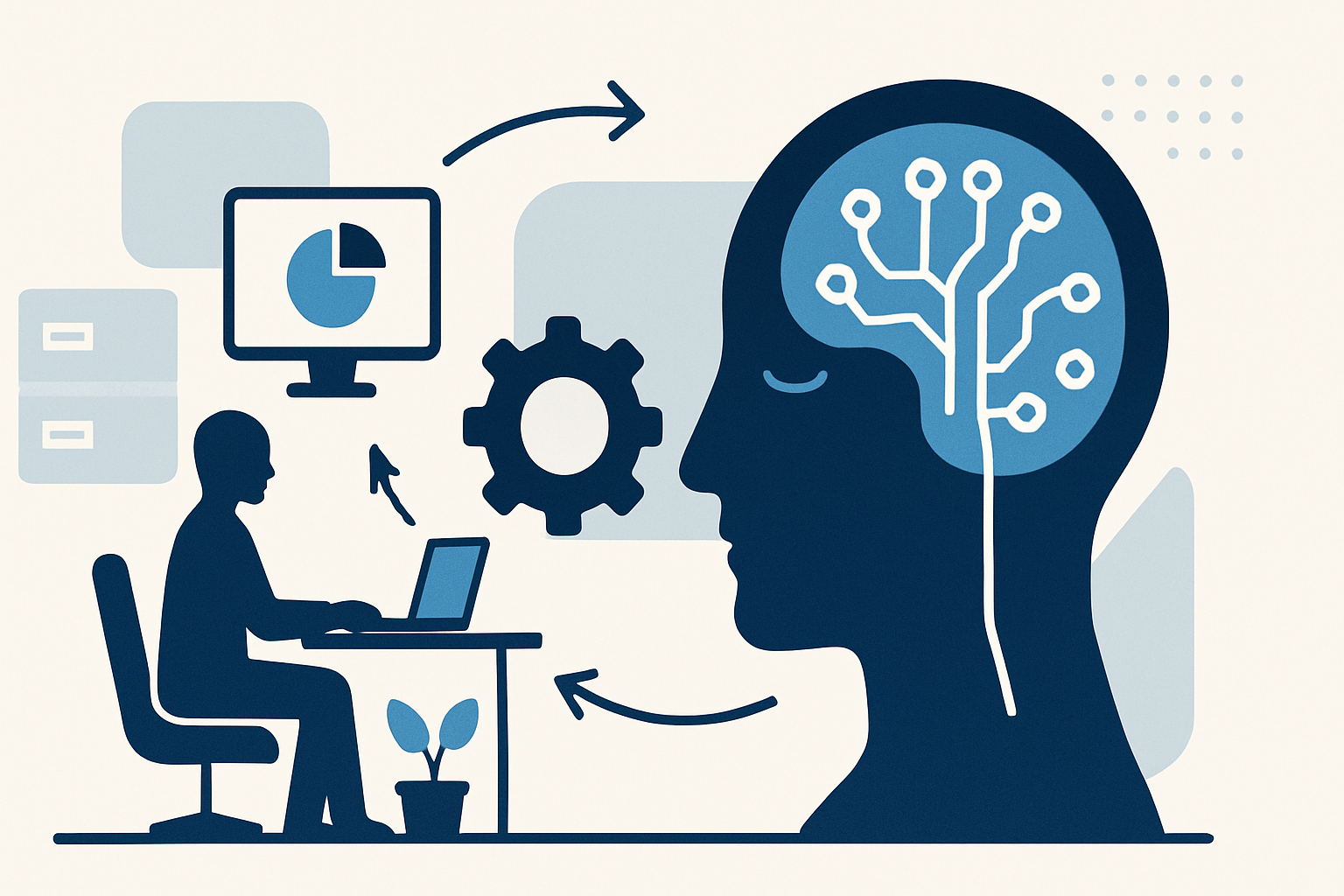
AI transforms back-office operations by automating routine tasks, improving accuracy, and generating analytics that speed processing and support better decisions. Applied across administrative and financial workflows, AI can reduce manual work, shorten cycle times, and improve customer response.
Key takeaways
- Machine learning, natural language processing, and robotic process automation can handle repetitive tasks, analyze data, and produce insights that inform strategic decisions.
- AI can automate data entry and processing to reduce human error and free employees for more strategic work.
- For administrative tasks, AI can prioritize and draft emails and use optical character recognition to convert scanned documents into editable text.
- In finance, AI can automate invoicing and payroll and provide real-time financial reporting and forecasts.
- The article cites real-world results: a financial services firm automated audits to reduce time and cost, and a logistics company cut stockouts by 30%.
In today's fast-paced business environment, companies are constantly seeking ways to improve efficiency and reduce costs. One area ripe for transformation is the back-office. The rise of artificial intelligence (AI) offers a revolutionary way to revamp these operations. By leveraging AI, businesses can streamline processes, improve accuracy, and enhance decision-making capabilities. In this article, you'll discover how AI can transform your back-office operations, making them more efficient and cost-effective than ever before. For a deeper dive into AI's potential, visit this article.
1. Understanding How AI Can Transform Your Back-Office
AI technologies such as machine learning, natural language processing (NLP), and robotic process automation (RPA) play a critical role in transforming back-office functions. These technologies can handle repetitive tasks, analyze data, and even provide insights that drive strategic decisions.
- Practical point 1: Automate data entry and processing, reducing human error and freeing up employees for more strategic tasks.
- Practical point 2: Use AI-powered chatbots to handle customer inquiries and support, thus improving response times and customer satisfaction.
- Practical point 3: Implement AI-driven analytics to uncover business insights and predict future trends.
2. The Role of AI in Streamlining Administrative Tasks
AI can significantly streamline administrative tasks that are typically time-consuming. From scheduling and email management to document processing, AI solutions can enhance productivity and efficiency. Learn more about AI's impact on business efficiency in this blog post.
- Email Management: AI can prioritize emails, sort them by importance, and even draft responses.
- Document Processing: Optical character recognition (OCR) technologies can convert scanned documents into editable text, saving time on manual data entry.
3. Enhancing Financial Operations with AI
In the realm of finance, AI can transform your back-office by automating processes such as invoicing, payroll, and financial reporting. This not only speeds up operations but also increases accuracy and compliance. Explore more insights in this interview.
- Invoicing: AI can automatically generate and send invoices, track payments, and flag overdue accounts.
- Payroll: Automating payroll calculations ensures timely and accurate salary disbursements.
- Financial Reporting: AI-powered analytics can provide real-time financial insights and forecasts.
4. Case Studies: Real-World Applications of AI in Back-Office Operations
Many companies have successfully implemented AI to transform their back-office operations. Here's how:
- Example 1: A leading financial services firm used AI to automate its audit processes, reducing the time and cost involved significantly.
- Example 2: A global logistics company employed AI for inventory management, resulting in a 30% reduction in stockouts.
For more real-world applications, check out this blog post.
5. Best Practices for Implementing AI in Your Back-Office
Successfully integrating AI into back-office operations requires careful planning and strategy. Here are some best practices:
- Best Practice 1: Start small with pilot programs to test AI solutions before full-scale implementation.
- Best Practice 2: Ensure data quality and integrity for accurate AI analytics and predictions.
- Best Practice 3: Continuously monitor AI systems and refine algorithms to improve performance.
Visit ContentPod for additional resources on AI implementation.
6. Overcoming Challenges in AI Adoption for Back-Office Transformation
While AI offers numerous benefits, its adoption can pose challenges such as resistance to change and data privacy concerns. To overcome these, companies should provide training to employees and implement robust data governance frameworks. For more information, refer to the OpenAI website.
- Challenge 1: Employee resistance to AI adoption can be mitigated through education and demonstrating AI's value.
- Challenge 2: Ensuring data privacy and compliance with regulations is crucial for gaining trust.
Conclusion: Making the Most of AI to Transform Your Back-Office
AI presents a tremendous opportunity to revolutionize back-office operations by enhancing efficiency, accuracy, and decision-making capabilities. By understanding and overcoming the challenges of AI adoption, businesses can fully leverage its potential. To further explore how AI can transform your back-office, consider partnering with ContentPod for expert guidance and solutions.
Frequently Asked Questions
What is AI's role in transforming back-office operations?
AI can transform your back-office by automating routine tasks, improving data accuracy, and providing actionable insights through advanced analytics.
How can companies start integrating AI into their back-office processes?
Begin with small pilot projects to evaluate AI's effectiveness, ensure data quality, and involve employees in the transition to foster acceptance.
What are the common challenges faced when adopting AI in back-office operations?
Challenges include employee resistance, data privacy concerns, and the need for continuous system monitoring and algorithm refinement.
References & Further Reading
Put this into practice
Share this post
You Might Also Like
Discover more content tailored to your interests
 Highly Relevant
How AI Technical Debt Problems Spread Through Codebases
AI technical debt problems are the maintenance, reliability, security, and architecture costs that build up when AI systems generate code faster than teams can review, test, document, and own it.
Read More Highly Relevant
Why Anthropic Model Rivals Fable on Enterprise Cost
Anthropic's model is being pitched as close enough in quality to a premium frontier model that cost-conscious enterprises may switch or diversify. The real test for buyers is whether the model delivers acceptable output on their highest-volume tasks while lowering total operating cost and governance overhead.
Read More Highly Relevant
AI Risks to Global Security at the U.N. Briefing 2026
AI risks to global security are the ways advanced AI systems can increase cyberattacks, accelerate disinformation, lower barriers to biological or weapons misuse, and outpace the laws meant to control them. In the AI briefing to the U.N.
Read MoreReady to create amazing podcast content?
Choose a plan and start generating professional podcast content with AI
View Pricing Plans