How Artificial Intelligence Reveals Subtle Toddler Cues
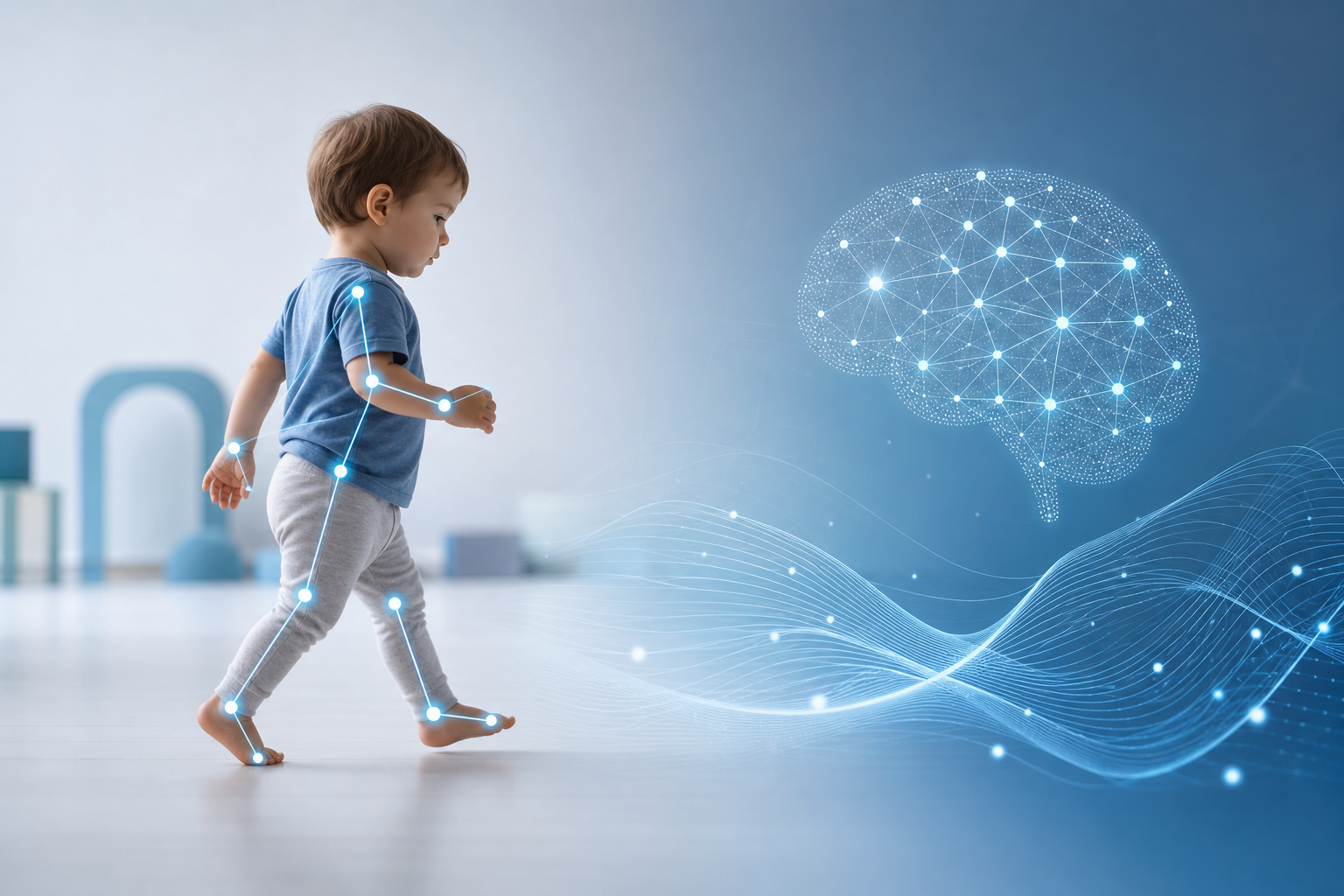
AI detects tiny, frame-by-frame differences in toddler movement—posture, gait, timing, and body coordination—by turning video or sensor data into measurable motion features. Those measurable signals can help flag patterns for clinician review and enrich early screening, but they do not replace a professional diagnosis.
Key takeaways
- Motor behavior is often under-discussed yet can add useful developmental signals when considered alongside language, social interaction, and play.
- Common motion features measured include position, velocity, rhythm, symmetry, transitions between actions, and consistency across repeated movements.
- A typical analysis pipeline captures short recordings, extracts features (for example joint angles, sway, acceleration, pauses, or repetition rates), uses models to compare or classify patterns, and presents outputs for clinician interpretation.
- When researchers say AI reveals subtle differences, they usually mean software quantifies micro-patterns at scale rather than providing an independent clinical understanding or verdict.
- Safe and useful implementation depends on data quality, informed consent, bias testing, and clear communication; confusing classification with diagnosis misleads caregivers and clinicians.
That matters because many families first notice communication or sensory differences, while movement patterns can remain under-discussed even though they may carry useful developmental signals. When autism signs and symptoms are reviewed in practice, motor behavior is often considered alongside language, social interaction, and play. This article explains what researchers mean when they say artificial intelligence reveals subtle differences, what kinds of motion data may be involved, why clinicians care, where the limits are, and what practical takeaways parents, healthcare teams, and health-tech builders should keep in mind.
1. Why artificial intelligence reveals subtle motor signals
Artificial intelligence reveals subtle motor signals because computers can measure frame-by-frame body movement, compare those measurements across many observations, and identify patterns that are too faint or inconsistent for a quick human glance. In a toddler assessment, that can include how a child shifts weight before walking, how long a pause lasts between motions, whether one side of the body leads more often, or how repetitive a reaching movement appears. A clinician may notice a broad impression, but a model can turn that impression into measurable features.
The phrase matters because it changes the conversation from a vague claim about AI “spotting autism” to a more precise claim about movement analysis. The best interpretation is not that software suddenly understands a child better than a pediatric specialist. The more accurate interpretation is that software can quantify micro-patterns in motion and potentially surface useful signals for expert review. If you work in content, healthcare communication, or product strategy, that distinction is the difference between responsible reporting and hype.
This is also why the topic fits broader discussions happening across ContentPod and similar publishing platforms: AI tools tend to perform best when they assist trained people rather than replace them. In a clinic, that means flagging patterns for developmental specialists. In editorial work, it means clarifying what a model actually did instead of overstating certainty.
- What is being measured: Position, velocity, rhythm, symmetry, transitions between actions, and consistency across repeated movements.
- Why it matters: Motor differences can provide an additional developmental signal, especially when combined with behavioral observation and caregiver input.
- What it does not mean: A detected pattern is not proof of autism, severity, or future outcomes for any individual child.
2. What the underlying analysis probably looks like in practice
Most systems in this area work by converting video or sensor recordings into structured motion data, then using machine-learning models to compare that data across groups or against known developmental patterns. In plain language, a camera or wearable captures movement, software estimates body points or trajectories, and a model evaluates whether the timing and coordination differ in meaningful ways. When people say artificial intelligence reveals subtle differences, they are usually referring to this pipeline rather than some mysterious black box.
A practical workflow often looks like this:
- Capture: Record short play, walking, reaching, or interaction tasks in a controlled or semi-natural setting.
- Extract features: Turn raw footage into measurable motion markers such as joint angles, sway, acceleration, pauses, or repetition rates.
- Train or compare: Use a model to distinguish clusters, classify patterns, or identify deviations that may warrant human review.
- Interpret: Present outputs in a way clinicians can understand, question, and combine with other evidence.
If you cover AI stories, this is where better reporting matters. Content that confuses classification with diagnosis misleads readers. A stronger framing is similar to how financial institutions explain assistance layers in pieces like Explained: bank america adds generative to EricaAssist: describe the workflow, show where humans remain in control, and explain the tradeoffs. The same caution applies when public reaction outruns the facts, as seen in Explained: a24 defends 75m google after backlash. For this health topic, accuracy matters even more because families may make emotionally charged decisions from headlines.
According to the CDC, developmental monitoring works best when concerns are noticed early and discussed with professionals, which is why movement analysis can be useful as one component of a broader evaluation rather than an isolated score.
3. Where artificial intelligence reveals subtle differences that clinicians may care about
Artificial intelligence reveals subtle differences that clinicians may care about when the detected motion patterns add context to real developmental questions such as coordination, planning, sensory regulation, imitation, or repetitive movement. A toddler may not simply “move differently” in a generic sense. The relevant issue is whether the difference appears in a repeated, measurable way and whether it aligns with concerns already present in communication, play, or social behavior.
For example, clinicians may be interested in whether a child shows unusual variability in gait, less fluid transitions between standing and walking, atypical arm coordination during play, or repeated motor loops under similar task conditions. Those observations can matter because motor development is intertwined with exploration, imitation, and engagement with the environment. A child who struggles to organize movement may also interact with toys, people, and routines in ways that look different from peers.
That still does not justify overclaiming. Development in toddlers is uneven by nature. One child may be late to a motor milestone and catch up quickly. Another may have a non-autism motor condition. A third may show movement patterns influenced by fatigue, anxiety, unfamiliar settings, or sensory overload. The useful reading is that artificial intelligence reveals subtle motion differences that can sharpen observation, not that it produces certainty.
If you want a broader strategic lens on how AI should support expert work instead of substituting for it, the interview The Future of AI in Business: From Hype to Reality offers a helpful parallel. In both business and healthcare, the winning systems are usually the ones designed for decision support, transparent handoffs, and realistic limits.
- Clinically useful signal: A movement feature becomes more valuable when it is repeatable, explainable, and relevant to a developmental question.
- Context matters: The same motion pattern can mean different things depending on age, setting, task, and co-occurring conditions.
- Interpretation risk: A strong model output can still be misleading if the recorded video is poor or the comparison group is narrow.
4. When artificial intelligence reveals subtle patterns, families need clear explanations
When artificial intelligence reveals subtle patterns, families need plain-language explanations about what was measured, what was inferred, and what should happen next. This is where many promising tools fail. A report that says a toddler’s movement differs from a model expectation is not automatically useful unless a caregiver understands the implications. Does the finding suggest more screening? A referral? Continued observation? A change in therapy planning? Without that bridge, a technically impressive system can create confusion instead of clarity.
A good communication model has three layers: first, describe the observation; second, define the confidence and limits; third, translate the output into a next step. For example, you might say that the software found atypical timing and symmetry during several play-based movement tasks, that such findings are not diagnostic on their own, and that a developmental specialist should interpret them with language and social observations. That sequence respects both science and the family’s need for actionable guidance.
This is also a useful lesson for anyone publishing health or AI content. Strong AI communication depends on careful framing, which is why posts like AI-Assisted Content Repurposing B2B: Founder Guide are relevant even outside healthcare: the structure of explanation matters as much as the tool itself. Clear summaries, accurate caveats, and audience-specific examples make complex systems easier to trust.
- Example 1: A clinician uses movement analysis to support a referral for a fuller developmental evaluation, not to deliver a diagnosis from software alone.
- Example 2: A research team compares play-session videos across groups to study coordination differences while reporting that individual variation remains wide.
When you read news coverage, look for wording that separates screening support from diagnostic determination. That difference is the core of responsible interpretation.
5. How to evaluate claims before you trust the takeaways
You should evaluate claims about toddler movement AI by checking the data source, comparison group, explainability, and clinical workflow before accepting any headline-level takeaways. The phrase artificial intelligence reveals subtle can sound impressive, but it only becomes meaningful when you know how the result was produced. Was the model trained on enough diverse examples? Were the children recorded in natural play or highly controlled tasks? Did researchers test across age bands, camera setups, and developmental profiles? Did experts review false positives and false negatives?
The most reliable way to read the evidence is to ask structured questions rather than chase novelty. If you publish on AI and health, that discipline protects both readers and credibility. Tools can be advanced and still be narrow. They can surface a real signal and still be unusable in frontline care. They can look accurate in one lab and weaken in broader settings.
If your team creates explanatory content around complex AI topics, ContentPod is useful as a publishing hub because it supports repeatable editorial structure: answer-first summaries, clear subheads, and source-driven writing. Those habits matter when a sensitive subject like autism is involved.
- Check the input: Ask whether the system uses video, depth sensors, wearables, or motion capture, because each method has different strengths and biases.
- Check the output: Look for plain-language results such as “atypical timing variability” rather than opaque confidence numbers with no interpretation guide.
- Check the decision path: The best implementations show what clinicians should do next instead of treating the model score as the endpoint.
6. The biggest challenge: artificial intelligence reveals subtle signals, but subtle is not simple
Artificial intelligence reveals subtle signals, but subtle is not simple because the smaller the pattern, the easier it is to misread, overfit, or oversell. The central challenge is not whether a model can find motion differences in a dataset. The real challenge is whether those differences remain meaningful across real toddlers, real families, real settings, and real clinical decisions. A finding can be technically valid and still lack practical value if it does not change care in a safe, explainable way.
Bias is one major issue. If a model has limited representation across races, body types, disability profiles, or recording environments, it may perform unevenly. Consent and privacy are another issue because movement data from toddlers is deeply sensitive, especially when video is involved. Then there is the communication challenge: anxious families may hear “AI found something” as far more definitive than researchers intend. That gap between output and interpretation is where harm can happen.
There is also a product-design challenge. A useful system has to fit clinical time, documentation, and reimbursement realities. If it requires specialized setup, lengthy calibration, or expert technical staff, adoption may stall even if the science is promising. The strongest path forward is modest, evidence-based integration: use AI to support observation, standardize measurement, and guide referrals where appropriate.
For additional context on autism as a developmental condition, readers often benefit from reviewing clinical overviews from public health organizations and comparing them against the language used in tech reporting. That habit helps you separate grounded interpretation from exaggerated claims.
Conclusion: Making the Most of artificial intelligence reveals subtle
The practical value of this story is not that software can magically detect autism from a glance. The real value is that artificial intelligence reveals subtle movement differences that may help experts notice patterns earlier, ask better questions, and build a fuller developmental picture. If you are a parent, that means treating AI findings as one source of information and discussing them with qualified clinicians. If you are a writer, marketer, or operator covering the topic, it means resisting hype and explaining the workflow, limits, and next action with care.
The best next step is simple: read the original reporting, compare it with clinical reference sources, and write or decide from evidence rather than excitement. If you publish complex AI explainers regularly, ContentPod can help you organize source-based articles that stay useful after the headline cycle fades. Bottom line: artificial intelligence reveals subtle movement patterns most usefully when it supports early, careful human assessment rather than pretending to replace it.
Frequently Asked Questions
What is artificial intelligence reveals subtle?
Artificial intelligence reveals subtle is a shorthand way of saying that AI systems can detect very small patterns in toddler movement that may be hard for humans to notice consistently during observation alone. In this topic, the phrase refers to motion analysis that may support autism screening or assessment, not a stand-alone medical diagnosis.
Can AI diagnose autism in toddlers from movement alone?
No responsible interpretation should say that AI can diagnose autism in toddlers from movement alone. Movement analysis can contribute useful evidence, but autism assessment requires broader clinical evaluation that includes developmental history, behavior, communication, play, and professional judgment.
What should you do if a report says a toddler shows unusual movement patterns?
You should bring the report to a pediatrician, developmental specialist, or other qualified clinician and ask how the finding fits with the child’s full developmental profile. A useful follow-up includes reviewing how the data was collected, what the software actually measured, and whether the result supports more screening, monitoring, or referral.
References & Further Reading
- Google News source article on AI and movement differences in autistic toddlers
- National Institute of Mental Health: Autism Spectrum Disorder
- World Health Organization: Autism spectrum disorders
- CDC: Signs and Symptoms of Autism Spectrum Disorder
Put this into practice
Share this post
You Might Also Like
Discover more content tailored to your interests
 Highly Relevant
Newsletter Growth Marketing Teams: Practical Playbook
A newsletter growth marketing team is a repeatable operating model that combines audience targeting, signup conversion, editorial planning, and performance review into one shared workflow to attract qualified subscribers, retain attention, and produce measurable business results. For the model to work, teams must define a clear audience and a primary growth outcome before deploying tactics.
Read More Highly Relevant
Content Calendar Planning for B2B: Mistakes to Avoid
Align your calendar to recurring buyer questions and buying-stage needs so each asset helps prospects compare options, reduce implementation risk, or move closer to purchase. Pick a sustainable cadence of fewer, stronger pieces and make the calendar a repeatable operating system rather than a collection of urgent one-offs.
Read More Highly Relevant
Newsletter Growth SaaS Companies Complete Guide 2026
Newsletter growth for SaaS means growing qualified email subscribers who support activation, retention, pipeline, and revenue rather than chasing list size alone. The most effective approach pairs a clear subscriber promise with targeted signup paths, useful content and segmentation, and measurement that links to business outcomes.
Read MoreReady to create amazing podcast content?
Choose a plan and start generating professional podcast content with AI
View Pricing Plans