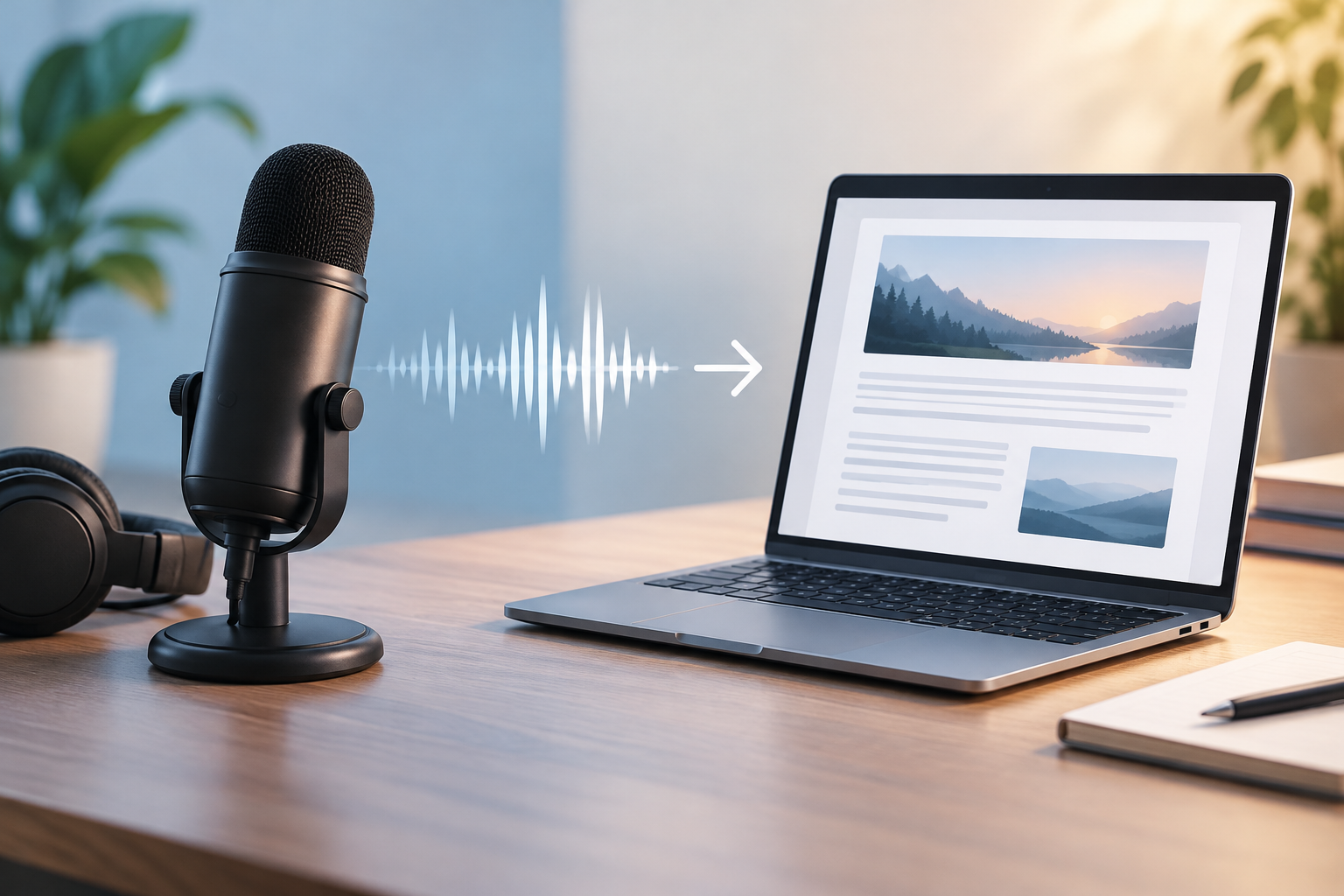
A podcast to blog post process means turning a recorded episode into a structured article by transcribing the audio, choosing one clear angle, organizing the strongest points, and editing the draft for search intent and readability. The best podcast repurposing posts do not copy the transcript word for word. They reshape spoken ideas into a written piece that is easier to scan, quote, rank, and share.
Key takeaways
- A transcript is raw material, not the finished article: Spoken conversation usually needs trimming and restructuring, with added context, before it works as a blog post.
- One episode can produce more than one article angle: A single interview may become a summary post, a tactical how-to, or a Q&A, depending on the search intent you target.
- Search intent should shape the draft before you write: Choosing the reader question first makes it easier to cut filler and keep only useful sections from the episode.
- Good repurposing keeps the speaker's ideas while changing the format: The goal is to preserve meaning, not to preserve every sentence exactly as spoken.
Most podcast episodes contain more useful material than listeners will remember after one play. A blog post fixes that problem by making the episode searchable, skimmable, and easier to reuse in newsletters, social posts, and sales follow-up. If you are learning how to turn a podcast to blog post, the main shift is simple: spoken content is linear, while blog content must help readers find the exact point they need in seconds. This guide walks through the full workflow, including how to clean a transcript, choose a format, write a reader-friendly draft, and avoid the mistakes that make repurposed content feel like a lazy transcript dump. If you work with AI podcast and interview content, this process also gives you a repeatable editorial system.
What you need before you start
You need a usable recording and transcript, plus one clear audience question before you begin writing. Beginners often assume the hard part is the writing, but the real friction starts earlier. If your audio is messy, your transcript is unreliable, or your episode wanders across six topics, the blog draft will drag.
Start with these basics:
- The full audio file: Work from the final published or near-final version so your transcript matches what listeners hear.
- A transcript you can edit: Any transcript format works as long as you can copy, highlight, and delete sections easily. According to Riverside's guide to podcast transcription, transcripts help with accessibility, search visibility, and reuse across other formats.
- A primary reader question: Examples include "How do I price my service?" or "What should a first-time founder know before fundraising?" A blog post built around a question is easier to structure than a generic episode recap.
- A destination for the finished post: If you are building a repeatable repurposing workflow, keep the final article aligned with your broader podcast content plan instead of treating each episode as a one-off asset.
If your show is interview-driven, the raw recording may already contain enough material for several supporting assets. Content teams that rely on recurring interviews often run a more efficient pipeline because each conversation can feed articles and executive summaries, along with social content. If that is your setup, these guides on interview-based content marketing teams and interview-based content marketing creators add useful editorial structure around the process.
Step 1: transcribe and clean the audio for a podcast to blog post
The first step in any podcast to blog post workflow is turning the audio into clean text you can shape. A raw transcript usually contains filler words, repeated phrases, false starts, and side tangents that make sense in conversation but slow down a reader.
- Generate or export the transcript. Use your recording or transcription tool to get text with speaker labels if the episode is an interview.
- Read the transcript once without editing. Mark sections where the guest makes a strong point, tells a useful story, or explains a process clearly.
- Remove spoken clutter. Cut repeated words, long detours, throat-clearing openings, and comments that only make sense in audio, such as "as I said a minute ago."
- Fix names, product terms, and industry language. Transcript software often mishears branded words and technical phrases.
- Pull timestamps for strong moments. Timestamps make it easier to fact-check and quote accurately later.
Do not aim for literary polish at this stage. You are creating a usable source document. Keep the speaker's meaning intact, but remove anything that will distract a reader. If the episode includes claims that need support, add a note to verify them before publication rather than guessing.
This is also the point where you decide whether the episode deserves a full article. Some recordings are better suited to a short recap, while others contain enough substance for a long-form guide. A focused 20-minute interview can produce a stronger article than a broad 60-minute panel discussion because the core argument is easier to identify.
Step 2: choose the right article angle before you draft
The right article angle decides whether your post reads like a useful resource or a transcript with headings. One episode can support several formats, but only one should shape the draft you are writing now.
Pick the angle by asking what a reader would search for if they needed the information from this episode. If your guest explains why onboarding fails, a good target may be "customer onboarding mistakes" instead of "Episode 47 recap." Search-driven posts win when the headline matches a real task or question.
| Episode type | Best blog angle | When to use it |
|---|---|---|
| Interview with clear advice | How-to article | Use when the guest explains a repeatable process readers can follow. |
| Wide-ranging conversation | Theme-based summary | Use when the episode covers one broad topic but not a step-by-step method. |
| Strong back-and-forth exchange | Edited Q&A | Use when the wording of the answers matters and the speaker's voice is a major draw. |
| Opinion or trend episode | Argument or analysis post | Use when the value is the interpretation, not the chronology of the conversation. |
A beginner mistake is trying to preserve every topic from the episode. Written content works better when it cuts hard. If the recording jumps from hiring to pricing to burnout, choose one topic and save the rest for separate articles. That is how you get real podcast blog examples instead of a vague summary no one searches for.
For instance, the interview Raising Your First Round: What VCs Actually Look For could turn into several different articles. One post could focus on fundraising mistakes, another on what founders should prepare before investor meetings, and another on how to talk about traction without overclaiming. The source conversation stays the same, but the article angle changes what gets included.
Step 3: build a podcast to blog post outline from the strongest ideas
A good podcast to blog post outline comes from extracting the few ideas worth reading, then arranging them in a logical order for someone who never heard the episode. Outlining is where you stop thinking like a listener and start thinking like an editor.
- Highlight the three to five strongest ideas. Ignore minor side comments. Keep the points that answer the reader's question directly.
- Group similar material together. If the speaker mentions planning mistakes in three different parts of the episode, merge those comments into one section.
- Write heading drafts as promises. A heading such as "Why onboarding plans fail when ownership is unclear" is stronger than "Onboarding challenges."
- Add missing context. Spoken conversation often skips definitions or assumes shared knowledge. Written articles need short setup lines so a new reader can follow.
- Decide where quotes help. Use direct quotes when phrasing carries authority or personality. Paraphrase when clarity matters more than exact wording.
Search engines and readers both prefer structure over chronology. According to Google's SEO Starter Guide, helpful pages should be created for people first, with clear organization that makes the topic easy to understand. For a repurposed article, that means your outline should follow logic, not the order in which people happened to speak.
A simple outline may look like this:
- Opening problem: State the question the episode answers.
- Core reason: Explain the main principle the guest repeats.
- Process or framework: Turn scattered advice into steps.
- Example: Show how the advice applies in a realistic situation.
- Action points: Tell the reader what to do next.
If you use ContentPod for interview-led workflows, this is also where its Interview tool can save time. The tool can turn one interview into a blog post, an X or Twitter thread, an email newsletter, a LinkedIn post, and an executive summary. That does not remove the need for judgment. You still need to choose the right angle and edit for audience fit. It does cut the time spent starting from a blank page.
Step 4: write the first draft for readers, not listeners
The first draft should read like an article written for search and comprehension, not like a cleaned-up transcript. Readers skim before they commit, so the structure has to deliver the answer early and keep the rest easy to scan.
- Start with the answer. In the first paragraph, state the main lesson from the episode in plain language.
- Use short paragraphs. Dense transcript blocks make readers leave. Break one long explanation into two or three paragraphs if needed.
- Add subheadings where the reader would pause. Each heading should answer a distinct question or make a clear claim.
- Convert spoken examples into written examples. If the guest says, "We had one client who..." rewrite it as a generalized scenario unless you have permission and details to use a named case.
- Keep selective quotes. One strong quote per section is often enough. More than that can make the article feel stitched together.
Writing for readers also means filling in small gaps that are obvious in conversation but unclear on the page. If a guest says "that failed because the handoff broke," your article should explain what handoff means in that context. A listener may infer it from tone and timing. A reader cannot.
One easy quality check is to read each section by itself. If a paragraph only makes sense because of what came before it, revise it until it stands on its own. That matters because search engines and AI systems often quote isolated sections rather than full articles.
Step 5: optimize the podcast to blog post for search without stuffing keywords
Search optimization for a podcast to blog post means making the page easy to understand, easy to navigate, and tightly matched to a real query. It does not mean repeating the same keyword in every paragraph.
Use the target phrase where it naturally helps:
- Title: Include the exact phrase if it fits cleanly.
- Intro: Define the process early so readers know they are in the right place.
- Headings: Use one or two headings with the target phrase, then rely on close variations elsewhere.
- Image alt text and internal links: Add context, not repetition.
- Meta description and URL slug: Keep them aligned with the article topic.
Search intent matters more than volume when you are repurposing a podcast. A post titled "Episode 62 with Sarah" may help existing listeners, but it gives little context to everyone else. A post titled "How to onboard B2B customers without losing momentum" has a clearer purpose.
According to Edison Research's The Infinite Dial 2024, podcast listening is mainstream behavior in the United States. That reach is useful, but audio remains harder to scan than text. A blog post extends the value of an episode by giving search engines and busy readers a format they can index, skim, quote, and revisit.
If your team creates repeated repurposing workflows, it also helps to build an editorial checklist. Confirm that the article answers a clear question, uses headings with actual meaning, links to related resources, and removes transcript filler before anyone publishes.
Step 6: worked example from raw episode to finished article
A worked example makes the process easier to copy, so here is a full beginner-friendly model from source audio to article outline. Assume you recorded a 35-minute interview with a consultant about why client onboarding breaks after the sales handoff.
Raw episode notes: The guest explains that onboarding problems usually start with unclear ownership, incomplete kickoff documents, and weak follow-up in the first two weeks. The episode also includes a side discussion about pricing, which is interesting but not central.
Article angle: "How to fix client onboarding after the sales handoff."
Transcript cleanup: You remove filler, repetitive examples, and the pricing tangent. You keep one short story about a client project delayed because no one owned the kickoff checklist.
Outline:
- Opening: Client onboarding often fails when the handoff from sales to delivery is informal.
- Section one: Explain why ownership confusion causes delays.
- Section two: Show what information must move from sales to delivery.
- Section three: Describe the first two-week follow-up system.
- Section four: Give a simple onboarding checklist.
Drafting choices: Instead of quoting the guest for every point, you paraphrase most of the advice into clear prose and keep one direct quote where the consultant explains that "handoff is a process, not a meeting." You add a bullet list for the checklist because readers will want to reuse it.
Search cleanup: You replace a generic heading like "Thoughts on onboarding" with "What the sales team must document before kickoff." You add internal links to related onboarding content. You end with a practical next step: review your current handoff form and compare it to the checklist in the article.
The result is a post a stranger can find through search, understand in five minutes, and act on immediately. The audio episode still matters, but the article has its own job and its own structure.
If you want more examples of turning conversation into written thought leadership, see interview-based content marketing saas. It shows how a single expert conversation can branch into multiple useful assets instead of one transcript-heavy post.
Common mistakes when turning podcast to blog post
Most weak repurposing happens because the writer treats the transcript as the article instead of treating it as source material. A strong podcast to blog post keeps the original ideas but changes the shape for readers.
- Publishing the transcript with light edits: Readers rarely want every greeting, aside, and tangent. Edit for usefulness.
- Keeping the episode's original order: Spoken conversation jumps around. Written content should group related points together.
- Trying to cover every topic from the episode: Narrow focus improves search fit and readability.
- Burying the main answer: Articles need the key point near the top, not 700 words in.
- Forgetting basic context: Define terms and add short transitions so a new reader can follow without hearing the audio.
- Overusing quotes: Direct quotes are useful in moderation. Too many make the post feel fragmented.
- Skipping editorial review: Check headings, claims, names, and formatting before publishing.
If your workflow produces a lot of interview-led material, the fix is often process, not more writing effort. Build a repeatable path from recording to transcript, transcript to outline, and outline to final article. That is the difference between occasional repurposing and a dependable content system.
Conclusion: Making the Most of podcast to blog post
Turning a podcast to blog post works best when you stop thinking about transcription as the finish line. The real job is editorial. You are identifying the best ideas in the episode, matching them to a reader question, and rewriting the material so it functions as a useful article on its own. That means choosing one angle, building a clear outline, trimming spoken filler, and optimizing the final piece for scanning and search.
If you want to speed up that workflow, ContentPod can help when your content starts with interviews. Its AI Interview format records voice-only conversations with adaptive follow-up questions, and its Interview tool can turn one interview into a blog post plus other written formats. Whether you use software or a manual process, the same rule applies: keep the ideas, change the format, and write for the reader's task.
Bottom line: a good podcast to blog post is a rewritten, structured article built from audio, not a transcript pasted into your CMS.
Frequently Asked Questions
What is podcast to blog post?
Podcast to blog post is the process of converting a podcast episode into a written article by transcribing the audio, selecting the main ideas, organizing them for reading, and editing them for clarity and search intent. A podcast to blog post workflow keeps the speaker's insight but changes the format so readers can scan, search, and share the information more easily.
How long should a podcast episode be to make a good blog post?
A good blog post can come from a short or long episode, as long as the recording contains one clear idea with enough detail to explain it well. A focused 15 to 25 minute discussion often turns into a cleaner article than a longer episode that jumps across many topics, because the written version needs a tight angle more than a long runtime.
Should I publish the full transcript or rewrite it?
You should usually rewrite the transcript because spoken language and written language work differently. A full transcript may help accessibility and indexing, but a reader-friendly article needs a stronger opening, cleaner structure, clearer headings, and less repetition than most transcripts contain.
References & Further Reading
- Buzzsprout: Podcast SEO
- Riverside: Podcast Transcription
- Edison Research: The Infinite Dial 2024
- Google Search Central: SEO Starter Guide
Put this into practice
Share this post
You Might Also Like
Discover more content tailored to your interests
 Highly Relevant
A Playbook for Interview-Based Content Marketing Teams
Record focused conversations with people who have direct experience, transcribe them, and turn the transcript into publishable assets. A simple, repeatable process for sourcing, questioning, recording, and repurposing interviews is the fastest way for teams to get specific, usable content without asking experts to write full drafts.
Read More Highly Relevant
Interview-Based Content Marketing SaaS Templates Guide
Use short, structured interviews with experts, customers, founders, or partners to capture real expertise and turn a 20–30 minute conversation into multiple publishable assets that are faster to produce, more credible, and more useful for search and buyers than generic brand copy. This guide explains when to use interviews, who to interview, how to prepare a focused brief and recording workflow, and how to turn one conversation into blog posts, case studies, newsletters, social posts, and sales snippets.
Read More
Best AI Podcast Generator Like NotebookLM Picks
An ai podcast generator like notebooklm is a tool that turns source material or a script into spoken audio, often with AI voices, conversational structure, and editing support.
Read MoreReady to create amazing podcast content?
Choose a plan and start generating professional podcast content with AI
View Pricing Plans