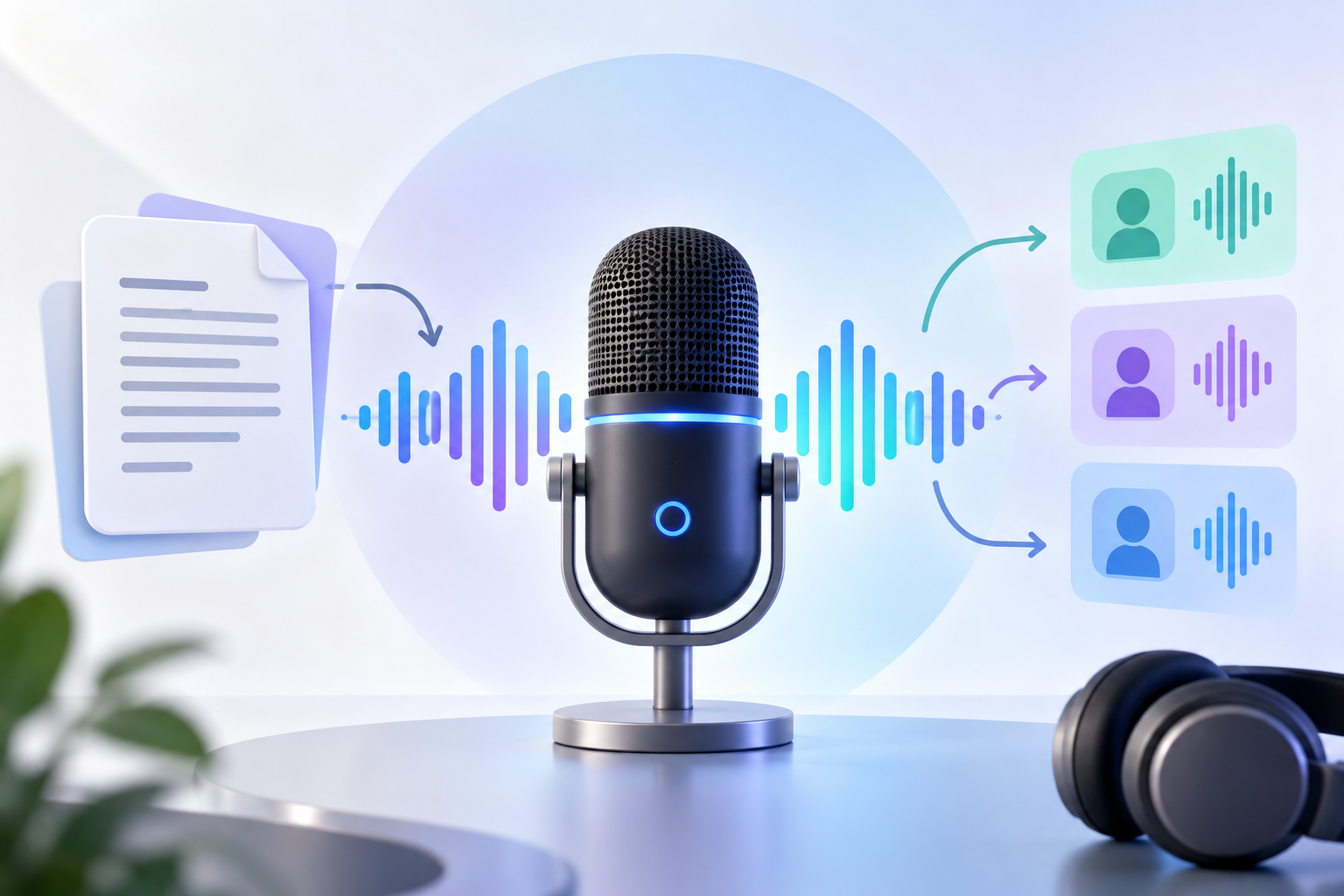
An ai podcast generator like notebooklm is a tool that turns source material or a script into spoken audio, often with AI voices, conversational structure, and editing support. The best choice depends on whether you need document-to-audio summaries, scripted text to podcast production, or a more controlled interview workflow than NotebookLM provides.
Key takeaways
- NotebookLM is best for fast source-based audio overviews: NotebookLM is strong when you want uploaded materials summarized into a conversational audio format with minimal setup.
- Most notebooklm alternatives split into two camps: Some tools are built for text to podcast production from scripts, while others are built for recording, editing, or AI-led interviews.
- The right alternative depends on your input format: If your starting point is a PDF or notes, document-aware tools matter more; if your starting point is a script or spoken interview, editing and repurposing matter more.
- Production control is the main reason people switch: Teams usually leave NotebookLM because they need greater production control and better downstream content outputs.
You can get a useful audio summary from NotebookLM quickly, but that does not always solve the whole job. A team may need clearer voice control, better post-production, a repeatable workflow for branded episodes, or a tool that can turn PDF into podcast style audio without sounding like a raw summary. This guide compares the strongest options for anyone looking for an ai podcast generator like notebooklm, including when to choose a scripted audio tool, when to use a recording platform, and when a conversational workflow makes more sense. If you are building a repeatable system, the broader AI podcast and interview content hub is a useful next stop after this comparison.
Why people look for an ai podcast generator like notebooklm
NotebookLM is useful because it can turn uploaded sources into conversational audio overviews, and people look elsewhere when they need more control than that workflow allows. NotebookLM is best understood as a source-grounded research and summarization tool with audio output. That makes it appealing for students, analysts, marketers, and founders who want to hear a summary of notes, documents, or PDFs. In practice, that same strength creates its main limits. You may want to rewrite the structure, swap in a different voice style, control pacing, add music, publish a polished episode, or edit the transcript line by line.
That is why notebooklm alternatives tend to fall into a few distinct categories. Some tools aim to turn PDF into podcast style audio from documents. Some are better if you already have a script and want a produced show. Others are closer to recording studios with AI editing layered on top. A smaller group focuses on AI-hosted conversations rather than document summaries.
If your team publishes interviews as well as summaries, it helps to look beyond document-to-audio tools. The workflows in interview-based content marketing teams and interview-based content marketing saas show why many content programs care as much about repurposing and consistency as they do about voice generation.
Wondercraft is the closest fit if you want an ai podcast generator like notebooklm from text
Wondercraft is one of the closest matches to an ai podcast generator like notebooklm when your goal is to turn written material into polished spoken audio with more production control. Wondercraft is generally positioned around AI audio creation rather than document research. That difference matters. NotebookLM starts with source understanding and then creates an audio overview. Wondercraft starts closer to the production side, where you shape a script, choose voices, and assemble a finished audio asset.
Wondercraft is best for marketers, internal comms teams, and creators who already know what they want the episode to say. If you have a blog post, webinar notes, or a written briefing, Wondercraft is better suited to building a branded piece of audio from that material. That makes it a stronger option when you want a controlled text to podcast workflow rather than a source-driven AI discussion.
- Best for: Scripted explainers, narrated episodes, branded educational audio, internal communications.
- How it differs from NotebookLM: It gives you more control over the produced output and less emphasis on research-grounded source synthesis.
- Main limitation: If you want the tool to reason over a pile of source documents and generate the structure for you, NotebookLM may feel more natural.
If your main need is production polish, Wondercraft usually makes more sense than a document-first tool. If your main need is hearing the gist of a report or reading pack, NotebookLM still has the simpler starting point.
Descript works better when editing matters more than generation
Descript is a stronger alternative when you need to edit spoken content precisely, because its value is script-based editing after recording or generation rather than document-to-dialogue generation. Descript is widely known for transcript-based editing of audio and video. That means you can treat spoken content more like text during post-production. For many teams, that is the real bottleneck. The hard part is not generating a first-pass episode. The hard part is tightening it, removing filler, and preparing a version you can publish.
Descript is best for podcasters, agencies, and in-house teams that already record conversations or create voice content regularly. It also fits teams that want one workspace for transcripts, cleanup, and repurposing. If you record expert interviews and then need blog, social, and email outputs, the surrounding workflow matters as much as the audio itself. That is why some teams pair Descript-style editing with broader editorial systems such as interview-based content marketing creators workflows.
- Best for: Transcript editing, tightening recorded episodes, polishing interviews, mixed audio and video workflows.
- How it differs from NotebookLM: It is much stronger after the audio exists, and much less centered on uploaded source documents.
- Main limitation: If your priority is to turn PDF into podcast output automatically, Descript is not the most direct fit.
Choose Descript when you already have audio or know you will record it. Choose NotebookLM or a script-first generator when you need the first draft of the spoken content created for you.
ElevenLabs is the better choice when voice quality is the main requirement
ElevenLabs stands out when voice realism, multilingual narration, or fine-grained voice selection matters more than source summarization. ElevenLabs is known for AI voice generation. If you have a finished script and want it read clearly in a particular style, this category of tool is often a better fit than NotebookLM. The output can be useful for explainers, translated audio versions of written content, and narration-heavy series where consistency of voice matters.
This is where many people get tripped up when searching for an ai podcast generator like notebooklm. They think they need a NotebookLM replacement, but they really need a voice engine. If the structure is already decided and the copy is approved, source reasoning is less important than delivery quality.
- Best for: Scripted narration, multilingual audio, controlled voice selection, repeatable narration pipelines.
- How it differs from NotebookLM: It focuses on voice generation quality rather than creating a conversational audio overview from documents.
- Main limitation: You still need a script or structured prompt. It does not replace a research assistant on its own.
For a marketer converting articles into audio, ElevenLabs can be the cleanest route from approved copy to spoken output. For a researcher who wants AI to interpret a packet of source materials, NotebookLM is the better starting point.
Riverside fits teams that record real people and then add AI assistance
Riverside is a stronger alternative when your workflow starts with real interviews or co-hosted conversations, because it is centered on recording and production rather than AI-generated source summaries. Riverside is best known as a remote recording platform for podcasts and video interviews. That means it solves a different problem from NotebookLM. Instead of turning documents into audio, it helps you capture original audio and video with better production quality than a casual meeting app.
This matters if your content strategy depends on recurring hosts, subject-matter experts, or recorded customer conversations. A generated audio summary may be useful for background listening, but it cannot replace original reporting or firsthand perspective. If that is your content model, a recording-first platform is often the better investment.
- Best for: Remote podcast interviews, video podcast workflows, capturing original expert conversations.
- How it differs from NotebookLM: It starts with live recording, not uploaded documents.
- Main limitation: It is not the simplest answer if your goal is pure text to podcast generation from notes or PDFs.
If you want to hear the difference between source-based commentary and conversation-led content, listen to a published AI interview format such as AI and the Future of Content Marketing: A Dynamic Discussion. The editorial job is different. One format summarizes information. The other develops perspective through dialogue.
Adobe Podcast is useful when cleanup and studio sound matter more than document input
Adobe Podcast is a good alternative when your problem is audio quality and workflow cleanup, not source-to-episode generation. Adobe Podcast is commonly used to improve spoken audio and support recording and transcript-related production tasks. If your team records webinars, expert explainers, or internal briefings, audio cleanup can save more time than a generator that creates a draft episode from written materials.
This is a practical distinction. Many teams searching for notebooklm alternatives are not dissatisfied with AI. They are dissatisfied with rough output. A better microphone chain is nice, but a better cleanup workflow is often enough to publish more often. Adobe Podcast sits in that part of the stack.
- Best for: Cleaning speech audio, preparing spoken content for publication, improving rough recordings.
- How it differs from NotebookLM: It helps refine captured audio instead of synthesizing a source-grounded discussion from files.
- Main limitation: It does not solve the initial ideation or source summarization problem by itself.
If you already have experts talking into a microphone, Adobe Podcast addresses a more immediate need than a document-to-audio tool. If your starting point is a white paper and no speaker, NotebookLM or a script-based generator is more relevant.
When ContentPod fits better than an ai podcast generator like notebooklm
ContentPod fits better than an ai podcast generator like notebooklm when you want conversational content generated through an interview workflow instead of document summarization. This is the least direct replacement on the list, but it can be the best fit if your goal is not to summarize PDFs. ContentPod has AI Interview, which is a voice-based interview with an AI host that asks adaptive follow-up questions. Voice recording is the only input for AI Interview. There is no text input. ContentPod also has Two-Way Interview for studio-quality dual-voice AI conversations.
That distinction matters because many teams do not need an automated summary of source material. They need a way to draw out expertise from a founder, consultant, operator, or creator and then turn that spoken material into publishable assets. ContentPod also includes Interview content repurposing, which turns one interview into eight formats, including a long-form blog post, short blog post, LinkedIn post, Twitter/X thread, Instagram caption, email newsletter, 3-part email sequence, and YouTube description. If your end goal includes audio and written distribution, that workflow can be more useful than a strict text to podcast tool.
The relevant action step is to look at the podcast content solution and then compare it against your actual input. If your source is a spoken expert, ContentPod is a fit. If your source is a PDF research packet, it is not a document importer and should not be treated as one.
- Best for: AI-led interviews, dual-voice conversations, repurposing one spoken session into multiple marketing assets.
- How it differs from NotebookLM: It starts with voice input and interview structure rather than uploaded documents.
- Main limitation: It is not built to ingest a document library and automatically summarize it into a podcast-style audio overview.
If you are trying to turn expert knowledge into a content engine, the plan in interview-based content marketing saas shows how that workflow can support a month of output from one conversation.
A side by side view of the main notebooklm alternatives
The fastest way to compare notebooklm alternatives is to match each tool to your starting input and your publishing goal. The table below keeps the decision practical.
| Tool | Starting input | Best use case | Where it beats NotebookLM | Main limitation |
|---|---|---|---|---|
| NotebookLM | Documents, notes, source materials | Audio overviews grounded in uploaded sources | Fast source understanding and summary | Less production control for polished publishing |
| Wondercraft | Script, article, written brief | Produced AI audio from text | More control over structured audio creation | Less centered on research over uploaded sources |
| Descript | Recorded audio or video | Editing and post-production | Transcript-based editing and workflow control | Not the most direct document-to-podcast path |
| ElevenLabs | Approved script | High-quality AI narration | Voice realism and voice choice | Needs structured copy first |
| Riverside | Live participants | Remote interviews and recording | Captures original conversations well | Not designed around turning PDFs into episodes |
| Adobe Podcast | Existing spoken audio | Speech cleanup and production prep | Improves recording quality quickly | Does not create source-based scripts on its own |
| ContentPod | Voice input from a person | AI interviews and multi-format repurposing | Interview-led content creation and reuse | Not a PDF ingestion tool |
How to choose the right ai podcast generator like notebooklm for your workflow
The right ai podcast generator like notebooklm is the one that matches your source material, your editing tolerance, and your publishing workflow. People often evaluate tools by the demo output alone. That is the wrong place to start. Start with your input and your constraints.
- Identify your true starting point. If you begin with PDFs, reports, and notes, stay close to document-aware tools. If you begin with a written script, choose a script-first audio generator. If you begin with a person talking, choose an interview or recording workflow.
- Decide how much editing you can absorb. A quick AI draft is only useful if your team can clean it up. If no one wants to edit heavily, look for stronger first-pass structure or cleaner narration.
- Separate listening use from publishing use. Some audio is meant for private consumption, like hearing a briefing on a walk. Some audio is meant for public release, where intros, pacing, music, and consistency matter.
- Map outputs beyond the episode. If one conversation also needs to become a blog, email, or social posts, the repurposing workflow matters. That is where interview-led systems can outperform a pure generator.
- Run one test with the same source material. Use the same article, same talking points, or same expert topic across two or three tools. Compare setup time, edit time, and whether you would publish the result.
A simple example helps. If you are a consultant who wants to turn PDF into podcast explainers for clients, NotebookLM or a text-first generator is the short path. If you are a founder who wants weekly thought leadership from your own ideas, an AI interview flow may produce more original content with less scripting. If you are a podcast producer handling guest recordings, Descript, Riverside, or Adobe Podcast may solve more of the real work than a summary generator.
Conclusion: Making the Most of ai podcast generator like notebooklm
The best ai podcast generator like notebooklm depends on whether you need source-grounded summaries, polished scripted narration, recorded interview production, or AI-led conversation capture. NotebookLM is strong for fast audio overviews from uploaded materials. Wondercraft, Descript, ElevenLabs, Riverside, Adobe Podcast, and ContentPod each make more sense when you need a different starting input or a different level of production control.
If you are comparing tools for a team, test them against one real use case instead of a generic demo. Use a PDF packet if your work is research-heavy. Use a founder interview if your content depends on original thinking. If your goal is to create reusable spoken content and spin it into blog, email, and social assets, ContentPod is worth evaluating alongside stricter notebooklm alternatives.
Bottom line: the right ai podcast generator like notebooklm is the one that matches your actual input, whether that input is documents, scripts, or a real person speaking.
Frequently Asked Questions
What is ai podcast generator like notebooklm?
An ai podcast generator like notebooklm is software that turns source material, written scripts, or spoken input into podcast-style audio. Some tools focus on summarizing documents into conversational audio, while others focus on scripted narration, interview generation, or editing recorded conversations for publication.
Can I turn PDF into podcast audio with these tools?
You can turn PDF into podcast style audio with tools that accept documents or let you convert extracted text into a script for narration. NotebookLM is one of the clearest options for source-based audio overviews, while script-first tools are better if you want tighter editorial control over the final spoken episode.
Which notebooklm alternative is best for marketing teams?
The best NotebookLM alternative for a marketing team depends on the workflow. A script-first generator is best for narrated brand content, a recording platform is best for guest interviews, and an interview-led system such as ContentPod is best when one conversation needs to become multiple assets across blog, email, and social channels.
References & Further Reading
Put this into practice
Share this post
You Might Also Like
Discover more content tailored to your interests
 Highly Relevant
A Playbook for Interview-Based Content Marketing Teams
Record focused conversations with people who have direct experience, transcribe them, and turn the transcript into publishable assets. A simple, repeatable process for sourcing, questioning, recording, and repurposing interviews is the fastest way for teams to get specific, usable content without asking experts to write full drafts.
Read More Highly Relevant
Interview-Based Content Marketing SaaS Templates Guide
Use short, structured interviews with experts, customers, founders, or partners to capture real expertise and turn a 20–30 minute conversation into multiple publishable assets that are faster to produce, more credible, and more useful for search and buyers than generic brand copy. This guide explains when to use interviews, who to interview, how to prepare a focused brief and recording workflow, and how to turn one conversation into blog posts, case studies, newsletters, social posts, and sales snippets.
Read More Highly Relevant
Interview-Based Content Marketing Consultants Guide
Interview-based content marketing consultants record focused conversations with founders, experts, clients, or internal leaders and turn the resulting examples, objections, and phrases into articles, newsletters, case studies, social posts, and sales assets. That method reduces blank-page friction, preserves the expert's voice, and yields more specific, credible content than writing from scratch.
Read MoreReady to create amazing podcast content?
Choose a plan and start generating professional podcast content with AI
View Pricing Plans