Why Humanoid Robots Steal Show at Shanghai AI Event
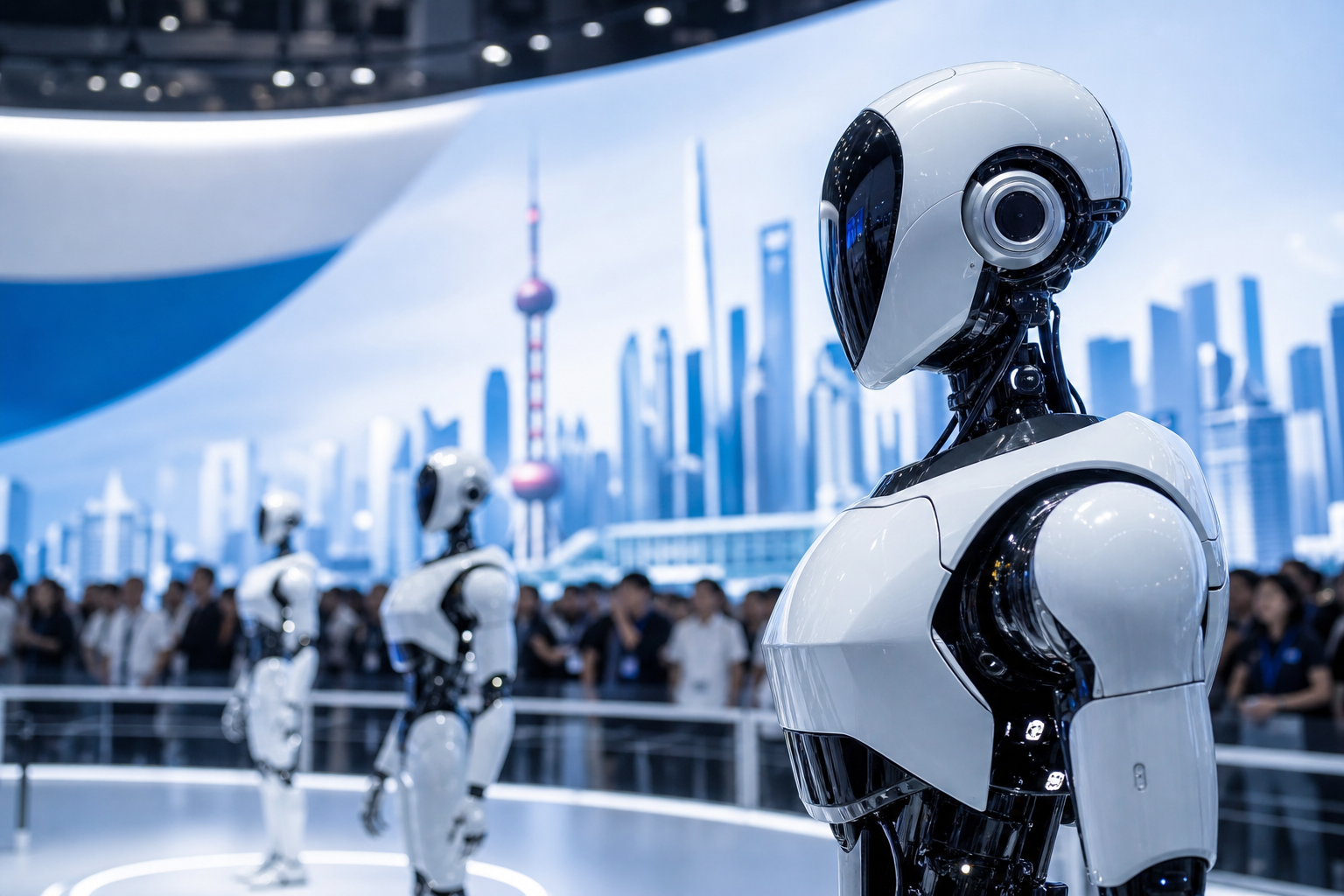
Humanoid robots drew attention because they make AI tangible and testable in physical settings: movement, dexterity, safety, and autonomy are now as important as model performance. The Shanghai demos showed that hardware lets observers judge real-world behavior in ways slide decks and benchmarks cannot.
Key takeaways
- A live humanoid demo compresses perception, planning, motor control, language interaction, and safety behavior into one observable experience, revealing system integration.
- Humanlike form factors give observers an intuitive benchmark: standing, walking, carrying, and using tools are easier to judge than abstract model claims.
- Early commercial opportunities are likely industrial: warehouses, factories, logistics sites, and repetitive service environments are more realistic targets than general home assistants.
- Deployment success will depend on safety, control systems, risk management, uptime, and human-robot interaction standards, not AI capability alone.
If you are trying to understand why the conference spotlight shifted toward machines with arms, legs, sensors, and humanlike interaction, the short answer is that hardware finally gave AI a stage that software alone cannot. A robot folding clothes, carrying parts, greeting visitors, or navigating a crowded booth creates a more immediate impression than another slide deck about model benchmarks. That is why humanoid robots steal show is more than a catchy headline; it is a useful lens for reading where AI investment, regulation, and product strategy are heading next. The original news report matters, but the bigger value for you is the analysis: what these demos mean, where the hype is justified, and what takeaways actually matter for the future of artificial intelligence.
Why humanoid robots steal show in live conference demos
Humanoid robots steal show in live demos because they compress several AI breakthroughs into one observable experience: perception, planning, motor control, language interaction, and safety behavior. When you watch a humanoid pick up an object, avoid a person, adjust its grip, and continue a task, you are seeing multiple layers of AI working together. That integration is what makes these machines conference magnets.
The appeal is not only visual. A humanoid form gives observers an intuitive benchmark. You already understand what it means for a machine to stand steadily, move through a doorway, carry a box, or use tools designed for humans. A wheeled warehouse robot may be commercially useful, but a humanoid instantly raises a broader strategic question: can AI operate in environments already built for people without redesigning the entire workplace?
This is also why the Shanghai conference mattered. The event did not simply present AI as text generation or analytics. It framed AI as a system that can act. For executives, investors, and operators, that shift is crucial. A model that writes code changes digital workflows. A humanoid that can inspect shelves, sort parts, or assist on a production line changes labor design, safety planning, and capital allocation.
If you create AI-facing content or track technology markets, ContentPod is useful for organizing how these product shifts should be explained to business audiences. The conference story is not just that robots looked impressive. The deeper point is that humanoid robots steal show when the industry wants proof that AI can leave the screen and function in physical settings.
- Practical point 1: A live robot demo reveals latency, balance, coordination, and failure recovery in a way prerecorded software clips cannot.
- Practical point 2: Humanlike form factors matter because most workplaces already use tools, layouts, and safety assumptions designed around people.
- Practical point 3: The phrase humanoid robots steal show signals investor interest in embodied AI, not just public fascination with futuristic hardware.
What the Shanghai spotlight says about the future of AI
The Shanghai spotlight says the future of AI is shifting from model intelligence alone to embodied intelligence, where reasoning must connect to movement, manipulation, and real-world uncertainty. That is the most useful reading of why humanoid robots steal show at this conference: the market is starting to ask whether AI can do work, not just generate outputs.
This matters because software AI and robotic AI face different constraints. A language model can be updated overnight and scaled through cloud access. A humanoid requires sensors, actuators, batteries, materials, onboard compute, and carefully tuned control loops. The result is a slower path to deployment, but potentially a much larger impact in sectors where labor is physical, repetitive, risky, or hard to staff consistently.
If you want a geopolitical lens on the same theme, the related analysis in Explained: china world artificial intelligence order is helpful because it shows how AI leadership is increasingly discussed as infrastructure, manufacturing capacity, and platform control. If you want a policy angle, Explained: utah becomes first state on AI prescriptions shows the opposite side of the same equation: as AI enters higher-stakes domains, governance becomes part of the product story.
The conference takeaway is not that general-purpose humanoids are ready for every household. The takeaway is that the AI stack is maturing enough for companies to demo end-to-end systems in public. When humanoid robots steal show, the audience is responding to integration: language, vision, control, and task execution working together under real constraints.
That is why the next phase of AI competition will not be won by the best demo alone. It will be won by the teams that can combine intelligence with repeatability, maintainability, and safe deployment at scale.
Why humanoid robots steal show even when software AI dominates headlines
Humanoid robots steal show even when software AI dominates headlines because physical systems answer a harder question: can intelligence survive contact with the real world? Text models can appear superhuman in narrow tasks, but embodied systems have to deal with friction, clutter, interruptions, edge cases, and human unpredictability.
That difference explains why robot demonstrations tend to generate stronger reactions than another chatbot update. People instinctively understand how difficult it is for a machine to grasp an irregular object, maintain balance after a bump, or perform a sequence of actions without constant correction. A humanoid demo therefore serves as a stress test for AI credibility. It can impress you quickly, but it can also expose limitations immediately.
For business readers, this is the right way to interpret the event. Do not ask whether a robot looked human. Ask whether the system handled task variation, environmental noise, and recovery behavior. A robot that performs one rehearsed motion is interesting. A robot that can continue after a slight disturbance is much more important.
This is also where strategy conversations become more grounded. The interview The Future of AI in Business: From Hype to Reality is a useful companion read because it frames the same commercial challenge: impressive AI gets attention, but operating value comes from workflows, economics, and adoption barriers. In that sense, humanoid robots steal show at a conference, but they only create durable advantage if they solve a job more reliably or more safely than the alternatives.
So the better analysis is not software versus robots. The stronger conclusion is that robotics is becoming the most demanding test bed for modern AI systems, and that makes every successful public demo strategically significant.
Where humanoid robots steal show first: factories, logistics, and service work
Humanoid robots steal show first in industrial and semi-structured settings because those environments offer the clearest balance between economic value and technical feasibility. A home is chaotic, emotionally sensitive, and full of edge cases. A warehouse aisle, assembly cell, or controlled service environment is still difficult, but it is easier to map, supervise, and optimize.
The most practical near-term uses are not science-fiction roles. They are support tasks that fit existing human workflows. Think material handling, visual inspection, replenishment, repetitive transport, basic sorting, or night-shift assistance in locations where staffing is expensive or inconsistent. The humanoid design helps when spaces are already built for human reach, stairs, workstations, and handheld tools.
| Environment | Why it fits humanoids | Main constraint |
|---|---|---|
| Factories | Human-sized work cells and repeatable tasks | Safety certification and uptime requirements |
| Logistics | Frequent lifting, carrying, and transfer tasks | Battery life and throughput economics |
| Retail and service | Customer-facing assistance and back-room support | Social acceptance and unpredictable interaction |
If you cover AI applications sector by sector, Artificial Intelligence Cardiology Applications Explained offers a useful contrast. In healthcare, trust and regulation dominate. In robotics, the equivalent questions are physical safety, consistency, and accountability. Different sectors, same lesson: adoption depends on fit, not novelty.
- Example 1: A humanoid on a factory floor can be valuable when it uses existing tools and workstations instead of forcing a complete layout redesign.
- Example 2: A service humanoid can create value in off-hours stocking or inventory checks even if it is not yet ready for fully autonomous customer interaction.
The reason humanoid robots steal show in these settings is simple: they promise compatibility with the built world. Whether that promise becomes a business case depends on cost, safety, and repeatable task performance.
How to analyze humanoid robots steal show without falling for hype
You should analyze conference robots through an operations lens, not a spectacle lens, because the real question is whether the system can perform useful work under realistic constraints. When commentators say humanoid robots steal show, the statement is true visually, but your analysis should focus on evidence.
A strong evaluation framework looks at five things: task scope, reliability, human supervision needs, economics, and safety. A robot that can complete one task under supervision may still be commercially promising. A robot that needs constant resets, ideal lighting, or carefully staged environments is much further from deployment than the demo suggests.
According to NIST’s AI Risk Management Framework resources, trustworthy AI requires governance, measurement, and risk-aware deployment. That principle applies directly to embodied AI. A robot is not only an AI model; it is a physical system capable of causing delays, damage, or injury if poorly designed or poorly supervised.
If you publish analysis or explain these shifts to clients, ContentPod can help you turn crowded conference coverage into clearer decision-oriented content. Instead of writing “robots are the future,” you can explain what decision-makers actually need to know: where the hardware fits, what metrics matter, and what milestones signal real progress.
- Best Practice 1: Evaluate the task, not the theatrics. Ask what the robot actually completed, how long it took, and whether the environment was controlled.
- Best Practice 2: Look for recovery behavior. Robust systems can handle interruptions, repositioning, or small errors without total failure.
- Best Practice 3: Check deployment assumptions. The fastest way to misread a demo is to ignore staffing needs, charging constraints, and maintenance overhead.
The phrase humanoid robots steal show is useful only if you pair it with disciplined analysis. Otherwise, you are describing attention, not progress.
The biggest risks behind the hype and the most realistic takeaways
The biggest risk is confusing a compelling demo with a scalable product, because conference performance and operational performance are not the same thing. That is the final and most important lesson behind why humanoid robots steal show in public settings.
Several challenges still stand between attention and broad adoption. Battery limits reduce useful operating windows. Mechanical wear creates maintenance complexity. Safety expectations are far stricter when robots work near people. And general-purpose autonomy remains difficult because real environments contain exceptions that are expensive to model and test.
You should also pay attention to economics. In many workflows, a specialized robot or a simpler automation system may still beat a humanoid on cost and reliability. Humanoids become more compelling when flexibility matters more than maximum speed, or when redesigning a workspace is more expensive than deploying a human-shaped machine.
Another challenge is public expectation. Because humanoids look familiar, people overestimate what they can do. A robot with a humanlike body does not automatically have humanlike common sense, judgment, or dexterity. That gap can create disappointment if marketing runs ahead of engineering reality.
Still, the most realistic takeaways are strong. First, embodied AI is no longer peripheral. Second, industrial adoption is the clearer path than broad household use. Third, safety and trust frameworks will shape commercialization as much as model capability. Those are the insights you should keep when you hear that humanoid robots steal show. The headline is exciting, but the enduring value lies in understanding where the technology is actually becoming useful.
Conclusion: Making the Most of humanoid robots steal show
The right way to read the Shanghai conference is not that humanoids suddenly solved general intelligence. The right way to read it is that embodied AI has moved into the center of the conversation. When humanoid robots steal show, the audience is reacting to a visible convergence of language models, computer vision, motion planning, and robotics engineering. For investors, operators, marketers, and policy watchers, that convergence matters because it turns AI from a software layer into a labor, safety, and infrastructure question.
Your next step is to evaluate every new robot announcement with a practical checklist: what task is being solved, in what environment, under what supervision, with what safety assumptions, and at what likely cost. If you need help turning complex AI developments into clear, search-ready analysis for your audience, ContentPod is a useful place to structure editorial workflows and publish higher-signal content.
Bottom line: Humanoid robots steal show because they make AI tangible, but the future of artificial intelligence will be decided by reliability, safety, and real economic usefulness rather than spectacle alone.
Frequently Asked Questions
What is humanoid robots steal show?
Humanoid robots steal show is a headline-style phrase that means humanoid machines became the main attraction at a major AI event because they displayed visible, physical intelligence. The phrase usually signals that embodied AI, including movement, manipulation, and human interaction, drew more attention than software-only announcements.
Why are humanoid robots important for the future of artificial intelligence?
Humanoid robots are important for the future of artificial intelligence because they test whether AI can operate in real physical environments instead of only producing digital outputs. A successful humanoid combines perception, reasoning, planning, balance, dexterity, and safety, which makes it one of the most demanding forms of applied AI.
Are humanoid robots ready for everyday business use in 2026?
Humanoid robots are ready for limited business use in carefully chosen environments, but humanoid robots are not a universal plug-and-play solution in 2026. The best near-term fits are repetitive, supervised tasks in factories, logistics sites, and structured service settings where flexibility matters and safety can be managed clearly.
References & Further Reading
Put this into practice
Share this post
You Might Also Like
Discover more content tailored to your interests
 Highly Relevant
How AI Technical Debt Problems Spread Through Codebases
AI technical debt problems are the maintenance, reliability, security, and architecture costs that build up when AI systems generate code faster than teams can review, test, document, and own it.
Read More Highly Relevant
Why Anthropic Model Rivals Fable on Enterprise Cost
Anthropic's model is being pitched as close enough in quality to a premium frontier model that cost-conscious enterprises may switch or diversify. The real test for buyers is whether the model delivers acceptable output on their highest-volume tasks while lowering total operating cost and governance overhead.
Read More Highly Relevant
AI Risks to Global Security at the U.N. Briefing 2026
AI risks to global security are the ways advanced AI systems can increase cyberattacks, accelerate disinformation, lower barriers to biological or weapons misuse, and outpace the laws meant to control them. In the AI briefing to the U.N.
Read MoreReady to create amazing podcast content?
Choose a plan and start generating professional podcast content with AI
View Pricing Plans