Explained: Asia-Pacific Artificial Intelligence Optimised
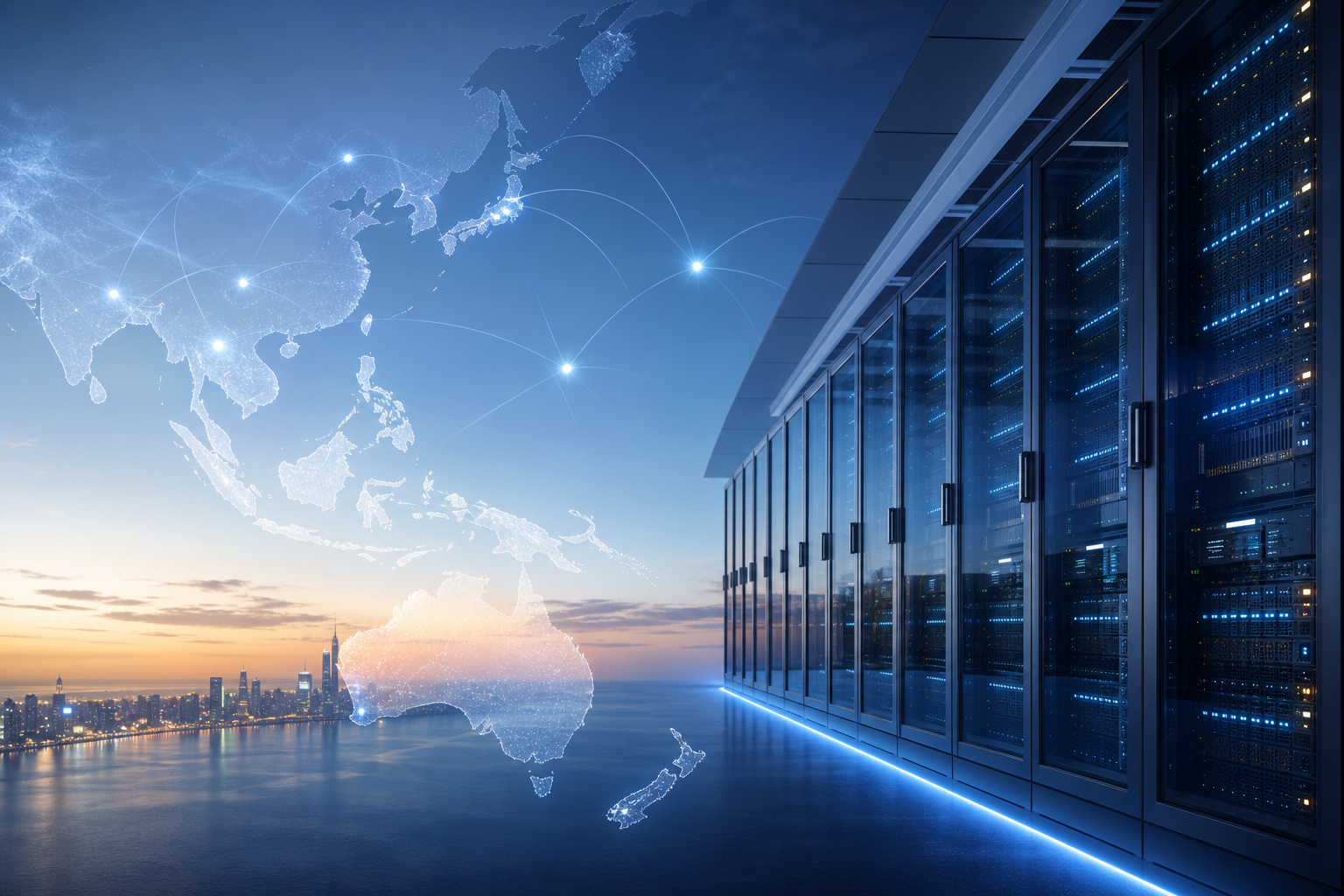
Asia-pacific artificial intelligence optimised means data centers and operating models built for GPU-heavy AI training, inference, and high-density compute across Asia-Pacific markets. These facilities combine higher rack density, specialized cooling and power, fast east-west networking, and governance controls to meet regional latency, energy, and compliance constraints.
Key takeaways
- AI facilities are designed around high-density accelerators, advanced cooling, resilient power delivery, and fast east-west networking rather than traditional enterprise rack assumptions.
- Location decisions in Asia-Pacific depend on grid access, water and cooling options, subsea cable proximity, latency targets, and local regulatory treatment of data and AI workloads.
- A large GPU cluster under weak orchestration, poor storage design, or inadequate networking will underperform a smaller but properly optimised AI environment.
- Governance should be built into infrastructure from the start, including security controls, model access policies, observability, and AI risk management.
- Buyers can test "AI-ready" claims by asking which specific bottleneck the facility was built to remove; vague answers usually indicate marketing language rather than meaningful design.
If you are trying to understand why operators, cloud buyers, investors, and enterprise technology teams keep focusing on asia-pacific artificial intelligence optimised infrastructure, the short answer is simple: ordinary enterprise data centers were not built for sustained AI power density, model-serving traffic, or the operational complexity of modern accelerators. The practical question is not whether demand exists. The practical question is where to build, how to cool, how to connect, how to govern, and how to avoid expensive mistakes when AI demand spikes faster than utility approvals or fiber capacity. This analysis breaks down what makes these facilities different, what signals matter in 2026, and what takeaways you can use if you are evaluating vendors, planning capacity, or tracking the region’s buildout.
1. What an asia-pacific artificial intelligence optimised data center actually means
An asia-pacific artificial intelligence optimised data center means a facility and operating model built specifically for AI workloads that need dense compute, fast interconnects, specialized storage, and reliable energy delivery across Asia-Pacific conditions. That definition matters because many facilities are marketed as “AI-ready” when they are only partially prepared for the realities of high-performance training clusters or latency-sensitive inference serving.
In practice, the phrase covers both physical infrastructure and operational design. On the physical side, you are looking at rack density, liquid or hybrid cooling, high-capacity power distribution, redundant networking, and storage layouts that can keep accelerators fed with data. On the operational side, you are looking at scheduling, tenancy isolation, observability, security, cost control, and the ability to scale across multiple markets without breaking compliance or performance targets. That is why the asia-pacific artificial intelligence optimised discussion is not only about construction. It is also about how compute is allocated and governed over time.
For a buyer, the easiest way to test the claim is to ask what bottleneck the facility was built to remove. If the answer is vague, you are probably looking at marketing language rather than meaningful design. If the answer includes concrete choices around cooling loops, interconnect topology, training versus inference separation, and energy redundancy, the operator is much more likely to understand AI infrastructure reality. Teams that publish thought leadership through ContentPod often benefit from translating those infrastructure choices into clear buyer language, because the market increasingly wants specifics, not slogans.
- Compute density: AI racks can require far more power and cooling than conventional application racks, so density planning is a first-order design issue.
- Data movement: AI workloads depend on rapid movement between storage, memory, and accelerators, which makes network architecture central rather than secondary.
- Workload fit: A facility tuned for model training may not be ideal for distributed inference, edge delivery, or sovereign deployment requirements.
2. Why asia-pacific artificial intelligence optimised capacity is expanding
Asia-pacific artificial intelligence optimised capacity is expanding because enterprises, model providers, and public-sector buyers need regional AI infrastructure that can deliver both performance and compliance. The demand signal is broad: model training needs dense centralized capacity, while inference increasingly needs geographically distributed capacity closer to end users and enterprise systems.
The regional story is also more complex than a single “APAC boom” narrative. Different markets offer different advantages. Some locations have stronger grid reliability. Others offer better connectivity to regional internet exchanges or subsea cable systems. Others make more sense for sovereign or industry-specific workloads because of data governance rules. If you are assessing the buildout, a useful frame is to separate training hubs from inference hubs. Training hubs need scale, power, and backbone networking. Inference hubs need proximity, resilience, and predictable latency.
The growth in asia-pacific artificial intelligence optimised infrastructure also reflects a wider enterprise shift from AI experimentation to AI operations. Companies are moving beyond single-team pilots and into organization-wide use cases such as internal copilots, search, classification, customer support automation, and developer tooling. If you work in content or digital strategy, the same shift appears in adjacent workflows, including repeatable search programs such as SEO Workflows Content Consultants 30-Day Action Plan and more practical discussions of market-facing AI adoption like Why fair foundations responsible access matters now.
According to NIST’s AI Risk Management Framework, organizations should treat AI risk as a lifecycle issue rather than a one-time procurement event. That principle applies directly to infrastructure. Capacity planning, access control, logging, data handling, and resiliency are not back-office details. They shape whether your AI deployment is governable at all.
3. The design choices that separate useful infrastructure from expensive hype
The most important design choices in an asia-pacific artificial intelligence optimised data center are power, cooling, networking, storage, and orchestration, because one weak layer can waste the value of every other layer. Buyers often focus on accelerator counts first, but the facility-level constraints usually determine actual output.
Start with power. High-density AI clusters can be limited by available utility capacity, substation timelines, and redundancy design long before they are limited by equipment procurement. Then move to cooling. Traditional air cooling may still work for some lower-density deployments, but many AI environments now evaluate direct-to-chip liquid cooling or hybrid approaches because thermal loads rise quickly. Networking is the next make-or-break layer. AI training jobs rely on fast communication between nodes, and inference platforms need predictable performance under bursty traffic. Storage is equally important. If data pipelines cannot keep accelerators supplied, compute sits idle.
The operational layer matters just as much. Good orchestration improves utilization, queue fairness, fault tolerance, and multi-tenant isolation. That is where strategy leaders often benefit from broader business conversations, such as The Future of AI in Business: From Hype to Reality, because infrastructure decisions become more sensible when tied to actual business workloads rather than abstract AI ambition.
A practical evaluation framework for asia-pacific artificial intelligence optimised facilities looks like this:
- Match the workload: Separate training, fine-tuning, batch inference, real-time inference, and data processing requirements before comparing sites.
- Inspect the bottleneck: Ask whether the likely limit is power, thermals, network throughput, storage IO, or software scheduling.
- Test fault handling: Confirm how the environment behaves during node failure, cooling incidents, or network degradation.
- Verify observability: Require metrics for utilization, queue times, energy, latency, and job success rates.
If an operator cannot discuss those points clearly, the asia-pacific artificial intelligence optimised label may be more aspirational than real.
4. Where the asia-pacific artificial intelligence optimised model changes by market
The asia-pacific artificial intelligence optimised model changes by market because Asia-Pacific is not a single operating environment; infrastructure strategy must adapt to local energy, land, regulation, connectivity, and customer demand. The most useful analysis compares markets by constraint rather than by hype.
For example, one market may be excellent for regional inference because it offers dense enterprise demand and strong network connectivity, but it may be less suitable for giant training clusters if power expansion is slow. Another market may support larger-scale builds because land and utility access are better, even if end-user latency to major business hubs is slightly worse. A third market may be ideal for sovereign workloads because customers require local hosting and tighter legal control.
| Decision Factor | Why It Matters | What You Should Ask |
|---|---|---|
| Power availability | AI deployments fail without dependable energy growth | What is the committed capacity and expansion timeline? |
| Cooling feasibility | Climate and water conditions shape rack density choices | Is liquid cooling supported and at what scale? |
| Connectivity | Backbone and metro links affect training sync and inference latency | How many carriers and cable routes are available? |
| Compliance | Cross-border data rules can limit architecture options | Which workloads must remain local? |
This is where concrete examples help. A team doing multilingual support inference for customers across Southeast Asia might prioritize distributed facilities closer to large user populations. A research organization running foundation-model training might prioritize utility scale and inter-data-center networking over metro proximity. If you track adjacent AI market signals, posts like Explained: which stocks win google in Walmart AI can be useful because they reveal how infrastructure economics increasingly shape broader business narratives.
- Example 1: A finance company may choose local inference nodes for compliance and customer latency, while keeping non-sensitive model experimentation in a larger regional hub.
- Example 2: A software platform may split AI training, vector search, and real-time inference across separate facilities because the ideal performance profile is different for each layer.
5. How to buy or build asia-pacific artificial intelligence optimised capacity without overspending
You can buy or build asia-pacific artificial intelligence optimised capacity without overspending if you size infrastructure to actual workloads, model your constraints early, and avoid confusing peak theoretical demand with sustainable business demand. Many teams overspend because they procure for the biggest imaginable training scenario rather than the mix of jobs they will really run.
The first decision is whether you need colocation, managed infrastructure, cloud capacity, or a hybrid path. The answer depends on capital structure, utilization consistency, compliance requirements, and team maturity. If your workload profile changes weekly, flexibility may be more valuable than maximum theoretical efficiency. If your demand is steady and large, more dedicated infrastructure may make sense. The right choice is not ideological. It is operational.
Clear communication also reduces waste. When executives, infrastructure teams, and application owners use different definitions of “AI-ready,” projects drift. Publishing a shared decision memo or buyer guide through ContentPod can help internal alignment as much as external marketing, because the language around asia-pacific artificial intelligence optimised infrastructure is often overloaded and vague.
- Map workloads before procurement: Estimate the share of training, tuning, inference, analytics, and idle reserve you expect over the next planning cycle.
- Price the full stack: Include power, cooling, network, storage, software, staffing, compliance, and migration costs rather than only GPU line items.
- Design for incremental scale: Build phases that can expand cleanly when utilization and revenue justify it.
- Avoid stranded specialization: Do not lock yourself into a facility design that only serves one narrow AI use case unless that use case is strategic and durable.
- Measure outcomes monthly: Track queue times, utilization, latency, error rates, energy intensity, and business impact together.
A good asia-pacific artificial intelligence optimised plan is less about winning a race to maximum capacity and more about building a system you can actually run, govern, and expand with confidence.
6. The biggest risks in asia-pacific artificial intelligence optimised deployments
The biggest risks in asia-pacific artificial intelligence optimised deployments are underestimating power and cooling constraints, overestimating workload stability, and treating governance as a later-stage add-on. Those risks are operational, financial, and reputational at the same time.
One common mistake is assuming that if accelerator hardware is available, deployment is straightforward. It is not. Utility approvals, transformer lead times, cooling retrofits, and network architecture can delay projects far more than the server order itself. Another mistake is combining every AI workload into one cluster. Training, batch jobs, experimentation, and low-latency inference often interfere with one another unless you plan isolation and scheduling carefully. The third major mistake is weak governance. If you do not know who can access models, data, logs, or fine-tuning pipelines, you do not have a mature AI environment.
Security and model safety expectations are rising, which is why infrastructure planning should align with broader governance guidance from organizations such as OpenAI Safety. For organizations that need a sharper public narrative around responsible deployment, ContentPod can also help turn technical controls into readable, trust-building content for customers and stakeholders.
To reduce risk, build your review process around specific questions:
- Can the site scale power realistically? Confirm contractual and engineering pathways, not just ambition.
- Can the network handle AI traffic patterns? Test east-west communication, storage paths, and failover behavior.
- Can teams govern access? Require role-based controls, logging, and model lifecycle accountability.
- Can the economics survive lower utilization? Stress-test the business case if projected demand arrives slower than expected.
Conclusion: Making the Most of asia-pacific artificial intelligence optimised
The smartest way to approach asia-pacific artificial intelligence optimised infrastructure is to treat it as a decision framework, not a buzzword. You need to match the facility to the workload, the workload to the market, and the market to the realities of power, cooling, connectivity, and governance. If you are evaluating a provider, ask what bottleneck the design removes. If you are planning your own rollout, separate training from inference, demand from aspiration, and marketing claims from operating facts.
The most useful takeaways are straightforward. An asia-pacific artificial intelligence optimised data center is fundamentally about fit: fit between compute density and thermals, fit between network design and model traffic, fit between geography and latency, and fit between AI ambition and business discipline. If your team needs help translating technical infrastructure shifts into decision-useful content, market analysis, or stakeholder communication, ContentPod is a practical place to start.
Bottom line: asia-pacific artificial intelligence optimised infrastructure only creates value when regional design, workload fit, and governance are aligned from the start.
Frequently Asked Questions
What is asia-pacific artificial intelligence optimised?
Asia-pacific artificial intelligence optimised is a term for AI-focused data center infrastructure and operations built for Asia-Pacific requirements such as high-density compute, low-latency delivery, regional compliance, and scalable power and cooling. An asia-pacific artificial intelligence optimised environment is designed for AI training and inference rather than general-purpose enterprise hosting.
How is an AI-optimised data center different from a normal data center?
An AI-optimised data center differs from a normal data center because AI workloads demand more power per rack, faster interconnects, more specialized storage behavior, and stronger thermal management. A conventional facility can host AI systems, but a purpose-built AI environment is more likely to support sustained accelerator utilization, predictable inference performance, and efficient scale-out.
What should buyers compare first when evaluating Asia-Pacific AI data center options?
Buyers should compare workload fit first, because training, inference, sovereign hosting, and edge-serving each require different tradeoffs. After workload fit, buyers should compare power availability, cooling strategy, network design, compliance constraints, and observability, because those five factors usually determine whether a deployment performs reliably and scales economically.
References & Further Reading
- Google News source article
- NIST AI Risk Management Framework
- OpenAI Safety
- Anthropic News
Put this into practice
Share this post
You Might Also Like
Discover more content tailored to your interests
 Highly Relevant
How AI Technical Debt Problems Spread Through Codebases
AI technical debt problems are the maintenance, reliability, security, and architecture costs that build up when AI systems generate code faster than teams can review, test, document, and own it.
Read More Highly Relevant
Why Anthropic Model Rivals Fable on Enterprise Cost
Anthropic's model is being pitched as close enough in quality to a premium frontier model that cost-conscious enterprises may switch or diversify. The real test for buyers is whether the model delivers acceptable output on their highest-volume tasks while lowering total operating cost and governance overhead.
Read More Highly Relevant
AI Risks to Global Security at the U.N. Briefing 2026
AI risks to global security are the ways advanced AI systems can increase cyberattacks, accelerate disinformation, lower barriers to biological or weapons misuse, and outpace the laws meant to control them. In the AI briefing to the U.N.
Read MoreReady to create amazing podcast content?
Choose a plan and start generating professional podcast content with AI
View Pricing Plans