AI Interview vs Human Interview: Pros, Cons, Use Cases
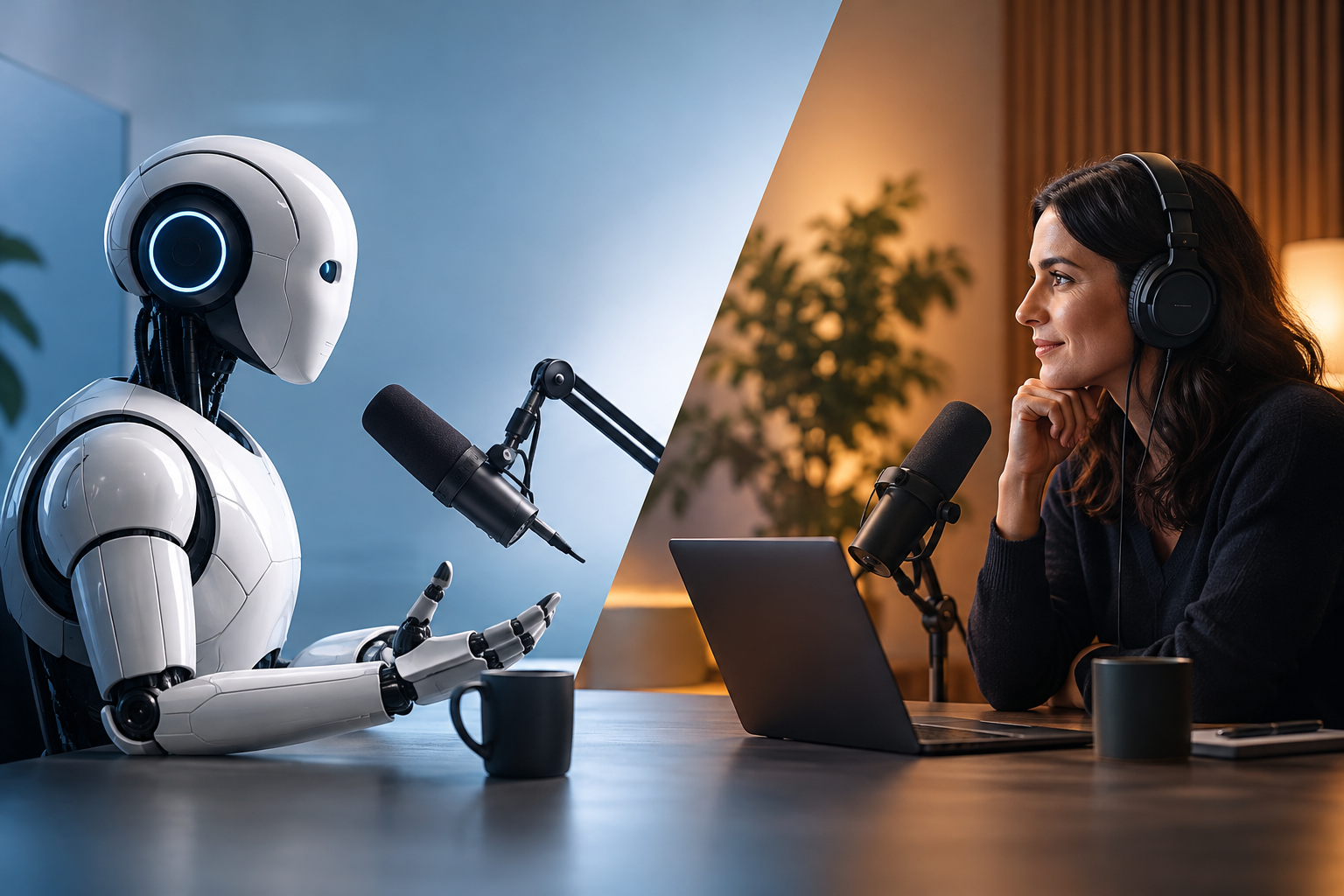
Ai interview vs human interview is a decision between speed, consistency, and scale on one side, and rapport, judgment, and nuance on the other. You should use an AI interview when you need repeatable voice-based conversations and structured output at volume, and use a human interview when trust, sensitivity, improvisation, or editorial depth matters more than efficiency.
Key takeaways
- AI interviews are best for repeatable capture: An AI interviewer is strongest when you need consistent prompts, quick scheduling, and voice-based interviews that can be run often.
- Human interviews are best for nuance: A human interviewer is stronger when the conversation depends on trust, emotional context, editorial judgment, or real-time reframing.
- The best choice depends on the content goal: Draft-generation, internal knowledge capture, and first-pass research usually fit AI, while flagship podcast episodes and sensitive subject matter usually fit humans.
- A hybrid workflow often saves the most time: Many teams get better results by using AI for intake and structure, then using a human to refine the angle, challenge assumptions, and shape the final story.
The hard part is not choosing a side. The hard part is matching the interview format to the job you need done. A founder collecting ideas for a content pipeline has different needs from a podcast producer booking a high-profile guest, a marketer gathering customer stories, or a researcher handling sensitive topics. That is where ai interview vs human interview becomes a practical workflow question, not a philosophical one. This guide compares both options in plain terms, shows where each one breaks down, and explains how to combine them without making your process messy. If you work in AI podcast and interview content, the goal is simple: get usable material faster without losing the parts that only a person can hear, question, or interpret. For governance and risk context, the NIST AI Risk Management Framework is a useful reference point.
The short verdict on ai interview vs human interview
Ai interview vs human interview is not a winner-take-all choice because each format solves a different production problem. If your main constraint is time, scheduling, or the need to run many interviews with a similar structure, AI is often the better fit. If your main constraint is quality of judgment, emotional intelligence, or the ability to notice what matters beneath the obvious answer, a human interviewer is still stronger.
A simple way to decide is to ask what failure would hurt more. If the bigger risk is inconsistency, missed documentation, or interviews that never happen because calendars never line up, choose AI. If the bigger risk is a flat conversation, a weak quote, or a guest who never opens up, choose a human. That framing works for marketing teams, consultants, subject matter experts, and podcast producers.
If your end goal is reusable podcast content, the format also matters after the interview ends. The better your source material, the easier it is to turn one conversation into articles, newsletters, posts, and summaries. That is why teams building repeatable workflows often pair interview capture with structured transformation, similar to the process described in this guide for podcast to blog post repurposing.
Ai interview vs human interview at a glance
Ai interview vs human interview becomes easier to judge when you compare the two across the same production criteria. The table below focuses on the tradeoffs most teams feel first: speed, consistency, cost of coordination, depth, and fit for different content types.
| Criteria | AI interview | Human interview |
|---|---|---|
| Speed to start | Fast once the prompt structure is ready | Slower because scheduling and prep depend on people |
| Consistency | High consistency across sessions and question order | Varies by interviewer skill, energy, and preparation |
| Follow-up quality | Good for pattern-based follow-ups and clarifying details | Stronger for subtle cues, contradiction, and emotional nuance |
| Guest comfort | Good for low-pressure intake and asynchronous capture | Better when guests want rapport, validation, or human chemistry |
| Scale | Strong for many interviews in a repeatable process | Harder to scale without more staff time |
| Sensitive topics | Riskier if empathy and judgment are central | Better for sensitive, personal, or high-stakes conversations |
| Best fit | Research intake, content capture, first-pass interviews | Flagship interviews, journalism, customer stories, live podcasts |
The table also helps with the related question of ai interviewer vs podcast host. An AI interviewer is mainly a capture tool. A podcast host is more than a question-asking system. A strong host controls pacing, creates atmosphere, reads a guest’s confidence level, and decides when to challenge, pause, or change the frame. Those are not identical jobs.
Where AI interviews work best, and where they fall short
AI interviews work best when your goal is structured voice capture at scale, and they fall short when the conversation depends on trust, social context, or hard editorial calls. That distinction matters because many teams expect AI to replace every interview, then feel disappointed when the output sounds organized but not alive.
The strongest use cases are operational. You may need to interview sales reps for recurring customer objections, collect founder insights every week, capture subject matter expert knowledge before a launch, or gather a first draft of material from clients who are hard to schedule live. In those cases, AI reduces friction. A voice-based AI interview can ask follow-up questions, keep the structure on track, and produce source material without waiting for a host, producer, or strategist to attend every call.
That is where ContentPod fits naturally for some teams. Its AI Interview is a voice-based interview with an AI host that asks adaptive follow-up questions, and voice recording is the only input. That matters because spoken answers are often richer than typed notes, but you are still keeping the process simple enough for busy contributors to complete. If you want a more conversational format, Two-Way Interview creates studio-quality dual-voice AI conversations, which can be useful when the output needs to sound more like a natural exchange than a prompted intake.
The weaknesses are just as important to state clearly. AI is weaker when a guest is hesitant, vague for political reasons, or unsure what they think until another person challenges them. AI may catch contradictions in a pattern-driven way, but it does not have lived social intuition. It may ask a follow-up because a topic was mentioned, not because the room changed. That difference shows up in founder interviews, grief and burnout stories, executive conflict, hiring controversies, and any conversation where subtext matters as much as the transcript.
You can see the difference by comparing routine insight capture with a human-centered conversation such as The Burnout Epidemic: Why High Achievers Struggle. Topics like burnout often need pacing, permission, and tact. The gap between a useful answer and a guarded answer is often the interviewer, not the question list.
Where human interviews still win, despite the extra work
Human interviews still win when the value of the interview is in the relationship, the framing, or the interviewer’s judgment more than the raw answers alone. That is why good hosts remain hard to replace even when AI tools get better at transcription, prompting, and summarization.
A human interviewer notices shifts that are easy to miss in a structured process. A guest hesitates before answering. A polished answer sounds rehearsed and invites a challenge. A casual aside points to the real story. A founder says “we” when the decision was clearly personal. A customer describes a workaround that is more interesting than the official use case. Those moments are not random. They often become the best clip, the headline quote, or the section that gives the final content authority.
Human interviews are also better when the interview itself is part of the experience. Podcast audiences do not only consume information. They respond to tension, rhythm, and chemistry. According to Edison Research’s The Infinite Dial 2024, podcast listening has become a normal media habit for a large share of the population in the United States. That makes hosting skill more valuable, not less, because listeners have many options and can tell when a conversation feels flat.
There is also a trust issue. A guest may share more with a person who can explain why a question matters, react with appropriate empathy, and make a real-time promise about how the material will be used. This is one reason interview-led editorial teams still rely on skilled humans, as discussed in this piece on interview-based content marketing teams. The interview is not just data collection. It is part reporting, part editing, part relationship management.
- Human advantage in flagship content: If the conversation will be published largely as recorded, hosting quality matters more than capture efficiency.
- Human advantage in sensitive topics: If the guest may feel exposed, judged, or uncertain, a person is usually the safer choice.
- Human advantage in ambiguity: If the point of the interview is to find the angle rather than fill an existing structure, a strong interviewer creates better raw material.
When to choose AI in the ai interview vs human interview decision
You should choose AI in the ai interview vs human interview decision when repeatability, speed, and throughput matter more than performance or rapport. That usually means the interview is an input to a later content process rather than the finished product itself.
Examples help. Choose AI when you are doing any of the following:
- Capturing internal expertise at volume. A B2B team may need ten product managers, sales reps, and founders to contribute insight over two weeks. AI can keep the structure consistent.
- Running pre-interviews before a recorded episode. You can use AI to gather background, timelines, and key claims before a human host steps in for the final conversation.
- Collecting source material for repurposing. Once the interview exists, structured outputs are easier to create. ContentPod’s Interview Transformer can turn one interview into a blog post, X or Twitter thread, email newsletter, LinkedIn post, and executive summary. The interview’s transform page also offers Instagram and Facebook posts, an FAQ, and a video script.
- Reducing dependence on one interviewer. If your entire content pipeline stops when one strategist gets busy, AI reduces that bottleneck.
- Helping reluctant writers speak instead of type. Many subject matter experts give better answers by voice than by draft document.
For consultants and SaaS marketers, AI can be especially useful in the early stages of content creation. If you are building repeatable expertise-based content, this guide on interview-based content marketing saas shows why interview workflows often outperform blank-page writing for teams that have ideas but limited drafting time.
There are still risks. AI can create a false sense of completeness. A clean transcript and neat summary may hide the fact that the most important question was never asked. That is why your prompt structure matters. You need clear objectives, not just a list of generic prompts. Ask for examples, tradeoffs, failed attempts, and opposing views. Those instructions do more to improve output than adding more questions.
When to choose a human in the ai interview vs human interview decision
You should choose a human in the ai interview vs human interview decision when the interview outcome depends on trust, interpretation, or strategic pressure-testing. In these cases, the interviewer is part of the value, not just the mechanism for collecting answers.
Use a human interviewer when:
- The guest is high-profile: Senior executives, public figures, and experienced creators often expect a host who can match their depth and adapt in real time.
- The subject is sensitive: Health, trauma, burnout, layoffs, conflict, and identity-based experiences require emotional judgment.
- You need challenge, not just extraction: Human interviewers can push a guest on vague answers, soft claims, and contradictions without sounding mechanical.
- The final product is the conversation itself: If you plan to publish the interview as audio or video, hosting skill shapes retention and audience trust.
- You are defining the angle live: Some interviews begin with only a broad thesis. A good human host can discover the real story during the conversation.
Human-led interviews also fit better when the brand voice matters in subtle ways. A podcast host is not merely asking questions. The host is setting standards for curiosity, skepticism, warmth, and pace. That distinction matters in the recurring debate around ai interviewer vs podcast host. AI can help with preparation and intake, but the host role often includes public-facing editorial responsibility.
If you are preparing people to speak more effectively, not just collecting raw material, human guidance is stronger. A human can tell a guest that an answer is too abstract, too safe, or too self-promotional, then help them reframe it on the spot. AI may ask for clarification, but it rarely carries the same persuasive weight as a skilled producer or editor.
A hybrid workflow usually beats treating ai interview vs human interview as either or
A hybrid workflow usually beats treating ai interview vs human interview as an either-or choice because AI and humans are strongest at different stages of the same content process. The best systems use AI to reduce admin and repetition, then use humans where taste and judgment matter.
A practical hybrid workflow looks like this:
- Use AI for intake. Ask the guest or internal expert to complete a voice-based AI interview that gathers baseline context, examples, and supporting detail.
- Review for gaps. A strategist or producer reads the output and marks weak claims, missing examples, and points that need challenge or verification.
- Run a shorter human interview. The human host uses the first interview to go deeper only where it matters.
- Transform the material. Turn the combined interview into publishable assets. This can include articles, FAQs, emails, and social posts.
- Refine for channel fit. A writer or editor adjusts tone, structure, and supporting evidence before publication.
This structure gives you many of the efficiency gains of AI without pretending that all interviews are the same. It also shortens human interviews, which reduces fatigue for guests and staff. If your team creates recurring educational or branded audio, pairing AI capture with editorial review often creates a better system than trying to solve everything inside one live call.
On the production side, a hybrid model also fits broader content repurposing. Teams that are already experimenting with tools like an ai podcast generator like notebooklm often find that source quality is the bottleneck. Better interviews create better downstream content. The raw conversation still matters, even when AI helps package it.
If you want to expand beyond text, ContentPod also includes writing tools such as Article Writer, FAQ Builder, and Email Composer, plus visual tools like AI Image Studio and Infographic Generator. Those tools are not a reason to skip editorial judgment. They are a reason to start with stronger source material so the later steps become easier and more accurate.
Conclusion: Making the Most of ai interview vs human interview
The best answer to ai interview vs human interview depends on what you need from the conversation. Choose AI when you need speed, repeatability, and a lower-friction way to capture spoken knowledge. Choose a human when the interview needs rapport, challenge, sensitivity, or a host whose judgment shapes the result. If you publish interviews or build content from them every week, the most efficient process is often hybrid: AI for intake, humans for depth, and structured repurposing after the call.
If you want to put that system in place, ContentPod is a practical option because it combines voice-based AI interviewing with content transformation tools that help you move from conversation to usable assets. Review your next five planned interviews, label each one by risk and depth, and decide which should be AI-led, human-led, or hybrid. That simple audit will make the ai interview vs human interview choice far clearer than debating the formats in the abstract.
Bottom line: Use AI interviews to capture repeatable spoken input efficiently, use human interviews when trust and judgment shape the value, and combine both when you want scale without flattening the conversation.
Frequently Asked Questions
What is ai interview vs human interview?
Ai interview vs human interview is a comparison between two ways of running interviews. An AI interview uses software to ask questions and gather spoken responses in a structured format, while a human interview uses a person to guide the conversation, interpret nuance, and adapt based on context, emotion, and strategy.
Are AI interviews good for podcast episodes?
AI interviews are good for podcast preparation, guest intake, and source capture, but AI interviews are not always the best format for the final published episode. A finished podcast episode often depends on timing, chemistry, and host judgment, so many creators use AI for pre-interviews and a human host for the recorded conversation that listeners hear.
How do I decide whether to use an AI interviewer or a human host?
You can decide by looking at the goal, the risk, and the audience for the interview. Use an AI interviewer when the goal is efficient voice capture or repeatable research, use a human host when the interview must build trust or uncover nuance, and use both when the first conversation can gather facts while the second conversation shapes the story.
References & Further Reading
- NIST AI Risk Management Framework
- EEOC AI and Algorithmic Fairness Initiative
- The Infinite Dial 2024
- OpenAI Usage Policies
Put this into practice
Share this post
You Might Also Like
Discover more content tailored to your interests
 Highly Relevant
How to Turn a Podcast to Blog Post Guide
A podcast to blog post process means turning a recorded episode into a structured article by transcribing the audio, choosing one clear angle, organizing the strongest points, and editing the draft for search intent and readability.
Read More
30 Solo Podcast Ideas with Setup and Script Example
Solo podcast ideas are repeatable episode formats you can record alone, such as quick lessons, stories from your work, FAQs, reviews, experiments, and breakdowns of news or trends.
Read More
Best AI Podcast Generator Like NotebookLM Picks
An ai podcast generator like notebooklm is a tool that turns source material or a script into spoken audio, often with AI voices, conversational structure, and editing support.
Read MoreReady to create amazing podcast content?
Choose a plan and start generating professional podcast content with AI
View Pricing Plans